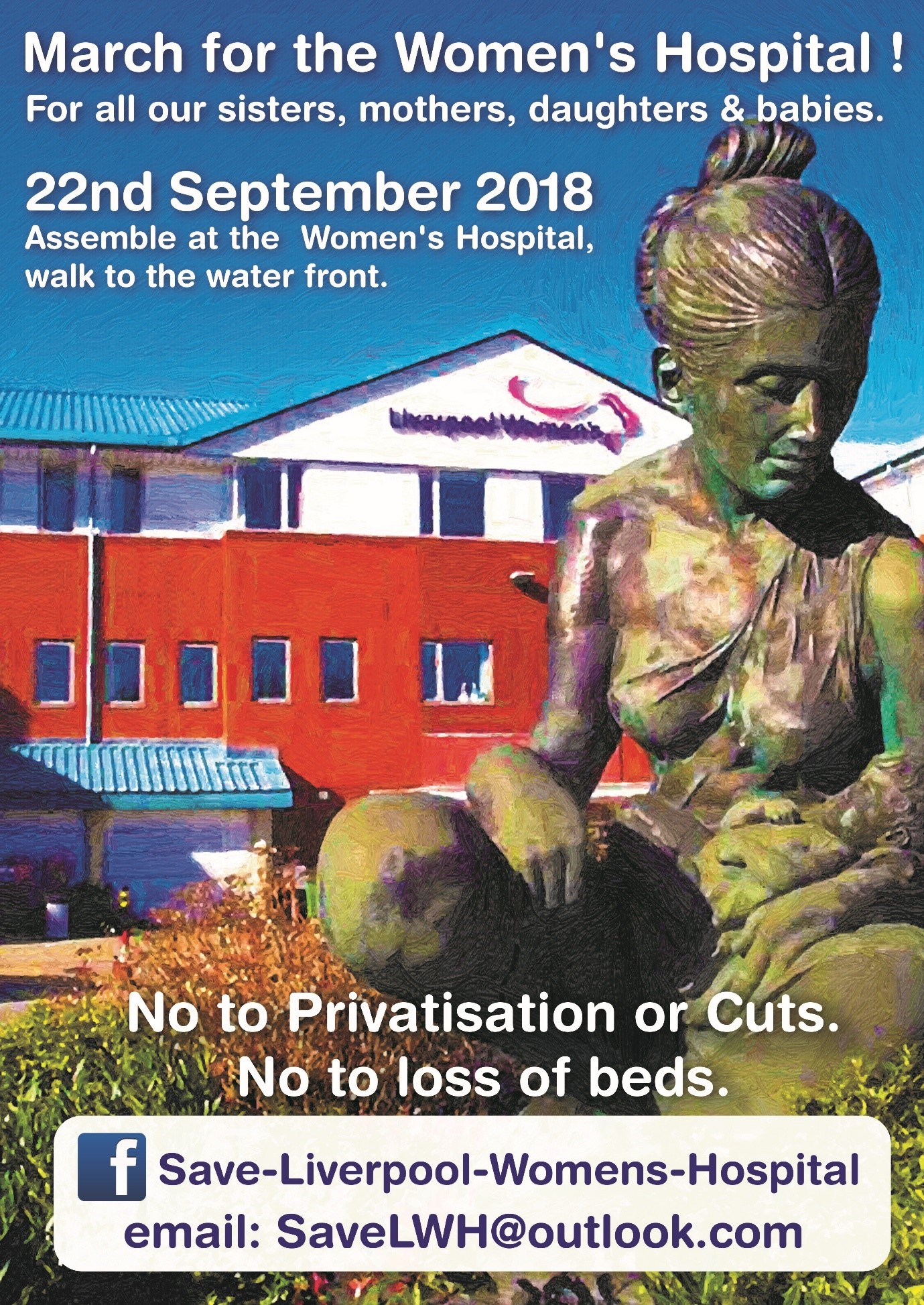
We are not stopping until we win back the full NHS, a health care system that properly values our babies and us as women. For all our mothers, daughters, friends and lovers and for every precious baby.
The latest blow to the future of Liverpool Women’s Hospital is the announcement of a joint chair with the Liverpool University Foundation Hospital trust (this is the merged Royal, Aintree and Broadgreen Hospitals). There was no mention of this at the last Liverpool Women’s Hospital Board meeting held in public, nor at the ICB meeting. Where are these decisions being made?
It is farcical that such an appointment is even considered. Women’s services must be prioritised and maternity must be led by people with deep experience in this matter. It cannot be an afterthought to a huge recently merged hospital system.
What has been and is still happening in maternity nationally can no longer be tolerated. A merger with Liverpool’s big merged hospital will not address these issues. The major reports on these issues are authoritative and powerful. The Government’s tactics are to publish and ignore the reports or issue a series of directives that are not backed by finance or staffing.
Maternity has not been given priority in the big merged hospitals, so favoured by this government. Women’s health has not been given its due importance in these merged hospitals either. We have previously quoted the mantra of the priorities for operating theatre as being Life, Limb, and Testicles.
Following Shrewsbury, the site of the first Ockendon report into unnecessary baby deaths, the NHS hospitals had to be told to have a maternity rep on each board. Maternity must not be a second-class, Cinderella service. Ockendon and other reports have shown how deeply damaged NHS maternity has become in this era of bureaucratic management. The reports describing the problems in these services are detailed, authoritative, and ignored. The Birmingham Hospital regularly hyped as the model by those who wish to merge Liverpool Women’s Hospital with the Royal/LUHFT was recently described as showing misogyny and medical patriarchy
We campaign for the restoration of the whole NHS, to get it back from the big corporations and their advocates who are damaging it. Maternity and women’s health issues need to be embedded into the whole health service, damaged as it is, and given greater, not less priority.
We campaign for Liverpool Women’s Hospital as
- a women’s hospital,
- a provider of services in the community,
- a maternity hospital, and
- a maternal medicine center,
- an NHS hospital, publicly provided for everyone free at the point of need, linked to the whole national health provision,
- and an excellent employer.
We have held three demonstrations, gathered more than 73,000 petition signatures, run stalls, attended meetings, gained the support of Kim Johnson the local MP, and others, had resolutions agreed upon at Liverpool City Council, gained support from local and national trade unions, met with the ICB, attended LWH board meetings for many years, run this blog and social media, attended academic and campaigning conferences, put up banners and posters and worked with many other campaign groups. All this, it seems is not enough to gain consultation.
The background to our struggle is both the damaging political reorganisations in the NHS and the consequential maternity scandals that have rocked this country. The dismantling of the NHS, transforming it into a for-profit system, and hence for the adoption of the American Accountable Care system, known here as the ICB (It is used in the US to administer second-class, state-funded healthcare). The private companies administering this get their huge profit by denying care). In the UK, it means fewer hospital beds, fewer staff, closed and merged hospitals, and money being the driving force in service provision. For more details see an earlier post here.
Despite promises both verbal and written of consultation, there was an announcement this week, without consultation with the public, that the chair of Liverpool Women’s Hospital is to be advertised as a joint position with the chair of Liverpool University Hospitals Trust. It was announced to the staff of LUHF T today and in a letter to some others.
Liverpool Women’s Hospital is the largest maternity Hospital in England. It is a maternal medicine centre and a referral hospital. It is a unique Women’s Hospital providing care for women at a time when women’s health is suffering. It provides care for some of the most vulnerable women and babies.
Like all maternity care, it has been underfunded and reorganized to fit the government’s ideology. Even when it meets the government’s staffing ratios we firmly believe that is insufficient for high-quality care.
Maternity nationally is a service struggling with cuts, poor reorganizations, staff shortages, poor working conditions, poor pay and staff attrition.
Two-thirds of England’s maternity units are dangerously substandard says the Care Quality Commission
CQC says too many mothers and babies receive care that is not good enough, with staff shortages among the reasons.
Almost two-thirds of maternity units provide dangerously substandard care that puts women and babies at risk, the NHS watchdog has said in a damning report.
The Care Quality Commission (CQC) has rated 65% of maternity services in England as either “inadequate” or “requires improvement” for the safety of care – up from 54% last year.
Services are beset by a host of problems, including serious staff shortages and internal tensions, which mean that too many mothers and their babies receive care that is not good enough.
Liverpool Women’s Hospital also had a highly critical CQC report, and this was despite the hard work of its staff. The UK does not match other developed countries in infant mortality or maternal mortality.
The board at Liverpool Women’s Hospital spoke about challenging the CQC report describing all their efforts to keep to regulations. We say in challenge to this that the regulations do not in themselves keep babies or women safe. That requires respect for women and babies, sufficient staff and good working conditions.
The CQC report on Liverpool Women’s said
“Liverpool Women’s NHS Foundation Trust is a specialist trust that specialises in the health of women, babies, and their families. It is one of only two specialist trusts in the UK and the largest women’s hospital in Europe. As a tertiary centre
the hospital provides care for a significant proportion of patients with high levels of complexity and clinical risk, as well as serving a local population with significant deprivation. The hospital teams deliver around 8,000 babies and perform
some 10,000 gynaecological procedures each year.
The trust is situated in an area where 44% of the population live in the lowest quintile for deprivation in England. 26% of children (0-15 years) live in poverty. The region performs significantly worse for premature cancer, cardiovascular disease (CVD) and respiratory deaths. 46% of women booking with Liverpool Women’s Hospital are from the 1st decile on the deprivation index, compared to a national average of 13%
The CQC report said
Following our inspection, we issued a warning notice requiring the trust to make significant improvements.
- The trust must assess and do all that is reasonably practicable to mitigate risks to the health and safety of women, birthing people, and babies. Regulation 12 (1)(2)(a)(b)
This includes but is not limited to:- Timely and effective triage of women and birthing people
- The trust must ensure they deploy sufficient, suitably qualified midwifery staff across all areas of the service.
Regulation 18 (1)- Assessing, documenting, and responding to ongoing risks to the safety of women, birthing people, and babies at all stages of pregnancy in line with national guidance
Our findings
5 Liverpool Women’s NHS Foundation Trust Inspection report- The trust must ensure staff are up to date with mandatory training. Regulation 12 (1)(2)(c)
- The trust must ensure there are sufficient numbers of suitably qualified, competent medical staff to deliver the service and reduce delays in medical review in maternity triage.. Regulation 18 (1)
- The trust must ensure it operates effective systems and processes to assess, monitor and improve the quality of services and mitigate the risks to women, birthing people, and babies. Regulation 17 (1)(2)(a)(b)
This includes but is not limited to:- The reporting and management of patient safety incidents
- Receiving and acting on feedback from women, birthing people, families, and staff
- Operating robust governance processes
- Taking action to improve perinatal mortality rates
- Taking timely and effective action to address risks and improve performance
- Operating a robust risk register, with effective mitigation and controls and updated action plans
- Collecting reliable data to analyze and improve performance
- Operating effective audit processes
The hospital does indeed spend time keeping to regulations, juggling how and where it uses staff.
Birthrate Plus is not enough. It is though, our view that the basic government criteria are inadequate. We need more than that, especially but not exclusively in the areas of high deprivation.
Maternity needs to be able to win back some of the staff who have left, to keep the newly qualified staff, (and LWH do seem to be doing that), to be generously funded, and to be able to provide care at least as well as other advanced countries. Once we were the best health service in the world… We can be that again.
Sharon Graham from Unite the Union said at our demonstration on October 7th,
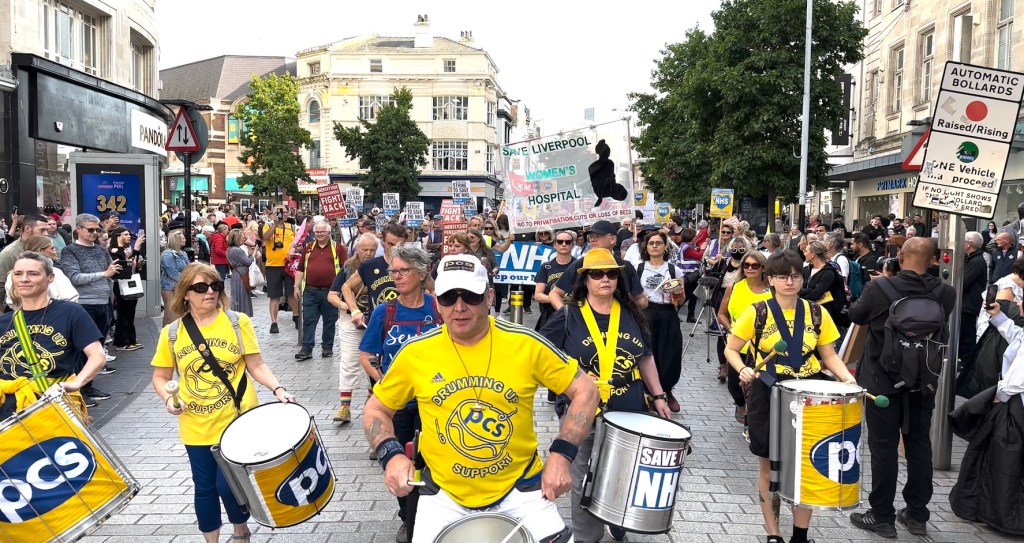
“What women know from the generations that came before us – from those who stood up and fought for the right to work, good pay and conditions – is that we don’t get what we want just because it is the right thing to do. We have to fight for it.”
Our campaign will continue. Please join us in fighting for Women’s health, and maternity and for the restoration of the NHS as a publicly owned, publicly delivered, not-for-profit health system.
 Save Liverpool Women's Hospital