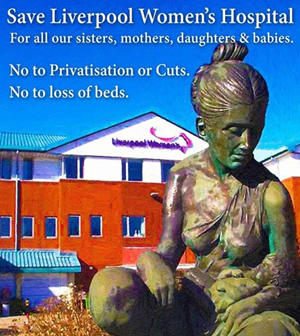
Our campaign has worked since 2015 to secure a future for Liverpool Women’s Hospital. We want no loss of services, no loss of beds, no privatisation. We want a continued and enhanced focus on the health of women and babies. We do not want relocation to the crowded, crisis ridden site of the Royal Liverpool Hospital. We want to preserve the site at Crown Street. We want no part in PFI. Tens of thousand have signed our petitions, in the streets and on line.
We have roundly condemned the plans previously put forward by the CCG and the Trust. We dismiss the description of the Crown Street site as “isolated”, it is far closer to the Royal than either the Aintree or Broadgreen sites of the new combined trust. With the demise of the PFI system and the huge scandal at the Liverpool Royal Carillion site, these initial plans have fizzled out, at least for now.
Some interesting new discussions have now begun. We are sharing these discussiosns from the hospital board meetings here for our supporters to read and consider. We will hold a meeting to discuss them in more detail when people have had a chance to consider them. We are posting key sections from the report for our supporters to read, not to endorse it.
The discussions from the board are in four sections;
Networked Maternal Medicine Services (which is the subject of this blog post). This means Liverpool Women’s hospital will be working with the Manchester Hospitals, with one of the Manchester hospitals being the lead on maternity, with LWH as a subsidiary hub. Some Liverpool women with the most complex needs, will have to travel to Manchester for their care. Often these women are the least able to travel longer distances.
We are posting these papers as four blog posts so the lay person can more easily understand them. Anyone who wants them in their original form can find them here, these are public documents.
Introduction from the Board
“Liverpool Women’s NHS FT (LWH) has previously set out the challenges it faces in delivering the highest quality of healthcare on its isolated Crown Street site. Clinicians at LWH have concluded that to sustain the services of the trust into the future, relocation onto an adult acute site would be required. These conclusions have been articulated in the trust’s Future Generations strategy, confirmed through a rigorous options appraisal process run by Liverpool CCG and supported in a Clinical Senate report from independent experts under the umbrella of NHSE.
To date, the DHSC has not given the trust permission to raise the capital required for the construction of a new hospital. Even if this was now achieved, services will continue to be run from the Crown Street site for several years to come. Given these facts, it is important that the trust revisits its clinical position periodically so that relevant and up to date information firstly can be used internally to counteract the clinical threat and secondly can be shared externally so that the need for relocation remains a visible priority for the system. To this end, a Clinical Summit was held in the Trust on 11th June 2019, to which all key stakeholders were invited and at which, a set of key clinical questions was asked.
NHSE/I have committed to ensure that all women in England have access to a level of expert clinical care before, during and after pregnancy that is commensurate with their clinical condition, if a significant medical problem isencountered. The national plan is to achieve this by establishing new Networked Maternal Medicine Services (NMMS), each with a Maternal Medicine Centre (MMC) at its heart.
Each MMC will be staffed by an experienced multidisciplinary team including an obstetrician with sub-specialty training in maternal medicine (or equivalent) and an obstetric physician (or equivalent) along with input from all relevant other medical specialists and support from specialist midwives. For the delivery of maternal medicine services within a given footprint, the MMCs will:
Provide a leadership role
Liaise
with the other providers of maternity care in its footprint
Agree
pathways of care and patterns of referral
Ensure that women are cared for by clinicians with an appropriate level of expertise.
Peripheral units will provide much of the maternal medical care required for women of low to medium complexity. The referral of some high risk or complex cases from across any given NMMS footprint into its MMC for the delivery of care is, however, inevitable.
To become an MMC, a trust must comply with a nationally determined service specification with its range of associated standards.
An assessment against that service specification has been carried out by the Clinical Director for Maternity at LWH and this has been included as an Appendix to this paper. The trust can demonstrate compliance against most of required elements but it is not co-located with other adult acute specialties, so full compliance has not been achieved.
In view of these constraints, earlier this year, the trust submitted a joint bid with other partners across the North West, outlining a proposal to develop an NMMS which will cover three LMS areas; Greater Manchester and Eastern Cheshire, Cheshire and Mersey and Lancashire and South Cumbria. In this proposal:
· An MMC will be established at Saint Mary’s Hospital at Manchester University NHS Foundation Trust (MFT). This centre can comply in full with the service specification as its women’s services are co-located with other adult acute services
· Two sub-centres will be developed including one at LWH, allowing most but not all women to be treated closer to home. Referral from Cheshire and Merseyside into MFT will be required for some women with severe medical problems: around ten per year will receive most of their care at MFT and a higher number will attend MFT for one or more outpatient reviews.
Establishing LWH as a sub-centre for maternal medicine will require the appointment of an obstetric physician in Liverpool. The Clinical Director for Maternity is presently working with partners at LUH to identify an appropriate clinician for this role. He is also writing to colleagues across Cheshire and Merseyside in order to formalise existing referral pathways for patients.
These are serious issues for Liverpool women. It would be better to have a self contained Merseyside and Cheshire service. Your comments are welcome.
The following posts will discuss the other issues raised.
The state of the NHS in November and December 2019 is utterly unacceptable. Responsibility for this state of affairs rests entirely on the shoulders of the governments who have been in charge since 2010. People should hold them to account.
The BMA said “Under this government’s watch, patients and staff working in the NHS have endured winter after winter of overcrowded emergency departments, long delays, and pitifully low staffing levels. It should not take an election to take stock of just how bad the situation has become”.
The Governments introduced the policies. They held the purse strings, they oversaw appalling practice and plans. They had the motives. Please hold them to account. Don’t let them wriggle out of responsibilities. It’s not all politicians, or “the cuts”, or “the economy”.
NHS staff are providing good services by their own efforts, at a real cost to their own wellbeing. Despite their working conditions, they still take responsibility for their own actions and for any mistakes. Indeed there are rigorous processes to hold staff to account. If they make mistakes or are negligent, they are called to account. So must the government be called to account.
From 2010 it was a Conservative-Lib-Dem coalition, from 2015 it was a Conservative Government and from 2017 to the present, it was Conservatives, supported by the Northern Ireland DUP. The dreadful state of the national NHS is the responsibility of the Conservative Party and from 2010 to 2015, the Lib-Dems too.
The responsibility for the state of public health and wellbeing rests on the shoulders of the government of the day. The poor have been hardest hit by public health spending cuts. The poor get ill more often and die earlier. The state of the Hospitals, GP services, the ambulance service and more, is the fault of the government.
The voters have to call this Government and its party to account in this general election.
Hospitals in England are struggling to cope safely with high but quite predictable numbers of patients, and with predictable levels of illness. There is no element of surprise about the number of older people in the country. These people were born some time ago.
Staff shortages were also predictable. The number of staff in training has been known to be inadequate for some time. The Hostile environment for migrants makes the NHS less attractive to migrant doctors. Cutting training bursaries for nurses and midwives was bound to cause problems
The Royal College of Nurses claims that the shortage of nurses is the greatest threat facing the NHS
Racism in the population is a problem, and this has been fuelled by the toxic debate around Brexit and the Governments hostile environment. Smaller numbers of staff from the EU have been joining the NHS since the EU referendum (and make up a smaller percentage of joiners) The toxicity of the Brexit debate lies squarely on the shoulders of the government.
There is a serious shortage of beds in the NHS. “However, the UK currently has fewer acute beds relative to its population than almost any other comparable health system.” This reduction in the number of beds flows from decisions to reduce the number of beds, not from any accident or change in population. The shortage of beds results from appalling decisions.
Additional calls on the NHS because of poverty are also well known and are sadly predictable. Cuts in benefits for housing has seen more people forced to sleep rough on the streets. The life expectancy of the street sleeper is 47 years old.
Seriously ill people can be discharged from hospital with nowhere to go once their treatment ends. NHS data confirms that some homeless people are discharged to the streets
Hospitals are critically short of funds, equipment and staff. Public money has been given to for profit-making companies providing services for the NHS and advising the NHS on how to spend its money. Privatisation is rife.
Care is being rationed. We look at just one of these rationed treatments in an earlier blog post. Charging has been introduced for some patients, and for some treatments. The Warrington My Choice experiment was “paused” after a public outcry but we know similar situations are happening elsewhere. The charging issues for migrants are well explained here The responsibility for all this all rests squarely on the heads of Government and their ‘ninja privatisers’.
“£20 Billion per YEAR to be made out of Outsourced contracts in NHS”
Votes can change things. In the United Kingdom, the people making the laws and the major decisions are the government. The party with the largest number of seats in Parliament chooses the Government.
There must be no attempt to blame the NHS workforce. Jeremy Hunt tried to blame doctors for waiting lists. Do you remember his 7 days a week NHS and his fight with the Junior doctors? Even now Government tax issues which could easily be solved, are directly damaging the NHS. Doctors should pay tax like anyone else but this case is solvable by negotiation. The Government negotiates quickly with big business. This pension issues too should be solved. The NHS needs many more doctors and doctors should not be expected to keep the system running by working over long hours.
“It (the election) comes as staff vacancies continue to put the health service under strain, with the NHS reporting last year it was short of 100,000 staff, including, 10,000 doctors and 35,000 nurses.” (BMA).
There is a lot of money spent on the NHS, but not enough of that money goes on beds, staff and frontline services.
Big corporations have made money from paying poor wages to provide cost-cutting services that have led to their own crisis. Money has been squandered on privatisation, the internal market, additional administrators, and fatally incompetent decisions about cleaning.
“Audits of wards hit by a major outbreak found mattresses contaminated with bodily fluids as well as poor cleaning practises” (Liverpool Echo about Arrowe Park’s infection crisis).
Workers, including those at Liverpool Women’s Hospital, are fighting back against poverty wages in outsourced companies. In London, another set of workers are fighting back.
The Health Service Journal claims that repairing the new build The Liverpool Royal Carillion will cost £300million.
This is yet another example of money-making being allowed to run riot in the NHS
The responsibility for the state of the NHS rests squarely on the shoulders of the Government. We are not uncritical of Labour’s record on some aspects of the NHS. Save Liverpool Women’s Hospital Campaign and other NHS campaign groups have been highly critical of local Labour decisions to use PFI to build the new Royal, the failure to adequately supervise the build, of local decisions to cut the numbers of beds and to implement uncritically Government policies on the NHS. But the government made the decisions and had motives for their actions
Governments since 2010 have failed the NHS, have allowed its exploitation for-profit and placed staff and above all patient safety at risk, whilst employing silver-tongued PR exercises to cover up the problems.
An election gives a welcome opportunity to hold the government to account.
Voting works. The old folks who are now accused of “Bed Blocking” voted in 1945 to start the NHS. Our whole NHS grew from their votes. Votes can change the situation
Don’t just vote, we need still more campaigners to join us.
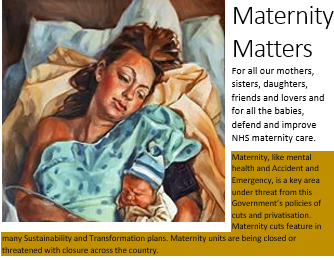
High-quality maternity care for all, free at the point of need, funded to Western European standards and above. Get rid of the internal market and focus funds on frontline staff.
Immediate removal of the charge
to migrant mums
The restoration of the Bursary for midwives and nurses and related professions.
Increased funding and support for the university courses training midwives, initially and throughout their working lives.
Increased neo natal beds.
Significantly improve support for women postnatally: physically emotionally and in terms of mental health
Reinstate breastfeeding support to allow women to choose to breastfeed
Provide good quality mental health support
No women to give birth in prison.
Our recent national meeting!
No private companies bidding for midwifery work.
End the personal budgets routine.
Respect for women in all aspects of childbirth.
Major research to reduce inductions.
Not one more closure of a maternity unit, nor one bed lost.
Make the NHS focus on women’s health, research into drug effects on
women, and make sure the differences in women’s symptoms are well understood
Improve abortion rights
Reverse all cuts in health vistor services and reinstae a full national service for all
Fund IVF
Improve the NHS insurance system for maternity
Protect the genome projects from private companies
End the mother penalty on pay. Stop discrimination against pregnant women.
Fund our whole NHS to Western European standards, and free it from the plague of privatisation and rationing
Save Liverpool Women’s hospital, on-site. Fund Liverpool Women’s Hospital so it can thrive, to serve women and babies locally and nationally and to continue to be a centre of world expertise
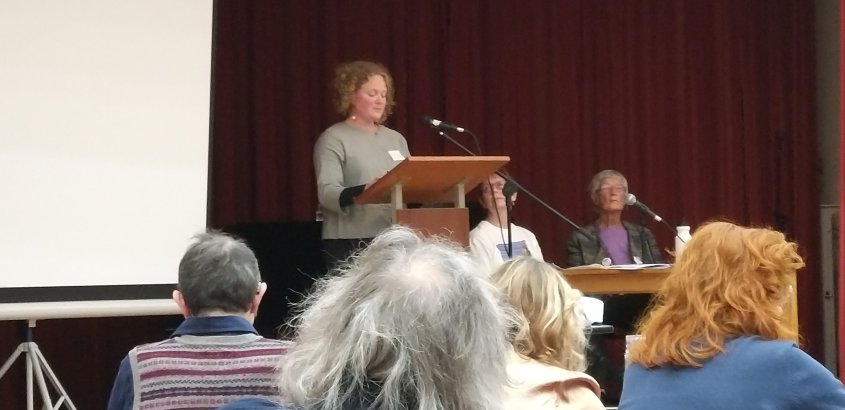
Jessica Ormerod speaks for maternity services as a public good.
Thank you for inviting me to speak to you today. My name is Jessica Ormerod. I run a research and policy analysis organisation called Public Matters with my lovely friend and colleague Deborah Harrington. We write mainly about the NHS but we are interested in all public services and keeping those service publicly owned and accountable. We also run an All Party Parliamentary Group for Health in All Policies. At the moment we are completing an inquiry into the Work and Welfare Reform Act. We see parallels across all public services in a systematic transformation (a word we hear all too often these days) to a corporate structure, a reduction in NHS provision and an ever widening landscape for private companies to move in and ‘fill in the gaps’.
I know I
have spoken to some of you before but I think it’s really important for us to
understand the picture of what has happened to our NHS as a whole. Because every
closed maternity ward, service or reduction in staff is the direct result of changes to the NHS that have been happening since the
2012 Health and Social Care Act. These changes are having a devastating impact
on access to care. It is no exaggeration to say that we are witnessing the reversal
of 70 years of universal, comprehensive and equitable care.
The 2012 Health and Social Care Act put into place all the major
elements for a step change in the privatisation of the NHS.
A QUANGO called NHS England was formed as the Commissioner-in-Chief of the
service, with over 200 subordinate local commissioning units. These
commissioning units broke with the tradition of planning services, replacing it
with buying in from public, private and voluntary sector providers. Areas of
work are subdivided into contractable units and NHS public providers
are obliged to compete. The loss of a contract means loss of income, which has
a knock-on effect on the viability of the public sector, which is left with
high cost acute care and a reduced income.
In 2014 a new CEO was appointed to run the NHS in England. He created a
new plan for the NHS, the Five Year Forward View and this was greeted
by the establishment as a welcome antidote to what was seen as the fragmented
mess left by the 2012 Act (this was only a mere 18 months on from it being
enacted). But it’s important to recognize that far from being an accident, the
Act achieved the fragmentation necessary for privatisation to be
embedded at an organisational level, including many major health
industry players taking key roles in the commissioning and policy-making
process.
At the heart of NHS England’s Five Year Forward View is the idea that
the NHS in England will never again be funded to a level that maintains its
services in the way they are run now. It puts together a series of proposals
for change which are not just cuts but are about a fundamental reshaping of how
services are provided. Expensive specialist and emergency care are relocated
to centralised hubs and more care is to be delivered in the community
via partnerships with local authorities. There is an aspiration for fewer
emergency admissions with an improvement to overall health which it argues will
lead to less dependency on NHS services.
We could say the scope of this aspiration is far reaching or we could
say it is pie in the sky. It not only assumes the NHS can cope with a growing
population without corresponding growth in services but that it will do so with
a reduced service with much of the change becoming the responsibility of local
authorities.
The process of transforming the NHS in England, is based on close
co-operation between successive politicians and Department of Health managers
over many years with the US Health Maintenance Organisation or Accountable
Care Organization principles of managed care. This process is continuing
without any checks and balances of substance within the
formal organisational structures of government. Politicians go to
great lengths to deny both privatisation and US influence on the
current changes.
There is, however, a groundswell of resistance to
the damage being done to the NHS and there is a lot of knowledge surrounding
individual service contractions and closures, but little in the public domain
about the overall programme of change. And that is what I am here to talk about
today.
The
National Maternity Review, aka Better Births – A Five Year
Forward View for Maternity Care, is one of the
Five Year Forward View’s New Models of Care. It emphasises community care
delivered through local hubs with a theoretical reduced demand on hospital
services. It recommends an increase in independent sector providers and
introduces Personal Care Maternity Budgets. Personal Care Budgets commoditise
and monetise the system. They add layers of unnecessary complication, increase
expense, fragment accountability and lead to an accounting nightmare.
44 Local
Maternity Systems have been established. The systems have been introduced without
consultation, peer review, pilot studies or effective oversight from public
health or parliamentary scrutiny. They are small-scale Integrated Care Systems.
Unlike the Integrated Care Organisations which are now under consultation, they
have been put into place with very little fanfare or institutional opposition.
As with all
the changes to the NHS currently taking place, there is a real problem that
rhetoric about better care closer to home is not matched by real resources or
access to physical structures like hospitals. NHS England consistently refers
to services being more important than organisations but fail to fill in the
blanks about how this works. They also insist that travelling in order to
receive excellent care is not a concern to patients. There is no acknowledgment
that time, expense and severity of health condition all very much effect the
distance people are able to travel regardless of the excellence of the service
at the end of the journey.
In the case
of maternity, these questions of distance and the emphasis on community care
run two different risks. The first being the potential for increase of
emergencies outside hospital setting. The second is that mothers might be taken
in to hospital for assisted birth or caesarean in order to pre-empt risk
arising.
But what
makes maternity different from other services?
Most people
use health services most at the beginning and end of their lives. Pregnant
women are the exception to this. During pregnancy women come into more contact
with the NHS than they probably have ever done in their lives. This is
particularly the case if they have a complicated pregnancy or birth. Healthy
women can become profoundly unwell during pregnancy and they can be vulnerable
to life-threatening complications during birth. That’s why it is so important
that women have all levels of care within easy access.
Until now
maternity services have been provided in the most part by the NHS. Women have
always been free to employ a private midwife. But the NHS has a duty to provide
a midwife at every birth even if a private midwife is also in attendance.
Maternity
services are woven through the traditional structure of the NHS. Women see
their midwife at home or at their local GP. They receive a minimum of two scans
to check the baby’s progress and health at the local hospital. If they have a
pre-existing condition or they develop a pregnancy-related illness then their
specialist will work alongside the maternity team to ensure that the woman and
baby are safe and as healthy as possible throughout the pregnancy.
Currently
women – depending on where they live – can give birth at home, in a
‘stand-alone’ facility run by midwives, ‘co-located midwifery unit’ – that’s a
midwife-run facility on hospital grounds, or in an obstetric unit which
includes doctors and surgical theatre. Obstetric units can only be sited in
hospitals with A&E because they require acute services which is blood, air
and surgeons. A woman can become dangerously ill very quickly during birth so
timely access to acute care is essential.
Put this
into the context that since 2010 maternity services have been starved of funds
and there has been a staff recruitment and retention crisis. Many maternity
units have already been downgraded or closed, hundreds of GP practices have
also closed so women already travel further to receive care. This means it
costs more and takes more time to see a midwife, GP or hospital doctor. It also
means longer emergency transfer times. The risk is this will only get worse
once the STPs restructuring of the NHS is complete.
Who is
driving the changes to maternity?
Surprise, surprise, Better Births panel includes private health providers and those private companies are working with government to re-write policy.
Although
most current providers are NHS hospitals, private providers are now being strongly
encouraged. Local Maternity Systems set their own payment systems. This means
that they can choose whether they pay via their geographical population or they
can pay per activity or service. However, they do not follow established budget
areas; they do not share boundaries with CCGs or Local Authorities even though
they rely on budgets from both. Across the country there is now a mish-mash of
payment systems. The risk is that women will fall through the gaps.
NHS Trusts have been ‘incentivised’ to adopt Better Births by offering a chance to win ‘pioneer funding’ to speed up the transition to the New Models of Care. In November 2016, Seven ‘early adopter’ sites started to implement the recommendations – I don’t need tell you about this because you’re part of it! The sites were told to be bold and radical. Another incentive is ‘the maternity challenge fund’ which instructs successful trusts ‘to explore innovative ways to use women’s and their partners’ feedback to improve maternity services’. A pioneer site is not the same as a pilot test site.
LMSs are encouraged to work alongside private providers in order to offer women a wider choice. As most women have previously been cared for by the NHS this simply means opening the door to the private sector. In a climate of serious staff shortages, it is possible that some midwives may see the benefit of setting up an independent midwifery practice rather than staying in the NHS. Despite protestations to the contrary, this does actually reduce the ‘NHS offer’ and opens an income stream for public money to be handed over to the private sector.
Better
Births tells us it is working on a new accreditation scheme for maternity
providers. But in a publicly provided NHS service, this is unnecessary because
the NHS trains staff to a professional standard.
Private
providers are required to have a contract with the NHS in order to receive
payment via a Personal Care Budget. It is claimed that the budgets (which are
described as ‘notional’) will demonstrate to CCGs the kinds of choices women
make during pregnancy, birth and postnatally. This will apparently encourage
CCGs to respond to women by increasing their offer. The claim is that this will
also empower women. But it is decidedly unclear about how this can be achieved.
The guidance talks about using Personal Care Budgets for birth pools, place of
birth settings or breastfeeding support but all of this should be available to
every woman regardless of a personal care budget. In fact, all of these used to
be available to women as part of the normal care given by the NHS.
Moreover,
it precludes the notion that women become ill in pregnancy. No one chooses to
get gestational diabetes, pre-eclampsia, HELLP or any other life-threatening
condition. What happens when your health needs change but you’ve used up your
£3000 on hypno-birthing? There should be real concern about the potential lack
of access to obstetric care when women have serious complications of
pregnancy. Or to return to the issue of financial balance, if £3000 is a
notional budget for a normal birth which can be used up in a number of ways
then the acute hospital will potentially have to pick up the cost of the
emergency care without a matching budget.
What does
this all mean?
Scale and
pace have taken precedence over caution and evidence. Academic research will
take years to catch up to establish the public health consequences of this new
policy.
This is a
top-down reorganisation of a national service with little to no consultation,
pilot schemes, peer review, oversight or risk assessment. A Health Select
Committee inquiry into the maternity transformation plan was not completed
because of the 2017 election. It has not been re-opened.
The Vice-Chair
of the maternity transformation programme finishes his report with the
following advice to LMSs: Be Bold! Don’t wait for instruction! Clearly long
gone are the years of epidemiological study, of public health planning, of
consultation with experts.
However,
there is one area that is getting a lot of investment and that’s technology. In
2018 all 44 local maternity systems were asked to supply data to NHS England on
the level of their digital capacity. There is a drive across the NHS towards increasing
the amount of technology. This can mean more efficient record keeping in
hospitals and GP surgeries, it can mean improved tools to cancer care all of
which are good and to be applauded. But we are also seeing technology replacing
face to face care; already women see a midwife far less regularly than she
would have done even five years ago. One area of major concern is in the
changeover from paper records to e records. We already know that there are
serious barriers to access for many people when they are forced to use
technology. The claim is that women will be able to take better ‘ownership’ of
their ‘personalised care’ but in reality a paper booklet kept by a woman in her
own handbag is far easier to access than erecords locked in a computer that she
may not have or may not know how to use.
Better Births is based on consumer choice issues around
personalised maternity care. There is a serious lack of evidence that this
restructuring will give women the vital services they need. There are fewer services,
obstetric departments are being stretched even further and technology is replacing
face-to-face clinical care.
On the other hand, it embeds private care and fee-for-service. And, most
importantly of all this is not how a national public service works.
Rebecca Smythe Senior lecturer in Midwifery Opening our National Meeting. Video courtesy of Phil Maxwell and Hazuan Hashim
Maternity services in the NHS are over stretched and underfunded. Maternity Units are under threat or closing across the land. Temporary closures are common. Staff are keeping the service afloat so most mothers and babies are still safely delivered.But serious damage is now showing in the research from Liverpool University into deaths of babies in the UK, especially in areas of high poverty.
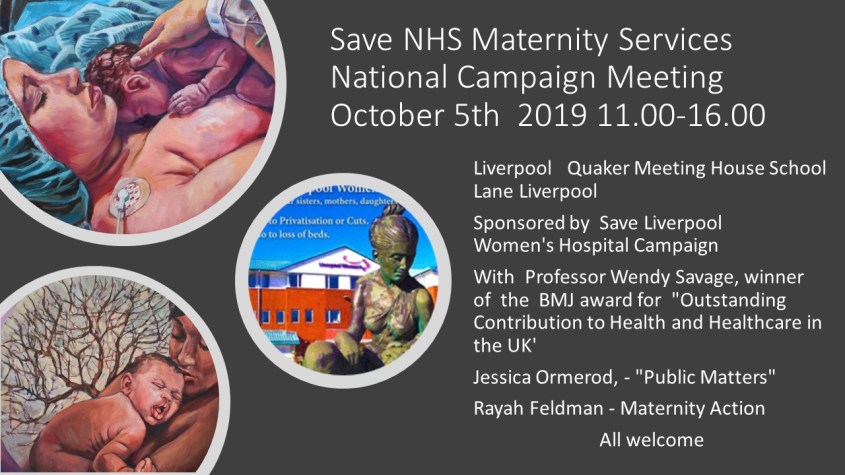
On 5th October 2019 October we met at the Friends meeting house in Liverpool to discuss the national state of the maternity services. We gathered people to hear Professor Wendy Savage, eminent doctor, Jessica Ormerod Researcher, from Public Matters, and Rayah Feldman from Maternity Action. We started with this video from Rebecca Smythe who teaches Midwifery in Manchester and was once a midwife at Liverpool Women’s Hospital and at Mill Road Hospital . Rebecca spoke of the realities and the hopes of mid wives and student midwives.
This was our agenda
Aims To discuss the state of NHS
maternity services nationally and to work out how to improve them, including
how to involve women, staff , the wider
trade union movement, and the public in this campaign
Agenda for the day
10-11am Registration, coffee
MORNING SESSION –“MATERNITY MATTERS”
11.00 Chair’s welcome & order of the day
11.05-11.15 – Video message from Rebecca Smyth, senior
lecture in midwifery, SLWH campaign (sadly Rebecca is out of the country, hence the
video message) dealing with issues facing midwives
11.15 -11.40 – Professor Wendy Savage
(including the battle for a women-centred NHS)
11.40-12 –Jessica Ormerod (‘Better Births’
& the Cumberledge agenda, Rhetoric v Reality)
12- 12.45 – Q & A & discussion from
the floor with the panel
12.345-1.30 LUNCH –lunch provided, some
flexibility to shorten if running late
3.15- Building the campaign to defend and
improve NHS maternity services, improve women’s health care services, defend
infant and child health services and defend and reinstate the NHS4.00 Chair’s close & thanks
We will share reports from the rest of the meeting over the next few days
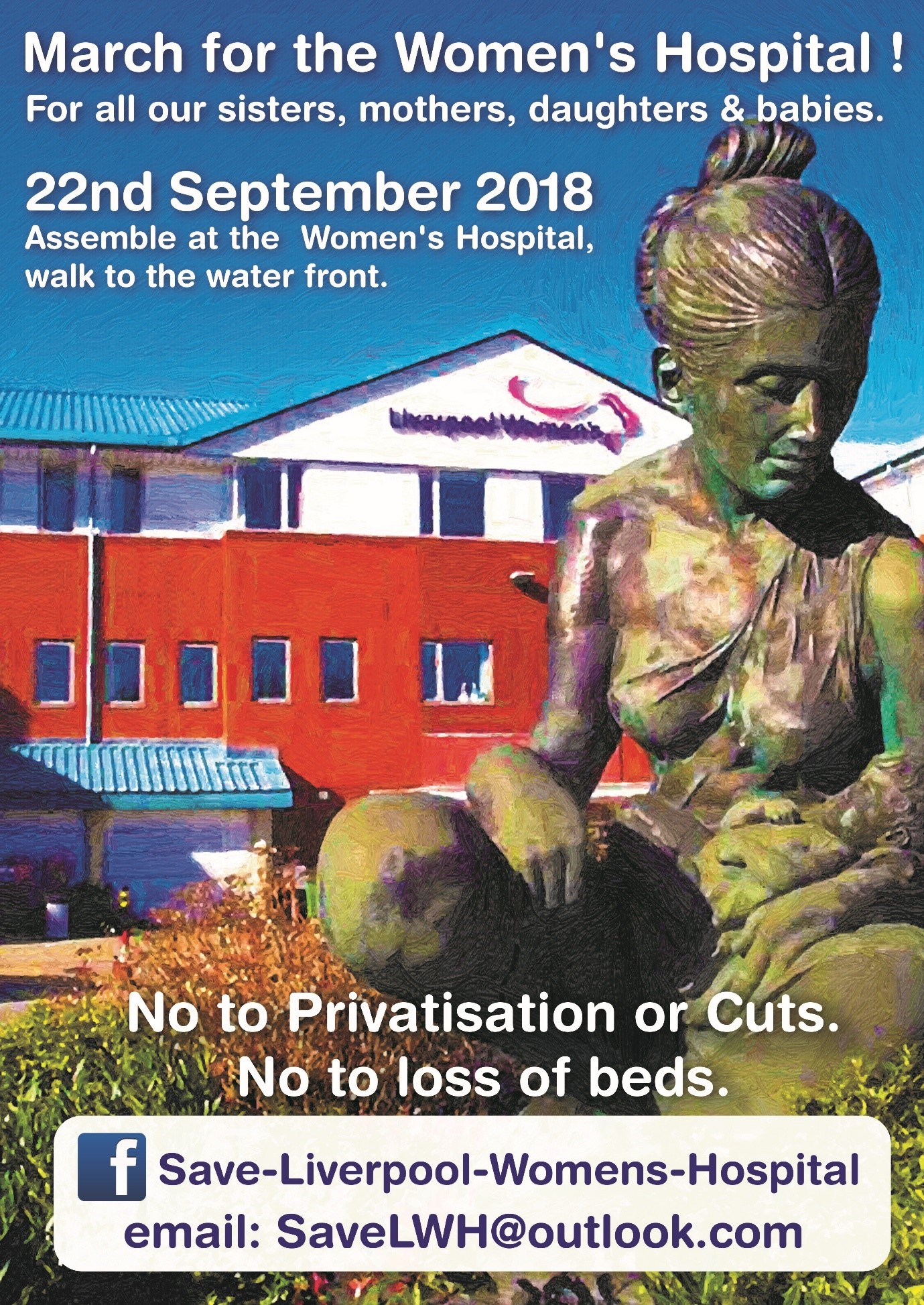
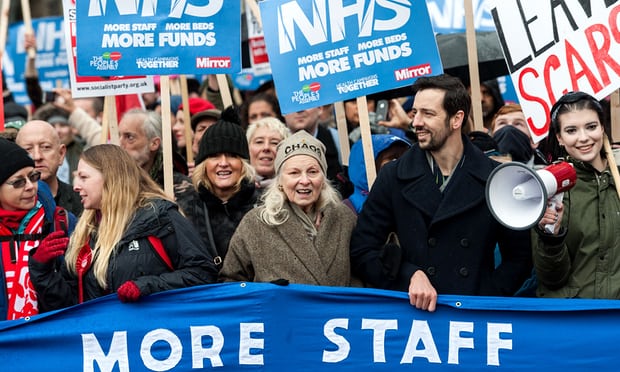
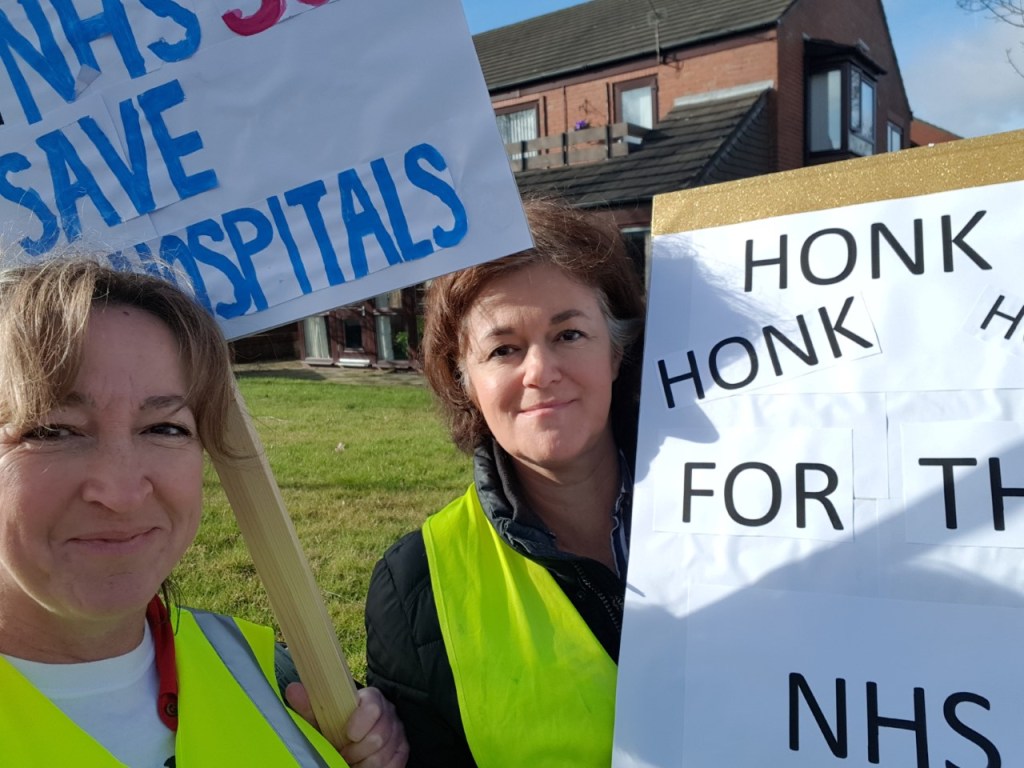
A year ago Save Liverpool Women’s Hospital Campaign held our second demonstration. We campaign for our mothers, daughters, sisters, friends and lovers and for each and every baby. We campaign for a fully funded NHS, for improved healthcare for women and babies and for the hospital to remain open and on its existing garden site.
Women can give birth at home in Liverpool using the NHS.
There is no sane case for commissioning another private for profit Maternity provider. This idea of bringing in yet another for profit provider was raised, in passing, at a health and social care select committee meeting in Liverpool this week. It follows the One to One company closing and causing significant hardship to pregnant women and to the midwives working for them.
Speak out for the NHS. Speak out for proper funding, proper staffing, decent buildings and for democratic control. Democracy means the government of the people, for the people by the people, with the right to speak out and speak up. The NHS, it is said, will last as long as there are people prepared to fight for it. Good care is still provided in may aspects of the NHS but the system is suffering significant damage. If enough of us speak out and mobilise in our workplaces and communities, we can save and improve the NHS. This is no time for despair or helplessness.
In this article, we are looking at care in pregnancy, delivery and post-natal care. The occasion for this article is the closure of One to One Midwives, a private, for profit company, contracted by the NHS.