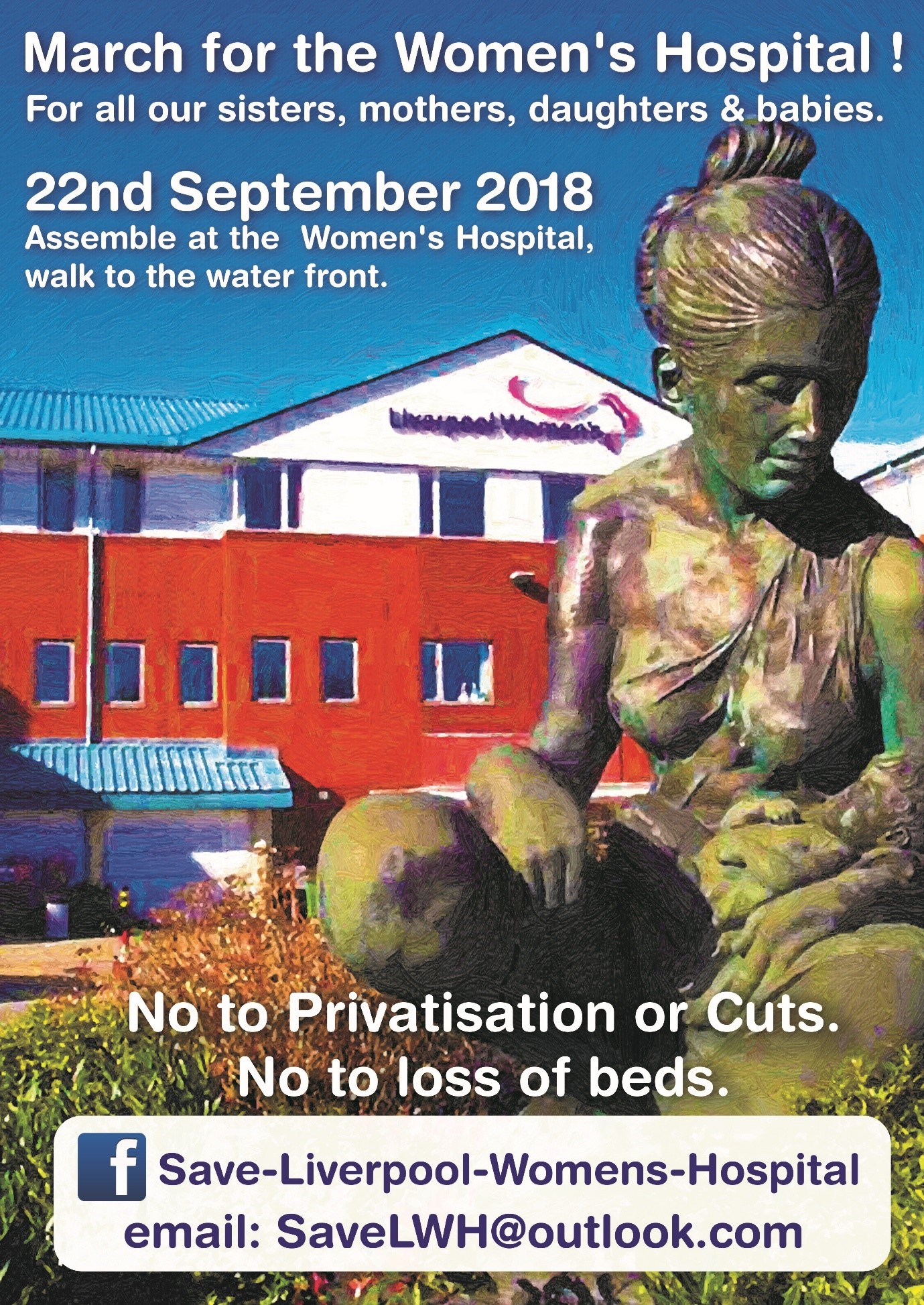

Campaigners from many organisations say Save Liverpool Women’s Hospital, Restore and Repair the NHS. There are huge problems in the NHS. Maternity and women’s health are just two areas of great concern. In this situation, we say fight for better services, kick out the many privatisation projects, and restore our lost services. Poor, underfunded, fragmented healthcare wrecks a country’s economy, costs lives, and damages individuals and the staff of the service.
This is a quick-fire post responding to questions people have asked about the proposals for the future of Liverpool Women’s Hospital.

- Is there really a threat to the future of Liverpool Women’s Hospital? Yes the ICB “engagement” is about Liverpool’s Hospitals’ Maternity and Gynaecological services. There are no other Maternity and Gynaecological services except those at Liverpool Women’s Hospital, so it is about the Women’s Hospital. At the ICB board on the 9th of October, when this “Engagement” was launched, moving all the services from the current site was discussed. This is the link to the “Public Engagement” about the future of Liverpool’s Hospital maternity and gynaecology services. After the “engagement” they will move on to “consultation”. This is part of the closure process and rarely stops, but a big campaign can still stop it.
- Where will our babies be born? This plan does not say, but it does discuss moving services from the current hospital. We say “No!!! Save Liverpool Women’s Hospital on the Crown Street site and improve the services there.”
- Why do we need women’s health care? Because women’s bodies are different from men’s bodies, because some (but not all) women give birth, because in the UK women’s health has been made worse by austerity, poverty, workplace stress, and pollution. There is a gender health gap. We live longer than men but have more years of ill health, and things are getting worse. It is crucial that women’s health is not subject to more cuts, but rather has massive investment. There is a Liverpool City Council report on women’s health deteriorating in Liverpool up to 2040 here. We campaign for women’s health and for health care for men too.
- Where is the money coming from to reorganise women’s health care in Liverpool? There is no mention in the report, nor in the ICB paperwork. Without funding, this is a cut. Liverpool Women’s Hospital has, like other hospitals, been forced to make cuts, they are called ‘cost improvement plans’ but cuts they are, and cannot be made safely. How a massive reorganisation makes sense in this situation of underfunded semi-privatised health care, we do not know. This country can afford world-class healthcare. It is a political choice not to fund healthcare and leave it for the wolves of privatisation who take £10 million a week in profits from our NHS.
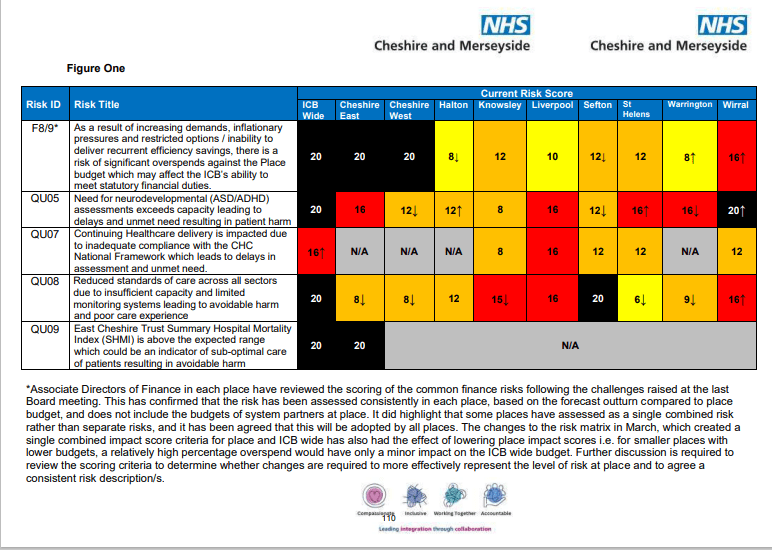
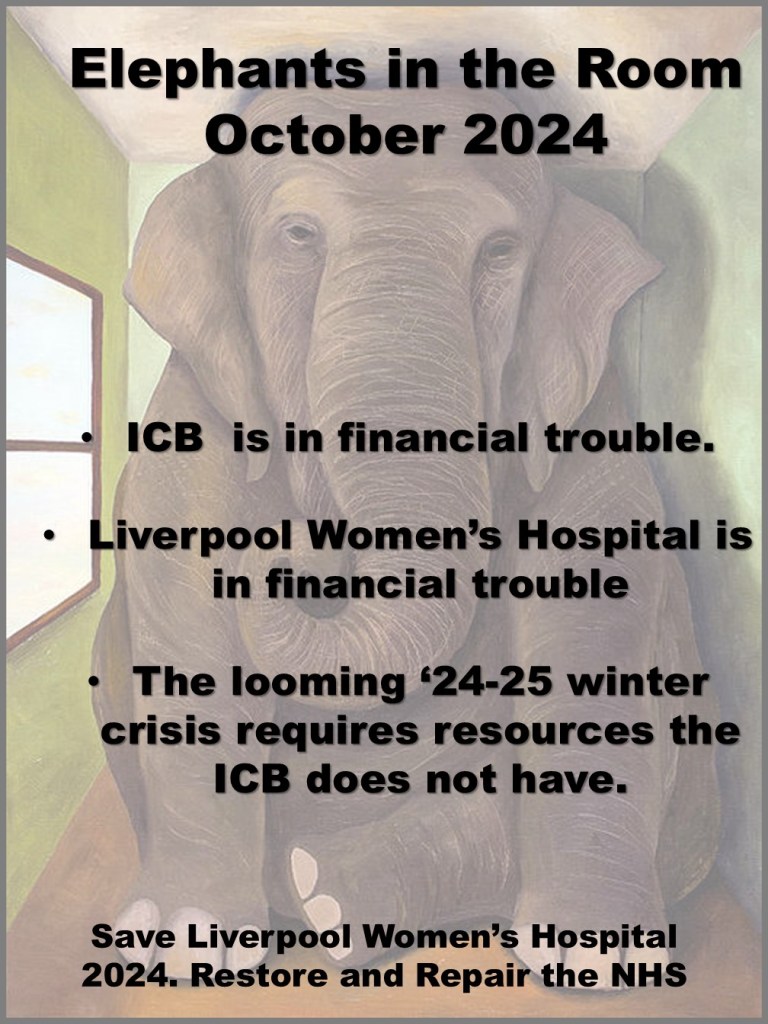
- Is there money for these plans? No. None has been identified. Both the ICB and Liverpool Women’s Hospitals are underfunded to a serious degree. This is a problem across the NHS but acute for maternity services. For detail see here. Page 56 of the September board meeting gives more detail.
- These plans are being led by the ICB. What is the ICB? The ICB is the Cheshire and Merseyside Integrated Care Board. It makes the financial and policy decisions for the NHS in the Cheshire and Merseyside area. The Conservative Health and Care Act 2022 set up forty-two such ICB areas covering the country. Originally they were called Accountable Care organisations. Accountable Care Organisations are an American system. They are intended to cut costs and services, particularly by reducing hospital services. Already this ICB has spent considerably in the private sector.
- Is the ICB the same as the Trust? No, but the ICB decides how much money a hospital gets each year and can make policy decisions. A Trust runs hospitals. A trust is the legal body that makes decisions about the hospitals, or in some cases the out-of-hospital services, that it runs. Trusts started in 1991. Then Foundation trusts were brought in in 2004. The idea was that hospitals should run like competing operations. It was a system designed for the private sector to make money. It caused chaos. Lord Darzi’s report has been described as a fig leaf for the government. It describes how bad the situation is so few can now deny the problems. This outright competition is no longer expected, but the laws have not been fully changed. The Government tells National Health Service England what to do, and what it can spend, NHSE then tells the ICBs, and the ICBs tell the hospitals.
- What will happen to the site if they take away babies and women? They do not say.
- Why do these papers not explain the benefits of Liverpool Women’s Hospital being on a single site? We do not know, but it is a very odd procedure not to include the benefits and costs. The papers do not say what will happen to the Women’s Hospital’s role as a maternal medicine centre for the region, or as a tertiary hospital, which takes complex patients babies and women from other hospitals.
- We used to have maternity services available in Fazackerley, Mill Road and Oxford Street. Why close Liverpool Women’s when these services were closed to make way for Liverpool Women’s? We don’t know, and the information published in this report does not make that clear. There were and are advantages to having one maternity hospital and Liverpool Women’s has been good not just for Liverpool women and babies, but as a point of reference for good practice for other Maternity services.
- Why the focus on some extremely sick women and not on the thousands of babies born in Liverpool? We do not know. Obviously, sick women and babies are both important.
- Staff working at the women’s do not seem to know about this. This is in the public domain. It is not a secret. The plans started ten years ago when the then-head of the CCG (a kind of forerunner of the ICB) announced on Panorama that there were too many hospitals in Liverpool. The next day the Echo said the Liverpool Women’s Hospital was to close. The current documents are similar to the documents produced previously. The original document “Future Generations” formed the basis of the (ridiculously expensive) Carnall Farrar report in 2022, and in turn, this document follows Carnall Farrar.
- What’s this about a merger with the Royal, Aintree and Broadgreen? The Royal, Aintree, and Broadgreen formed the Liverpool Universities Hospital Foundation Trust (LUFHT)in October 2019. Liverpool Women’s is now working closely with the LUFT, and sharing a board. That has happened without any public consultation and little discussion at the public meetings of the board. It has not been led by the ICB but by the two trusts. The first joint board meeting is to be this month (November 2024). Legally, the two trusts still exist but have delegated their responsibilities. There was no public consultation on this. The hospitals plan to form a similar committee with the specialist hospitals, Clatterbridge, The Walton Centre and the Liverpool Heart and Chest. For now, it looks like the funding for the specialist hospitals will be ring-fenced, but eventually will be part of the ICB funding system“Today’s NHSE board paper says it will “ringfence” specialised commissioning allocations to ICBs which have the most severe financial problems, including “reserves and discretionary growth funding meaning they could not use it to support other services.” HSJ 7th Dec 2023. However, the joint committee of the hospitals in Liverpool will control finance and staffing for all the hospitals. Where will women’s health stand then? What about our babies? There is a real danger of funding meant for maternity and women’s health being pushed to the background as has happened for a decade nationally.
- Can the services just go to the Royal? The Royal has had many problems, not least the loss of beds, ongoing building problems with the new building and the demolition of the old building. There is no room for 7,000 plus babies a year, nor thousands of Gynaecological treatments.
- Is there going to be a new building? Highly unlikely, and we think not required. The NHS has a huge problem with building maintenance. Money for buildings is referred to as “capital” to distinguish it from day-to-day spending There is a £13.8 billion backlog, more than the whole capital budget for the year. Darzi’s report said there is a shortfall of £37billion in capital requirements. Some hospitals are practically falling down. Capital spending covers not just buildings but the most expensive equipment, such as intensive care beds (where the UK falls way behind Europe), and robotic surgery, which has excellent results in pain management and length of stay in hospital. Liverpool Women’s Hospital is a good building on a good site.
- It is hard to get to Liverpool Women’s Hospital on the bus. What happened to the round the hospitals’ bus service? It was supposed to be every half hour. We are trying to find out. This will be updated when we find out.
- How does this address the national maternity crisis? It does not address these issues, which are preventable baby deaths, harm to mothers giving birth and postnatally, funding of staffing, birth trauma for mums and babies, and immense stress for staff. Midwives have made their complaints loud and clear, but despite the many formal hearings into the issues, little progress has been made. Please see here for the list of reports on maternity. None of the hospitals mentioned in these tragic reports were standalone maternity hospitals. The UK does not get into the top twenty countries worldwide for the lowest infant mortality. One in seven maternity units have been closed in the last ten years despite fine talk about choice. The pressure in maternity wards is clear to see.
- Is it worse to give birth now than a few decades ago? Yes. Maternal mortality has worsened in the UK. It is now more dangerous to give birth in the UK than it was in in1985 “In the United Kingdom of Great Britain And Northern Ireland, the maternal mortality ratio (per 100 000 live births) has worsened by 1.41 deaths per 100 000 live births from 8.43 [7.66 – 9.26] in 1985 to 9.84 [7.89 – 12.2] in 2020.” (see the link above for details).
- Does the report on Liverpool’s hospital maternity and gynaecological services have data or comparators? No comparators, no impact assessment, no equalities assessment, no concrete data, no mention of the dreadful state of maternity finance or the state of the ICB finances. All we are given is unsupported assertions and broad generalisations.
- Is the Liverpool Women’s Hospital really “isolated”? No, it is closer, by far, to the Royal,(just one mile down the road) than Broadgreen and Aintree are to the Royal Building or the other two hospitals, even though technically they are one hospital. Liverpool Women’s Hospital has worked as a system with other Cheshire and Merseyside hospitals since the Pandemic through CMAST and has mutual arrangements with other hospitals to operate or collaborate in other buildings, as they should. It is “isolated” in that it is a separate Foundation trust, not part of a bigger hospital but being part of a bigger hospital has far from protected maternity across the country.
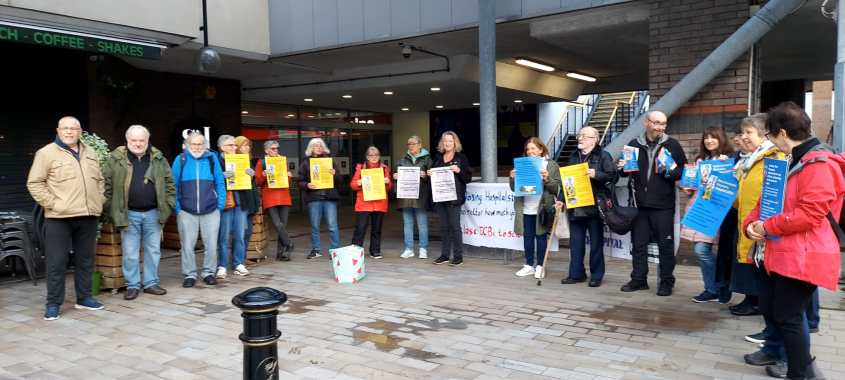

Save Liverpool Women’s Hospital campaign was set up after the first attempt to close Liverpool Women’s Hospital nine years ago. We have attended all the public board meetings of the Women’s Hospital and board meetings of the ICB and studied their papers. We have attended conferences, run stalls, produced leaflets, run workshops, and produced this blog. We work closely with other NHS campaigns in Cheshire and Merseyside and nationally. Our campaigners include a range of ages, occupations, women and men, trade union members and pensioners.



Brilliant.
LikeLike
Typo:
wrecks a country’s s economy
LikeLike
And forty-two such ICB areas (not 44)
LikeLike
AND! Liverpool Women’s Hospital was too close (to close?)
LikeLike