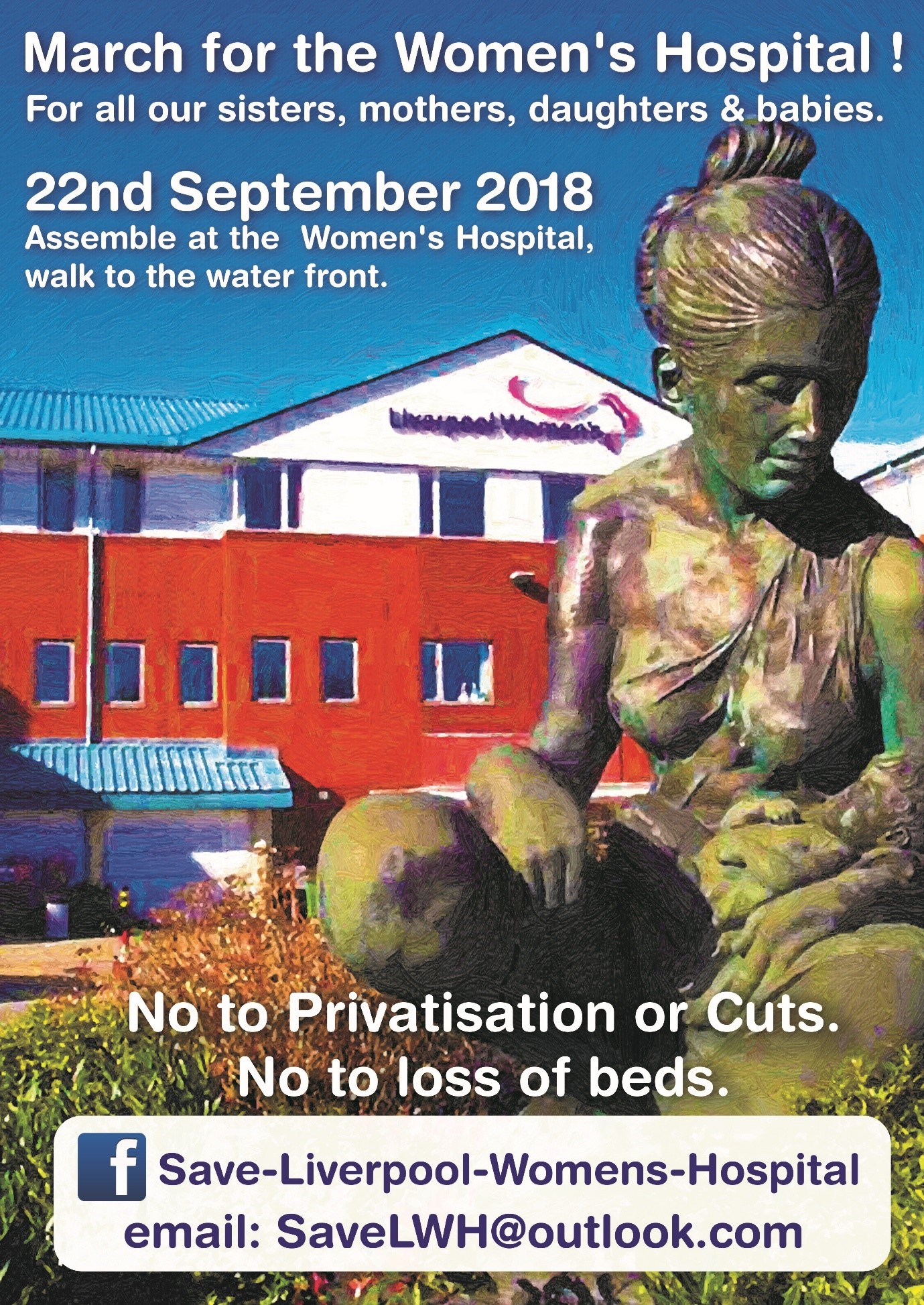
Save Liverpool Women’s Hospital. Myth Busters Spring 2025
Myth 1. “There is no threat to Liverpool Women’s Hospital.”
Evidence of the threat.
When the ICB (the lead organisation in the NHS in Cheshire and Merseyside ) was formed, the future of Liverpool Women’s Hospital was one of its first pieces of work (see page 18.) It commissioned private consultancy Carnal Farrar to create a report. This report went to the ICB in January 2023. The action from this report was to enter the first stage of engaging with the public about the hospital’s future. Their case for change can be seen here. https://www.cheshireandmerseyside.nhs.uk/media/so2bbinw/case-for-change-nhs-cm-eo-mtg-091024-presentation.pdf. The report and the engagement were expensive.
Myth 2
“There will be a new building for Liverpool Women’s Hospital at Liverpool Royal.”
Contrary evidence
There is no new building planned. Many urgently needed hospital building projects have been postponed for years. The current plans for the area to be cleared by demolition is earmarked for an Academic Health Sciences Campus from the University of Liverpool.
“The new plans for the last wave of identified new hospital building schemes in wave 3 are expected to begin construction between 2035 and 2039. There are no identified and accepted plans for a new Liverpool Women’s Hospital, so if one were agreed on current policies, it would not arrive before the 2040s.
Leeds Children’s Hospital closed, and services were dispersed to five different hospitals on the promise of a new hospital. That was then downgraded to a wing of a new hospital and now has no promise at all. That new build has not happened and isn’t in the new list of hospitals to be built.
Let’s be aware of that example and save what we have: a good building that is nearly 30 years old on a good site with a good team.
Myth 3
“Liverpool Women’s Hospital will move to Liverpool Royal Hospital.”
There is no room in the Royal for 7,000 babies and 50,000 gynaecology and other appointments.
There is no room for the Neonatal Intensive Care Unit ( NICU).
“At Liverpool Women’s Hospital, each year we deliver approximately 7,500 babies, carry out around 50,000 gynaecological inpatient and outpatient procedures, care for over 1,000 poorly and premature newborns, perform around 1,000 IVF cycles, and conduct over 4,000 genetic appointments.
If there is room at the Royal and other sections of the Liverpool University Hospitals’ Group, why on earth was corridor care so bad each of the last winters?
Myth 4
The hospital is dangerous.
There is no evidence of these “dangers” in recent Care Quality Commission reports nor in serious incidents reported in board papers related directly to the need for transfers. There were problems, hopefully now resolved, about overnight consultant presence, the need for better access to blood products, and the need for a medical team aimed at deteriorating patients. There are ongoing problems with delayed induction of labour, as there are in other hospitals. This is caused by poor levels of staffing and inadequate workforce planning nationally. It also reflects the increase in C-sections
The hospital recently passed all requirements for the Maternity Incentive Scheme. Those hospitals which pass all 10 safety requirements get a refund of some of the premiums they pay for this service. Liverpool Women’s Hospital is one of the few who get this refund.
The Maternity service in the UK is underfunded, understaffed and in trouble.
The many scandals have not been attributed to “isolated” sites, but women travelling for hours to get to a Maternity hospital have caused problems. Hospital boards not giving due care to Maternity has been an issue nationally in these historic and ongoing problems.
There have been problems at Liverpool Women’s Hospital with understaffing on the Maternity ward in the past, but not related to “isolation” but to the gross underfunding of Maternity nationally. Being the largest Maternity provider, this underfunding hits Liverpool Women’s Hospital extremely hard.
In the March 2025 board papers on page 107 they report “Risk that the Trust cannot achieve long term financial sustainability and therefore resulting in the inability to continue activities of the Trust and deliver organisational strategy, due to: Inability to address underlying causes of structural deficit (isolated site, economies of scale, Maternity tariff). Risk that the national approach to contracting, tariff, and productivity through the 25/26 planning round will have an adverse impact on the Trust’s plan
Myth 5
“The Liverpool Women’s is uniquely dangerous because women are sometimes transferred in or out of the hospital to or from other hospitals.”
Response. Liverpool Women’s Hospital is a mile down a straight road to Liverpool Royal. Hospital transfers are often unpleasant but the safest option. Transfers should be minimised but will never be totally avoided. Approximately 20,00 -25,000 critical care transfers are performed within the NHS each year. It seems obvious that hospitals should work cooperatively and plan to minimise hospital transfers. However, the 2012 Health and Care Act and the Trust system made each hospital a separate entity, expected to compete. Those laws have changed, partly because the pandemic forced cooperation.
Myth 6
“The Liverpool Women’s lacks an Intensive care unit.”
Answer
Liverpool Women’s Hospital has level 2 intensive care. / According to the engagement meetings, there is insufficient demand at Liverpool Women’s to have a full level 3 unit, so women are transferred to the Royal, Aintree, or, if they are full, to another hospital.
Myth 7
“There are no published plans to close Liverpool Women’s Hospital.”
Accurate; no published plans, however
There are no “Plans” as such. However, throughout the “engagement”, the ICB spokespersons said that Obstetrics and Gynaecology must be co-located with an acute hospital. The case for change is made without any actual alternatives presented. The purpose of the exercise is to convince people that change is needed. They said at the Engagement meetings that the NHS will still use the Crown Street site but not necessarily for Maternity and women’s health. The actual plans will appear when the ICB accepts their Engagement Report. Plans are to be published according to the timetable presented at the ICB.
However, the Liverpool Women’s Hospital Trust Board no longer meets. It has given its powers to the Liverpool University Hospitals Group, a major step towards a merger. To our knowledge, no one on the Liverpool University Hospitals Group Board has qualifications and experience in Maternity or Obstetrics. It was the neglect of Obstetrics and Maternity care by the board at Shrewsbury which was fundamental to the Shrewsbury baby deaths.
What does the Save Liverpool Women’s Hospital Campaign want?
Women having babies have the right to excellent antenatal care. When giving birth, we need to keep our own agency, we need calm, and we need a good place to give birth, with well-rested, professionally qualified staff available to be with us to help in a timely fashion. Women and babies have a right to good restful care immediately after giving birth, with expert help in infant feeding and support with concerns. Mother and baby need speedy access to support in the early weeks and months.
That is good Maternity care. That is what we fight for.
Women’s health needs to be given fair treatment. The waiting lists for gynaecology treatment were the subject of a parliamentary report, which described the situation as medical misogyny. We think it is better described as political misogyny. The politicians decided that their cuts were more important than our health. Report after report has described the crisis in Maternity, like the report that described medical misogyny, and that on Birth Trauma were produced in Parliament. The politicians know, or should know if they read their own reports, what is happening. The restructuring of our health care on the US model is ongoing and must be resisted.
 Save Liverpool Women's Hospital