Insurance is often proposed, most famously by right-wing parties, as a solution to the NHS’s recovery. Yet, the American healthcare system is roundly disliked by ordinary people in the USA. It also has the worst health system in the developed world, according to research conducted over many years by the American Commonwealth Fund.
We have lots of links to give more information, but the post can be read without following them.
In this blog post, we are focusing on the insurance aspect of US healthcare.
US Healthcare Insurance premiums alone cost about half of a starting salary to insure a family. (Many people pay insurance through their wages.)
| Salaries in the USA | In ££ | Cost of health insurance per year for a family | Single person health insurance | family health private insurance per month | |
| Teacher (starting salary) | $50,000 | £38,000 | $25,000 | $8,951 | $2,084 |
| Bus driver (starting salary) | $41,000 | £31,000 Approx | $25,000 | $8,951 | $2,084 |
UK teachers start on £31,605 in 2025
The following are the most hated parts of that system:
Bankruptcy: Medical bills cause more bankruptcies than any other event.
Decide. The insurance company decides if you need the treatment, not you or your doctor.
Deductibles: This is the amount you have to pay before your insurance starts covering your costs. There are many payments patients have to make after they pay for the insurance premiums. “Deductibles are amounts patients pay before insurance starts covering expenses. Co-payments are fixed amounts paid for specific services, and co-insurance is a percentage of the cost the patient pays.”
Co-pays: This is like an excess on your car insurance. It’s what you have to pay in addition to the insurance for each different incidence of illness or health protection event (check-ups etc.)
Denial. You can be denied care by your insurance.
Defend. The insurance companies fight you in court if you contest their decision. They have big legal teams and it can be cripplingly expensive fight them in court.
Debt. 100 million Americans have medical debt.
Die early. Americans die earlier than in other wealthy countries
Disrespect. Giving birth costs a fortune, and more women and babies die at birth than in the UK. “25% of all stillbirths in the US are preventable today. 47% of all stillbirths in the US at 37+ weeks are preventable today.”
Fragmentation and complexity: There are many different kinds of health insurance, depending on how much you can pay. The more you pay, the better the service.
Medicines, even with insurance, cost too much, including essentials like Insulin and EpiPens.
No Cover.Some people can’t afford insurance at all.These people pay for healthcare from their own savings if they have any, from go fund me appeals, charity or go without.
Waste. Healthcare costs the US government twice as much per person as the NHS costs in the UK, despite insurance, yet it has worse outcomes for patients.
The system makes billions for the big corporations and is designed for profit.
AI, artificial intelligence data is used by insurers to say when patients should be discharged, causing real hardship.
The average cost of childbirth in the USA in 2020 was $13,383, with patients paying about $2,300 out of pocket in addition to the insurance
- Infant mortality in the US is a disgrace. The UK isn’t even in the top ten, but the US is worse again.”America’s infant mortality rate of six [per 1,000 live births] is nearly 70 per cent higher than the average rate of about three for the European Union countries. And a baby born in the United States is nearly three times as likely to die during their first year of life as a baby born in Iceland, Japan or Sweden“
- 2022 Infant Mortality Rate: 5.547 deaths per 1,000 live births.
- 2022 Maternal Mortality Rate: 22 deaths per 100,000 live births.
- Factors contributing to higher rates: The US has higher rates of infant mortality compared to other developed countries, with factors such as racial disparities and lack of access to healthcare.
The complexity of the US system is staggering and difficult for people to navigate. Healthcare calculations take a lot of people’s time and effort. This quote from a report to Congress shows some of the complexity.
“Private health insurance is the predominant source of health insurance coverage in the United States and includes both group coverage (largely made up of employer-sponsored insurance) and direct-purchase coverage (which includes plans directly purchased from an insurer, both on the health insurance exchanges and outside of them). In 2023, an estimated 180 million individuals (54.7% of the U.S. population) and 46 million individuals (13.9% of the U.S population)were covered by group coverage and direct purchase coverage, respectively.
On top of the price paid by ordinary people in the USA, the government then spends twice as much per person on healthcare as the UK government spends, so insurance is no answer to those who say, “We can’t afford the NHS”.
In 2023, the seven big for-profit U.S. health insurers’ revenues reached $1.39 trillion, with profits totalling $70 billion.Health insurance is run to make profit not provide care. The profits are enormous. United Health reported net earnings of $420 billion per year.
The US system costs the US government more per person than the NHS costs the UK government, even though ordinary people pay a lot for their healthcare.
- The federal government spent $1.9 trillion on health care programs and services in fiscal year (FY) 2024, 27% of all federal outlays in that year, and collectively the largest category of federal spending.
- Forgone tax revenues to the federal government resulting from tax subsidies for employer-sponsored insurance coverage (ESI) and a portion of the Affordable Care Act (ACA) premium tax credits, together totalled $398 billion in FY 2024.
- Over 80% of all federal support for health programs and services, including spending and tax subsidies, goes to programs that provide or subsidize health insurance coverage, with 36% going to Medicare, 25% going to Medicaid and CHIP, 17% going to employment-based health coverage, and 5% going to subsidies for Affordable Care Act (ACA) coverage.
- In 2023, U.S. citizens collectively spent $4.9 trillion on healthcare, which is equivalent to $14,570 per person. Some of this money will be paid for patient care, some for profits, and 85% will be held in trust and invested by the insurance companies, which gives them even more financial clout than their published profits indicate .
Many in the USA call for a single-payer system. “Single-payer” describes the mechanism by which healthcare is paid for by a single public authority, not a private authority, nor a mix of both. In the USA, this would mean that the government paid everyone’s premiums, and it would be an improvement, but it is not the same as the NHS, which is more than a single-payer system.
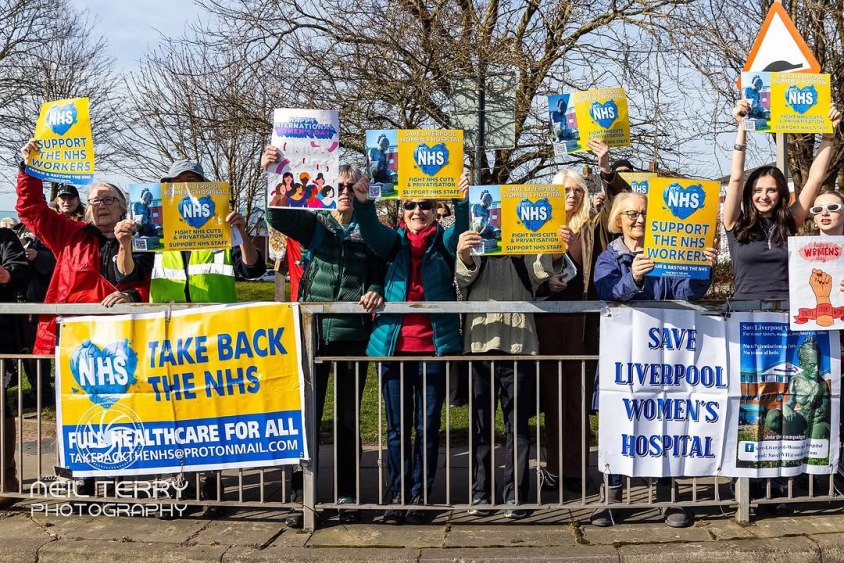
The NHS, as it was founded, is much more than a single-payer system. The government, acting on behalf of all of us, pays for healthcare and provides it through a coordinated and integrated national system of hospitals, general practitioners (GPS), and primary care. Social care was once part of Government provision, but it was privatised under Thatcher.
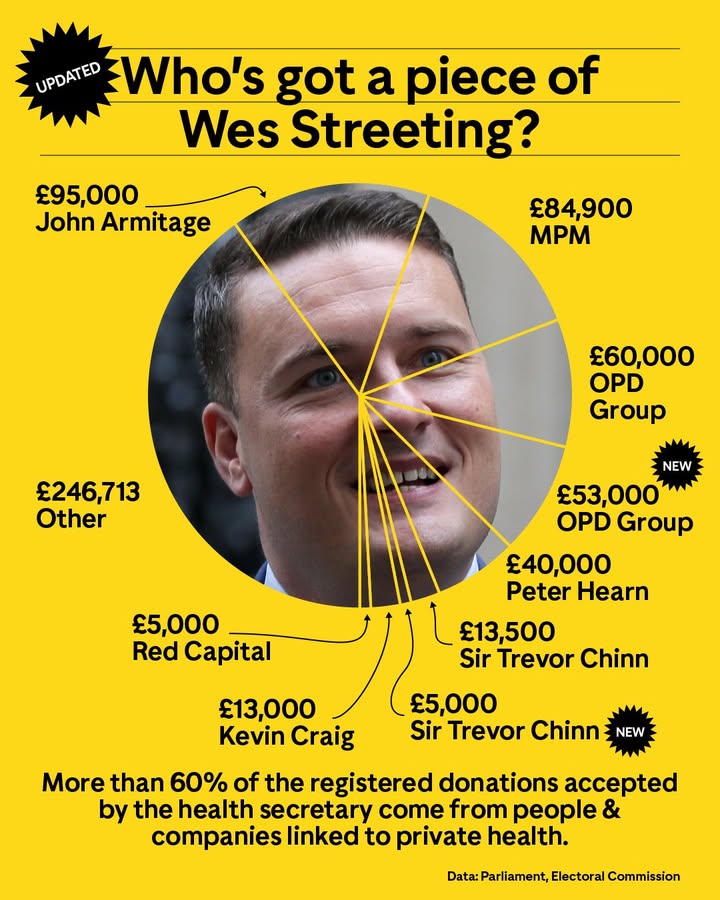
The same huge corporations that have inflicicted this damage on the health and well being of people of the United States, have been invited into the NHS including those who have been penalised in the US for their behaviours.
“Centene began moving into the UK healthcare sector in 2017. In 2020 it acquired Circle Health and later AT Medics becoming the largest private provider of UK GP surgeries.
Corporate Watch uncovered that Centene and its subsidiaries have received at least £970 million in NHS contracts since 2013; £346m of this was part of a £1.57 billion COVID contract issued in 2020.
In the US, Centene is in the top ten companies with the highest penalties for government contract related offences, having paid over $1 billion dollars in fines for filing false claims.
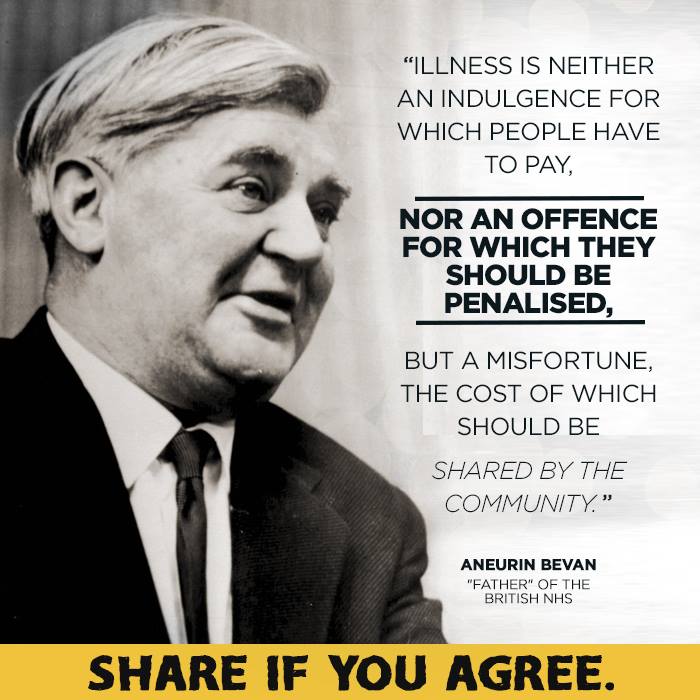
The miners who organised their own health service in some of the mining towns, the women’s organisations like the Cooperative Women’s Guild, and the socialist doctors in the 1930s who fought for health care for women and babies, all built the campaign for the NHS. It was Nye bevan who as the minister in the 1945 Government brought it into being and sustained it in its early years. It is well worth reading Bevan’s own thoughts on this matter reproduced here courtesy of Public Matters.
NHS was founded to provide:
Healthcare for all, free at the point of need (the previous government changed it to be no longer free for migrants).
A comprehensive, well coordinated national service (but the ICB system breaks that up).
Publicly provided, not for profit (Lots of profits are being taken now).
Education and long-term plans for the workforce (well, it did so some time ago, now, workforce issues are chaotic).
National terms and conditions of employment (unless it’s outsourced or in-sourced).
Focus on preventative medicine and public health. Public health has been cut by 26% since 2015/16, yet in this time of climate and environment crises, pandemic and, gross poverty and poor housing we need it more than ever.
Bevan said, “The essence of a satisfactory health service is that the rich and the poor are treated alike, that poverty is not a disability, and wealth is not an advantage.”
This national system has been damaged by recent governments and is still being damaged by the current one. It has been damaged by bringing in huge for-profit corporations and small-scale privatisations, and by massive cuts and underfunding and understaffing. That’s why we are fighting to restore and repair the NHS. The campaigners decades ago succeeded in establishing the NHS. If we build a big enough movement, we can do the same again; no-one else will do it for us.

Defend Our NHS writes”The biggest US health insurance outfit is the notorious United Health of Minneapolis[i]. Simon Stevens, a previous vice-president of this monster (now with a seat in the House of Lords), designed and introduced the destructive ICS changes with the connivance of Jeremy Hunt and without parliamentary approval“
Wes Streeting has made Samantha Jones, (a key member of the American health privatisers’ boss class), the head of the Department of Health and Social Care. Under Streeting, the NHS has told the different Integrated Care Boards to hand over the foundations of our health information to Palantir and Peter Thiel, a Trump “controller“.
We want to restore and repair the NHS on its founding principles. In that form, it was the best in the world. Cuts and austerity have severely damaged the NHS, but it is still better than the US insurance system. We need to go back to Bevan. Our campaigns fight to Restore and Repair the NHS. Please join us.
 Save Liverpool Women's Hospital