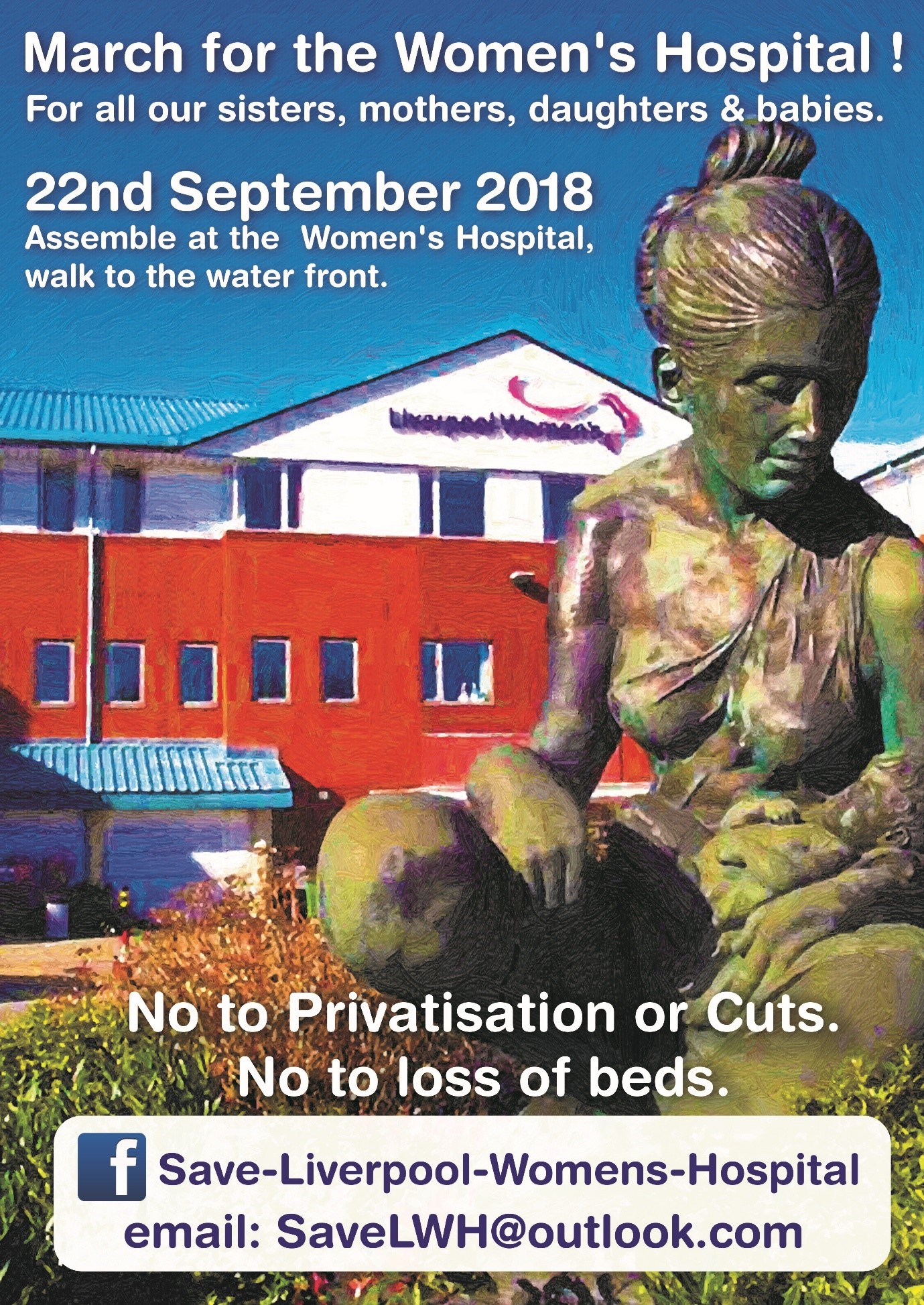
Today, October 9th 2024, the ICB started the legal process that will allow them to close Liverpool Women’s Hospital. The papers for this meeting can be found here. Campaigners opposed the plans. We include videos of some of the contributions in this post.

The document did not discuss the financial situation or alternative provisions, nor did it include an assessment of the benefits of having a stand-alone Women’s Hospital.

After decades of cuts in healthcare and growing crises in women’s health and Maternity, there is naturally great concern about these plans. Similar plans have been put forward before. Seventy-five thousand people have signed our petitions to keep Liverpool Women’s Hospital open, and we have held three large demonstrations over its future.
The campaigners’ key points are:
- Fund Maternity well nationally.
- Respect women, improve the experience of giving birth, and deliver timely gynaecological care.
- Fund the NHS well.
- Listen to the people.
- Act now to avoid the winter crisis, with patients dying because of the long waits.
- Keep Liverpool Women’s on the Crown Street Site and staff it well, with all the specialisms required to improve care and minimise transfers out of LWH. Give it long-term security.
- Improve the intensive care at Liverpool Women’s Hospital.
- Make all hospitals work cooperatively, not as competing organisations.
- Protect the Emergency Departments at Liverpool Women’s Hospital.
- Provide emergency Obstetric and Gynaecological care at the A and E at the Royal and Aintree.
- Nationally, address the workforce training issues that have resulted in shortages of key roles, like anaesthetists.
- Make the NHS a great place to work.
- Act against the racism that damages the health of women and babies health.
- Address the chronic poverty that is so severely affecting our children.
- End privatisation in its many forms.

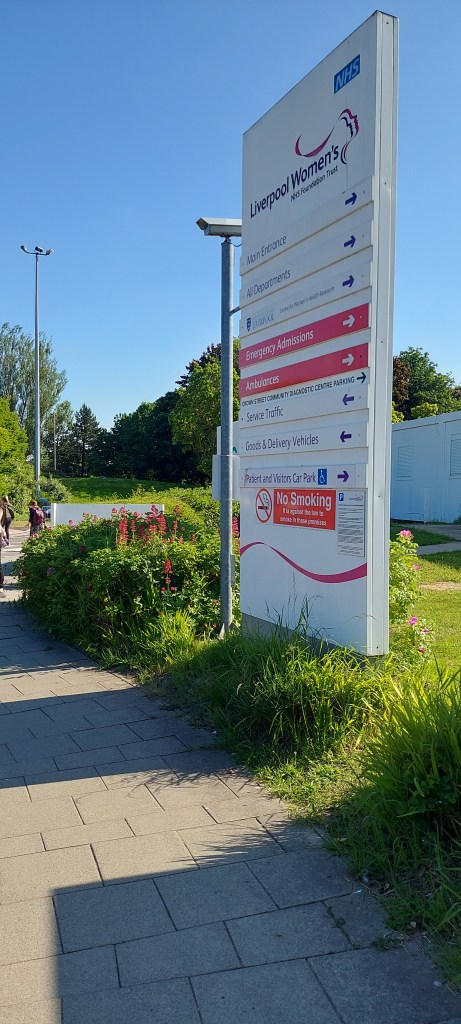
Liverpool Women’s Hospital opened in 1995. It is a modern low-rise hospital on a garden site in good condition. It provides maternity care and gynaecology for most of Liverpool’s women. About seven thousand babies are born there each year. It has a new large neo-natal unit and provides other linked services. It is just over a mile from the Liverpool Royal Hospital site.
The ICB (Integrated Care Board) now runs finance and planning for the Cheshire and Merseyside area of the National Health Service, one of 42 such areas in the country, following the 2024 Health and Care Act. The aim is to bring all health spending for the area into this body and to restrict that spending. This mimics the Accountable Care boards that operate in some US States or cities. In the US, these organisations comprise one big or several small private healthcare corporations providing healthcare for profit. The Government provides funding, and the corporation profits by restricting the service. There has been a revolving door between the leaders of the NHS and the big US health corporations for some time, and there are close links between the governments and those big US health corporations. For details, see here.
This is an American definition of ACOs. “Accountable care organisations (ACOs) are defined as groups of clinicians, hospitals, and other healthcare providers who work together to provide high-quality, coordinated care to a defined population. If an ACO meets quality standards, achieves savings, and meets or exceeds a Minimum Savings Rate, the ACO will share in savings based on the ACO quality score.“
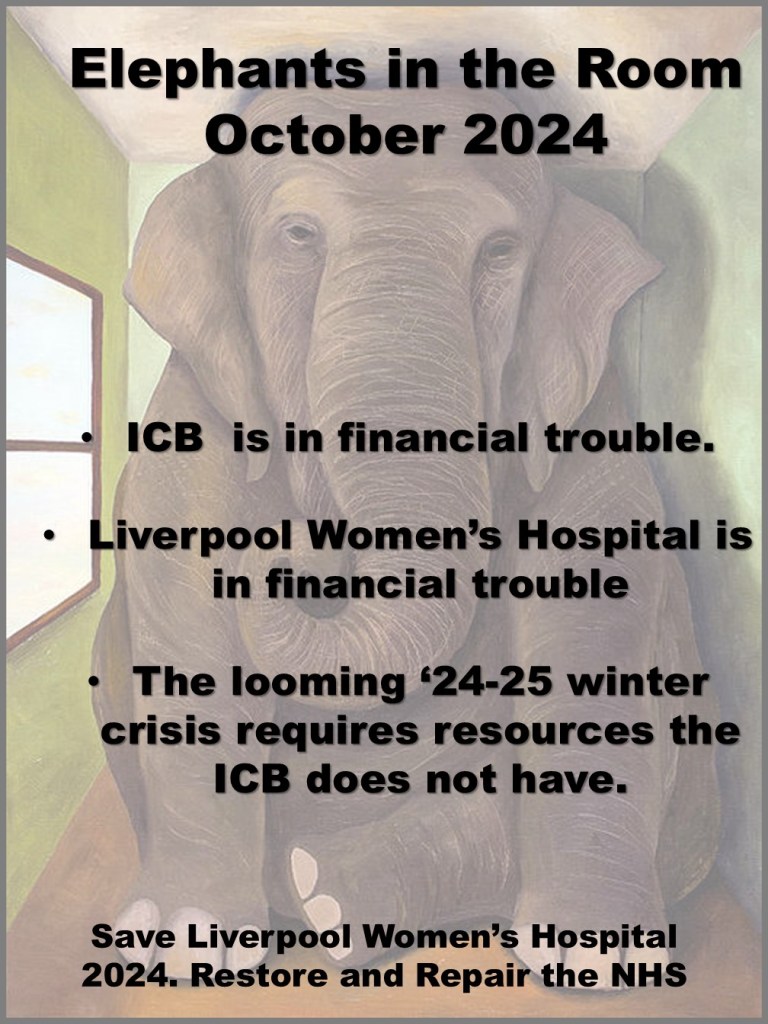
The very grave financial difficulties of the NHS, this ICB, and Liverpool Women’s Hospital were not discussed. It was presented as a purely clinical case – as though such an idea is possible in such a funding crisis for the NHS. The Liverpool Women’s Hospital has been structurally underfunded for many years. The Maternity tariff and Birth rate + are inadequate. This funding problem affects all Maternity units nationally. Still, the impact is starker at Liverpool Women’s because it is such a large Maternity unit and does not share its budget with a general hospital. The Government made up some of the difference until the ICB was formed two years ago, but that has ceased. Many of the very real problems at Liverpool Women’s over the last few years stem from this chronic underfunding.
Today’s meeting will be followed by a public engagement period, during which the public might be allowed to contribute to the discussion.
We believe Maternity is massively underfunded, and that is at the core of the national maternity and birth trauma crisis.
There were no alternative plans put forward as to where our babies will be born or where women’s health care will be delivered.
The core case made was that the most severely ill patients have to be transferred to the Royal, one mile away, and that women with obstetric and Gynaecological issues who present at the big A & E do not have on-site obstetric or gynaecological care available at those big sites.
Protestors reminded the board that the plans to close one hospital in Liverpool date back to 2015 when the then-head of the Clinical Commissioning Group announced them on a panorama programme.
Please sign our online petition.
Please talk about his to your friends family and work mates. Successful campaigns start with conversations.
Please let us know your views.
Please take part in the consultation. Please raise this matter in your union branch if possible.

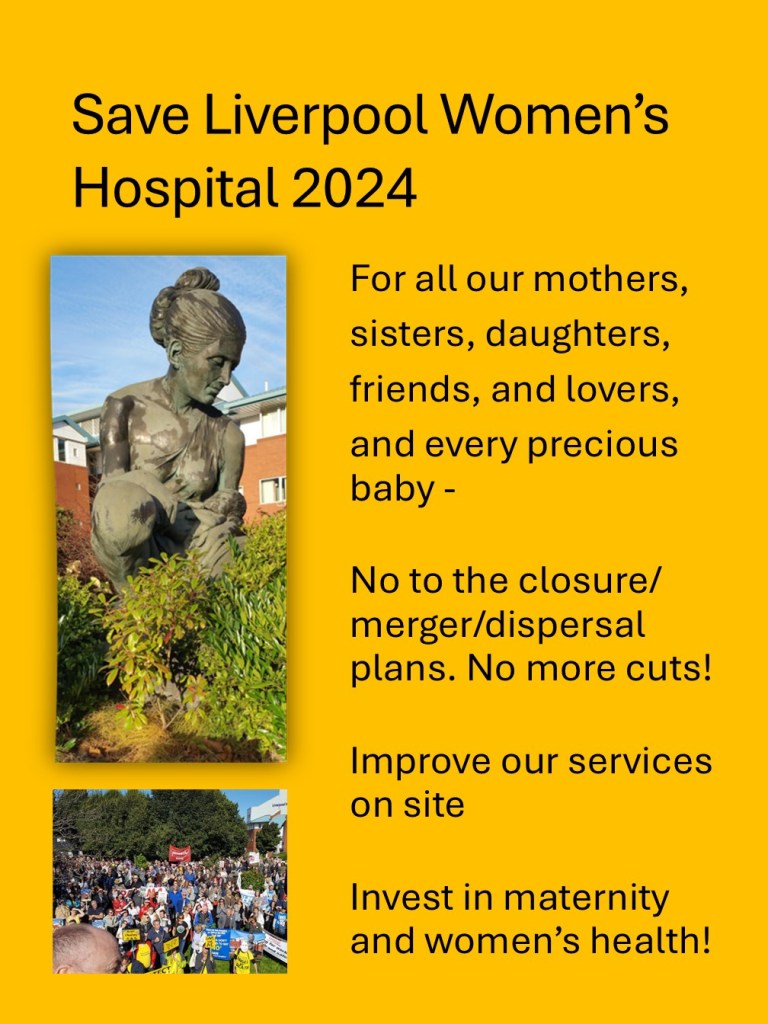
 Save Liverpool Women's Hospital