Why this matters to the staff working at Liverpool Women’s Hospital

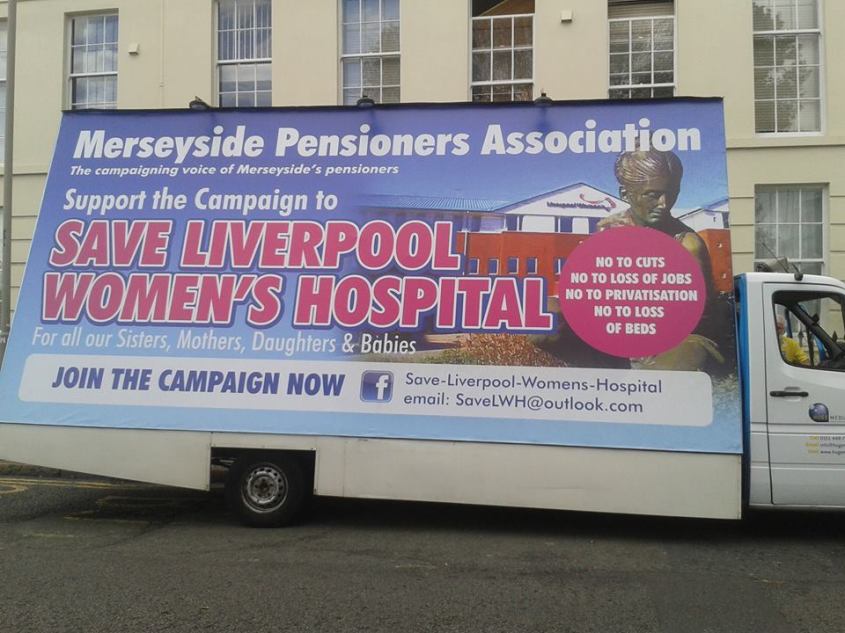
penioners-van
Pensioners including retired Nurses midwives and doctors paid for this poster.

Approximately 1,350 staff work at Liverpool Women’s Hospital.

It is the staff that provide the care that is so overwhelmingly valued in Liverpool. The building is good but the services and ethos have been developed and protected by the staff. This is everyone from receptionist to consultant, midwives to neo-natal nurses, from cleaner to senior admin.

There are national regional and local issues affecting Liverpool Women’s Hospital, including shortages of qualified staff, inadequate funding across the NHS but especially for maternity, and reorganisation in the NHS upon reorganisation, most of it politically driven by those who favour privatisation.

As this is written leaks from the Sustainability and Transformation Plans propose unheard of cuts in provision. Suggestions include the idea of closing Arrow Park, Clatterbridge and the Countess of Chester Hospitals and merging all the Liverpool NHS hospitals. Some  of these suggestions may be kite flying to see what response such suggestions gain. However the intention to reduce spending on the NHS and to facilitate still more for profit providers is absolutely plain

The proposals floated for the Liverpool Women’s Hospital for the hospital are not routine change and developmental change as they have been portrayed.

Staff are trained to look for normal change and to respond to abnormal and dangerous change. This is a dangerous and abnormal change

Nationally there is an acute shortage of midwives, of obstetrician, of pediatric nurses, and junior pediatricians. The age profile of midwives and of midwifery teachers and academics means shortages need urgent attention

“Quality of care was hampered (nationally, not at LWH, our edit) by a shortage of 25% to 30% of middle-grade maternity doctors, those who are halfway between being junior medics and consultants, he said. That had produced “a Rota gap problem nationally” which forced consultants to work extra hours to plug the gaps”. Dr David Richmond, president of the Royal College of obstetrician and Gynecologists (RCOG

https://www.theguardian.com/society/2016/jan/21/dozens-of-maternity-units-should-be-closed-down-says-doctors-chief


Nationally Midwives’ and nurses’ bursaries have been cut and there are cuts to medical educators jobs. Many midwives could not have trained without the bursary. Now  Student midwives will be PAYING the hospital to allow them to work .

The background is one of intensely hard conditions of work with nurses, doctors, midwives and related professions. all working under huge pressure throughout the NHS.

An NHS staff survey reveals that 50% of midwives in England suffered work-related stress during 2015. “. are shocking but not surprising, midwives, day in day out, face enormous pressure due to understaffing and an increased birth rate.” RCM https://www.midirs.org/about-midirs/

Cuts to funding for staffing

The back ground is also plans for major cuts in funds for staffing

“Hospitals are being told to shed staff to rescue the NHS from an acute funding crisis, leaving nurses and other front line medical workers at risk of the sack.

“NHS regulators have taken the controversial decision despite intense concern among hospital bosses and health unions that reducing staff will hit quality of care, patient safety and staff morale, while increasing waiting times.

Monitor and the NHS Trust Development Authority (TDA) have issued the instruction to reduce staffing almost three years after ministers ordered hospitals to do the opposite. They responded to the official report into the Mid Staffs care scandal by saying staffing levels must be increased in order to improve the standard of care…”

“NHS staffing levels must be cut if finances in the health service in England are to be controlled, a leading think tank has warned” https://www.politicshome.com/news/uk/health-and-care/nhs/news/77174/nhs-staff-levels-must-be-cut-control-spending-health

https://www.hsj.co.uk/topics/finance-and-efficiency/nhs-england-reveals-breakdown-of-22bn-savings-plan/7004629.article


The background is privatisation. Privatisation sheds all the safeguards we have come to expect in the NHS. Merseyside has been something of a pioneer in privatisations

  • Privatisation is a threat to national conditions of service, to rates of pay and to the right of access to training
  • Some private companies, who have dreadful records in other services, are granted contracts from the NHS
  • Virgin as one of the companies involved in privatisation has an active legal section which enforces its position against local Clinical Commissioning Group decisions.
  • Monitor has told seriously overspent trusts to ‘reduce their headcount’.
  • Within the Liverpool Women’s Hospital many services have been outsourced to for profit contractors who work in the building, mainly doing ancillary work.
  • There is more on privatisation in other parts of this document
  • Liverpool Women’s Hospital received a poor score on the staff trust in management to listen and act upon their concerns
  • Liverpool Women’s hospital is a resource we cannot afford to lose.

This attempted closure of the Women’s hospital is but one part of a very disturbing whole.

We will publish more on the Sustainability and Transformation Plans


History of the Liverpool Women’s Hospital

History of Liverpool Women’s Hospital

The Hospital site was opened 20 years ago, merging three maternity hospitals and the old Women’s Hospital, marking a sea change in provision.
It was built as part of Project Rosemary, to help heal the injustices which lead to the riots in Liverpool.
There have been problems in the past, but it is a world class hospital, with excellent outcomes for women and babies.

It was named one of the best hospitals in the country in an inpatient survey run by regulators the CQC (Care Quality Commission). It meets or exceeds all the standards required of it in patient care.
It is formally classified as “good” and “safe”
Since it was opened Liverpool’s infant mortality has improved. Many babies have survived because of it. It has an above average score for preventing baby deaths
There has been a women’s hospital in Liverpool since 1796 – though then it was only for ‘respectable’ women. It became open to all women in 1841.
Women in Liverpool campaigned for baby clinics, for free maternity care and more throughout the first half of the 20th century. There is record of this in the Women’s Cooperative Guild’s publications and in the in the oral history of Liverpool families.

Child birth then was a real risk.“In the 19th and first half of the 20th century, everybody knew about death in childbirth, particularly those women who were about to go through the process. … Death in relation to childbirth was mostly in fit young women who had been quite well before becoming pregnant. They died, often leaving the baby, and other children in the family from previous births, with a widowed husband. It is only recently that the Church of England prayer book removed the service for the ‘churching of women who had recently given birth’ which starts by giving thanks to God for: ‘The safe deliverance and preservation from the great dangers of childbirth.’
“The Four Horsemen of Death’ in maternal mortality were puerperal pyrexia, haemorrhage, convulsions and illegal abortion. They still are—in various proportions—major killers in most of the world, although their effects are greatly reduced in the UK now.” http://www.ncbi.nlm.nih.gov/pmc/articles/PMC1633559/

In the graph below we can see how child birth became much safer after the introduction of the NHS in the UK on July 5, 1948. Improved hygiene and greater medical knowledge also helped reduce the numbers of mothers and babies dying, but in countries where universal health care like the NHS has not been provided, the improvement has not been as great. The NHS brought free access to world class care to even the poorest mothers and a wonderful bank of experience has been developed and researched, making childbirth far safer.

Shamefully the UK is now 23rd in the world for the number of women dying in childbirth, with less than one percent improvement between 1990-2008. 8.2 women per hundred thousand die in childbirth compared to 3 per hundred thousand in Italy. Ireland is better than UK However the United States whose health care this government appears to admire has a death rate of 16.7 maternal deaths per 1000 thousand live births
https://www.theguardian.com/news/datablog/2010/apr/12/maternal-mortality-rates-millennium-development-goals

Services provided by Liverpool Women’s Hospital

Liverpool Women’s Hospital caters for in excess of 60,000 patients a year

Last year Liverpool Women’s hospital

  1. Provided Ante- Natalcare to 9,926 women,
  2. Delivered 8,648 babies
  3. Provided post-natal care to 8221 women
  4. Cared for 1,091 babies in the neo natal unit
  5. Provided fertility treatment to 2, 247 couples
  6. Assessed and treated 12,191 women in the Emergency Room
  7. Provided 70,789 gynaecology appointments of which 7,625 were for cancer
  8. Undertook 9479 different types of gynaecology procedures of which 917 were for cancer
  9. Provided 3,399 outpatient appointments for individuals with genetic conditions
  10. It is the major provider of abortion services in Merseyside.
  11. About 9,000 men also had appointments at the Liverpool Women’s hospital.

Some children are treated through the genetics programme

Liverpool Women’s hospital is the largest maternity Hospital in Europe. It provides maternity, care in multiple births, care for older mothers, care for young and teenage mums, care for pregnant women with health issues, mental health support, assistance and research in fertility.

It provides regional Neo-Natal care, Gynaecology, Genetics, support for bereavement, end of life support, an emergency room for gynaecology and early pregnancy and more.

It is the main provider of termination services in the area.

Women are transferred to Liverpool Women’s Hospital from other hospitals, in Merseyside and beyond.More women are transferred there than are transferred away from Liverpool Women’s hospital

It is a modern building on a landscaped site.

It provides a service for all the women of the area young and old. It is loved and respected. It is perceived as, and has been formally assessed as both “safe” and “good”.

Liverpool Women’s Hospital is a respectful place for women and babies.It is valued because women feel safe and respected in the hospital, and because it has a good record on safety for women and the babies.

 The Buildings and Site of Liverpool Women’s Hospital, and why they matter.

entrance


The Liverpool Women’s Hospital building is owned by the Trust. It is an attractive, valuable and useful building and, crucially, not an expensive PFI building. The site of the Liverpool Women’s Hospital is on a long lease, we believe from the city and the cathedral.

It a good site, with restful landscaping, far, far better than a high rise block in the middle of a major traffic system.

We are not being sentimental in praising its grounds. According to a study in the journal Science 1984 April 27;224(4647)420-1 View Through a Window may influence Recovery from Surgery Ulrich RS;

“All other things being equal, patients with bedside windows looking out on leafy trees healed, on average, a day faster, needed significantly less pain medication and had fewer postsurgical complications than patients who instead saw a brick wall.”

“Trees and bushes are good for physical and mental health. A large beech tree can provide enough oxygen for the daily requirements of ten people, and catches dust and pollutants on its leaves. Trees have a positive impact on the incidence of asthma, skin cancer and stress-related illness by filtering out polluted air; they also reduce smog formation and shade out solar radiation.” (According to Trees for cities)

And

Records on recovery after cholecystectomy of patients in a suburban Pennsylvania hospital between 1972 and 1981 were examined to determine whether assignment to a room with a window view of a natural setting might have restorative influences. Twenty-three surgical patients assigned to rooms with windows looking out on a natural scene had shorter postoperative hospital stays, received fewer negative evaluative comments in nurses’ notes, and took fewer potent analgesics than 23 matched patients in similar rooms with windows facing a brick building wall.

Similar studies can be found here http://conferences.ncl.ac.uk/unescolandscapes/files/HICKMANClare.pdf

https://drclarehickman.wordpress.com/hospital_gardens/

A set of rooms in a high rise block does not match the health benefits of Liverpool Women’s hospital site.

A high rise block with all the traffic and pollution that currently surrounds the area around the new Liverpool Royal site is bad enough, but   moving the Liverpool Women’s Hospital there will add 60,000 extra patients, increasing traffic significantly and increasing the pollutants caused by traffic.

The area has the heavy but relatively free flowing traffic on Low Hill and the often standing traffic on Prescott Street, featuring the busses coming to the hospital and on into town. Busses also use Pembroke Place and West Derby Place.  Air quality and traffic based pollution are significant problems. We need an environmental impact assessment.

WE quote below Liverpool studies of the damage to babies from traffic pollution. The new Royal, the site proposed in some discussions for the Maternity service is in one of Liverpool traffic hot spots.

Babies and children are vulnerable to traffic pollution

” The intrauterine, perinatal and early childhood periods, during which the lungs are developing and maturing, are very vulnerable times. These are periods when the lungs are susceptible to injury by air pollutants.

There is now substantial evidence on the adverse effects of air pollution on different pregnancy outcomes and infant health. The evidence shows that air pollution, with concentrations typical of many European cities, increases the risk of death from respiratory causes in the post neonatal period.

The evidence also shows a relationship between exposure to ambient air pollutants and adverse effects on the development of lung function. Reversible lung function deficits, chronically reduced lung growth rates and lower lung function levels are associated with exposure to air pollution. Moreover, the evidence shows clearer relationships for particulate matter and traffic-related air pollution (indicated by nitrogen dioxide) than for other pollutants. Based on current knowledge, air pollutants seem to interact with other environmental factors, such as allergens, viruses and diet, that influence the overall impact of air pollutants on children’s health

http://www.euro.who.int/en/data-and-evidence/evidence-informed-policy-making/publications/hen-summaries-of-network-members-reports/what-are-the-effects-of-air-pollution-on-childrens-health-and-development


Air quality is recognised as the UK’s second biggest public health concern after smoking, with the Environmental Audit Commission estimating it annually costs the nation £20bn and can cut life expectancy by years (Henderson, 2012). A Defra briefing paper summarised the health impacts of poor air quality in the UK as follows:

 The burden of particulate air pollution in the UK in 2008 was estimated to be equivalent to nearly 29,000 deaths at typical ages and an associated loss of population life of 340,000 life years lost.

  It has been estimated that removing all fine particulate air pollution would have a bigger impact on life expectancy in England and Wales than eliminating passive smoking or road traffic accidents.  The economic cost from the impacts of air pollution in the UK is estimated at £9-19 billion every year. This is comparable to the economic cost of obesity (over £10 billion)

Local interventions to tackle outdoor air pollution  with demonstrable impacts on health and health service use. LPHO Report Series, number 101 Rapid Evidence Review Series, number 4 Produced on behalf of the Merseyside Directors of Public Health

January 2015


Why we need a women’s hospital.


Why a Women’s Hospital?

Why do we want a women’s hospital?

We need a Women’s Hospital. Ours is one of only two in the country; it is not perfect but it is much needed. There are important medical and surgical differences between men and women. We have different life events, different illnesses, some different cancers, different symptoms for heart attacks, and we respond differently to some medicines. Women live longer than men, but have more illness in later life. Women’s role in reproduction means that we are subject to different physical and mental illnesses than men.

Women and children bear the brunt of poverty and ‘austerity’.

Every other field of medicine has specialist hospitals – in fact, the current ‘fashion’ is for specialist hospitals. Each of the Liverpool Hospitals is specialising, so why can we not keep our Women’s Hospital? Just as the other hospitals send women to LWH, LWH will need to liaise with other hospitals. We need integrated care  not the large scale privatising mechanism   used  in 2019 as euphamism  for cuts and rationing), but real integrated care for the individual. We need the focus and research a specialist hospital produces; research which is then fed back into all hospitals. The care of women is a valid sphere of medicine and surgery.

For matters that are specific and personal to women, we need to feel safe and respected. The over sexualisation of bodies, especially breasts, and the evident disrespect for breast feeding women, makes women uncomfortable, which then undermines the health of the infant.

Even naming body parts is still awkward for many women.

Violence against women means that one in four women have experienced male. violence. The nature of the women’s hospital makes women not only feel safer but to actually be safer from male aggression.

Pregnancy is one of the known danger points for male domestic violence.

Giving birth or having gynaecological procedures can trigger trauma beyond the physical.

women's rightsSafeguarding vulnerable women, let alone babies, in a big city centre acute hospital will be very difficult.

A 15-year-old pregnant girl might walk into the Liverpool Women’s with confidence; Would she feel the same walking into a giant acute hospital?

Fertility issues, pregnancy, birth, post-natal experience and motherhood can all impact on women’s mental health.

 A safe place to recover and to ask for help is essential. Relationships built up with midwives, health visitors, doctors and nurses are essential for our physical and mental health and recovery from stressful and traumatic events.

If patients are not confident in the staff and in the environment in which they are being treated, this will affect the outcomes of their treatment.

Care, respect and kindness are great healers. They provide the environment in which good medicine and surgery can thrive.

Beauty and nurture are needed by all creatures; but in our warped society they are predominantly seen as ‘women’s’ virtues and often disrespected.

Most carers, but not all, are women. Women, who have been carers for all their adult lives, clearly respond with recognition and relief when they, as older patients, come into the Women’s Hospital. This culture could be extended from the Women’s to other hospitals, but we need this hospital as the seed bed. We want ‘bread and roses too’.

A women’s space is rare. A well-funded, well-staffed and well cared for women’s space is rarer still. We have such a space, to some extent, in the Liverpool Women’s Hospital.

Women and babies matter. In this time of Austerity, human rights and life are being discarded and ignored.

For all the women, all the mothers, all the babies, and all the men who love them, we demand that Liverpool Women’s Hospital is saved.

The future of the hospital as a whole is also important for the men who are treated at Liverpool Women’s Hospital in genetics, for some cancers, and for transgender issues.

20151204_094617This is a women’s issue for staff too. The women’s hospital employs many female professionals and ancillary workers. (We are grateful too for the work of many males in the hospital). The problems facing women are also faced by the staff. The hospital needs to recruit and retain more staff. We know the new Junior Doctors’ contract is discriminatory against women.

Save Liverpool Women’s Hospital

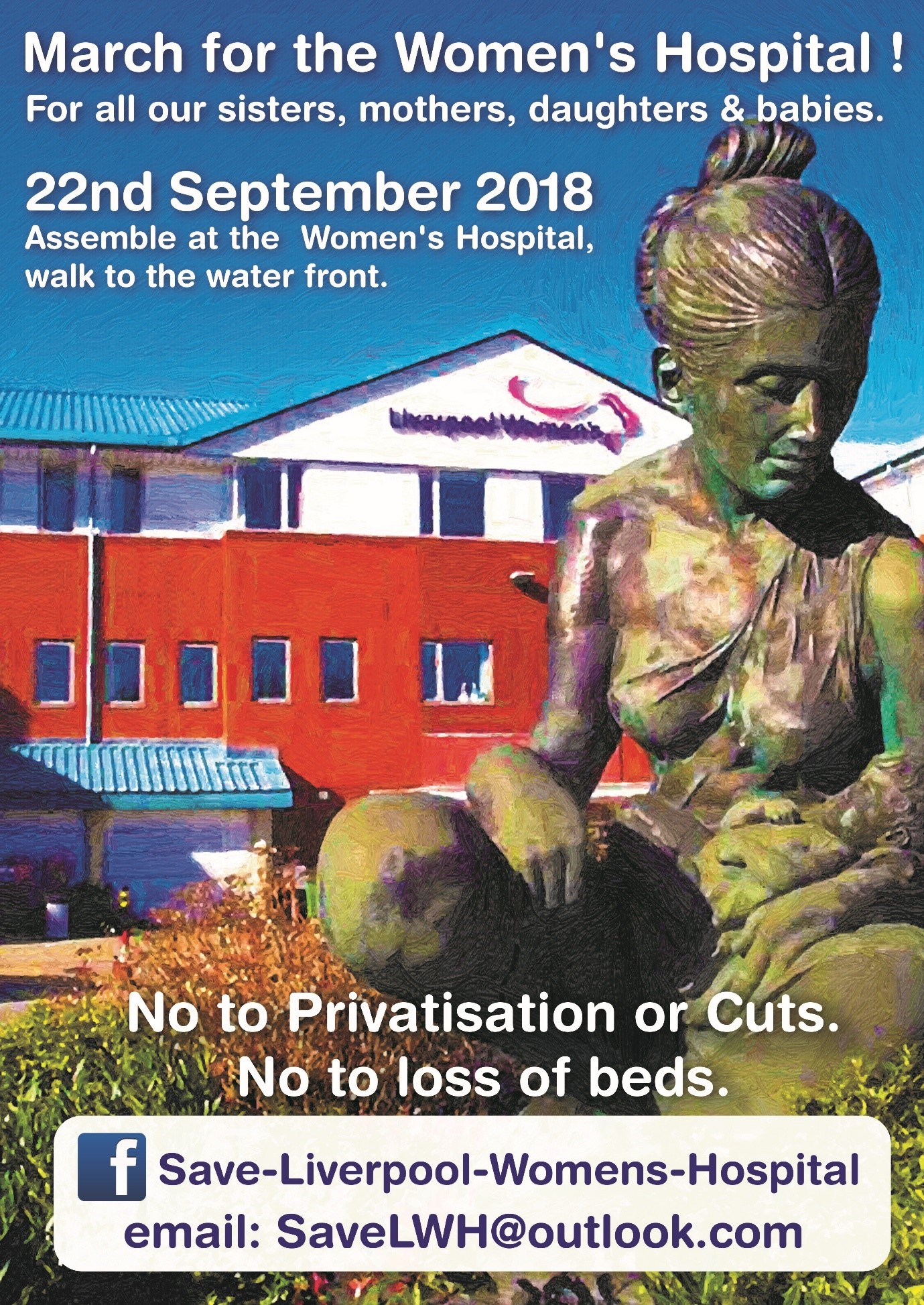
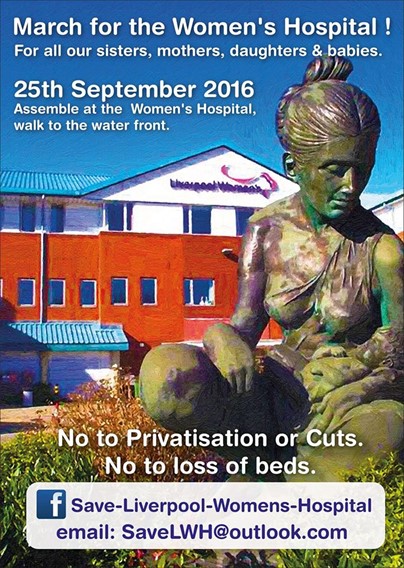
march poster

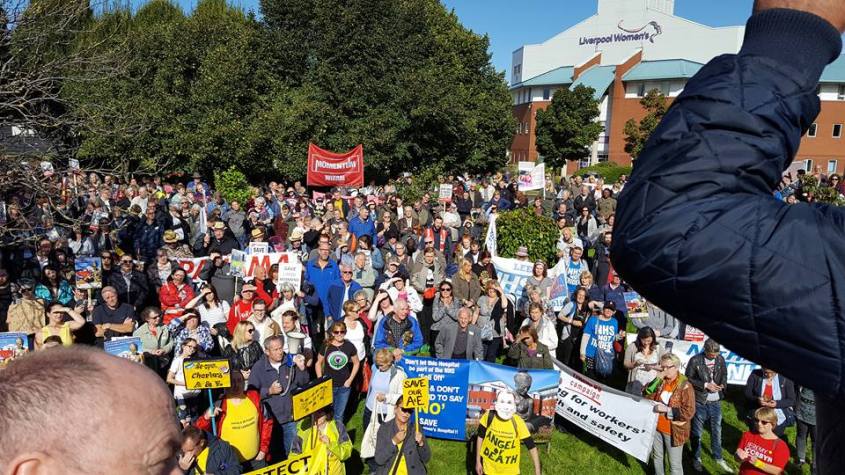
This blog is written by the Save Liverpool Women’s Hospital Campaign, from the standpoint of users of the hospital, past and present, although there are doctors, nurses and midwives helping us.

Some campaigners have previously been involved in different aspects of women’s rights and patient rights, but all are lay people. Mostly, we are current or past users of the hospital. It is based on the experiences shared with us by the tens of thousands who have signed Save Liverpool Women’s Hospital petitions, and of their family and friends. We have been overwhelmed by the support we have found amongst the people of Merseyside, women and men, young and old, for this campaign.

We are very aware that the Hospital is not perfect but it is very much needed.

Our grandmothers and great grandmothers, our grandfathers and great grandfathers struggled to build the NHS. It was far from easy. Plenty of people told them it was impossible, unaffordable and unworkable. They achieved it despite the gloom merchants.

Our hospital and the NHS are worth fighting for. They are affordable – this is one of the wealthiest countries on planet Earth.

There are many struggles, like ours, to defend parts of the NHS, all across the country. It’s not going to be easy to win this campaign. We need your help.

This is for all our sisters, mothers, daughters, lovers, friends and for the babies of Liverpool Merseyside and beyond. Nothing is more worthwhile.

Why we want to save the Liverpool Women’s Hospital

This  website  is written by the Save Liverpool Women’s Hospital Campaign, from the standpoint of users of the hospital, past and present, although there are doctors, nurses and midwives helping us.

Some campaigners have previously been involved in different aspects of women’s rights and patient rights, but all are lay people. Mostly, we are current or past users of the hospital. It is based on the experiences shared with us by the tens of thousands who have signed Save Liverpool Women’s Hospital petitions, and of their family and friends. We have been overwhelmed by the support we have found amongst the people of Merseyside, women and men, young and old, for this campaign.

We are very aware that the Hospital is not perfect but it is very much needed.

Our grandmothers and great grandmothers, our grandfathers and great grandfathers struggled to build the NHS. It was far from easy. Plenty of people told them it was impossible, unaffordable and unworkable. They achieved it despite the gloom merchants.

Our hospital and the NHS are worth fighting for. They are affordable – this is one of the wealthiest countries on planet Earth.

There are many struggles, like ours, to defend parts of the NHS, all across the country. It’s not going to be easy to win this campaign. We need your help.

20151204_094617This is for all our sisters, mothers, daughters, lovers, friends and for the babies of Liverpool Merseyside and beyond. Nothing is more worthwhile.

Save Liverpool Women’s Hospital

annettes-picture-of-new-mum

This blog is a collection of articles that the campaign has written to explore the many reasons to save Liverpool Women’s hospital and ro explore the background to the suggestion of fundamentally changing a hugely successful hospital. We welcome contributions to the discussions. We welcome contributions from hospital users, from parents, from staff, from other campaigns and from anyone who has information  to add to what we know.

This campaign needs all the support it can get from the people of Merseyside

We launched our campaign on the 25th September 2016 with a march through Liverpool to Labour’s conference to ask for support to keep our Hospital and to save the NHS. Read our posts to give you a clear picture of all the issues involved. This is the time to resist. Too much damage has been done already.For all out mothers, sisters, daughters, friends and lovers and for the babies help save Liverpool Women’s Hospital.