This article is a work in progress and is being amended and added to as events progress
25 October 2025, update.
The report on the future of Liverpool Women’s Hospital (Women’s Hospital Services in Liverpool programme) has been postponed again; this is their statement:
Save Liverpool Women’s Hospital
“To support options development, work to understand what each potential option would mean for estates (buildings), finance and workforce (staffing) has been taking place. This has been a complex process, and the level of detail required has meant that it has taken slightly longer to finish than had originally been planned. This means that the Women’s Services Committee will now consider the outputs of the work on potential options in November 2025 rather than October 2025. Following this, the Board of NHS Cheshire and Merseyside will discuss the potential options, and next steps, at a private meeting, which will also take place in November 2025.
The intention is that following the Board meeting, from December 2025 onwards, discussions will be held with partners, including local NHS trust boards and local authorities, about how the programme moves forward. At this point, if required, planning would also begin for an external review by clinicians from a different part of the country.
It is therefore likely that we will publish a further update about the programme during the first half of 2026. We know that many members of the public, NHS staff and wider stakeholders have a strong interest in women’s hospital services in Liverpool, and are keen to understand what will happen next. “
Our response
The “Women’s Hospital Services in Liverpool programme” is a working party of the Cheshire and Merseyside Integrated Care Board, the governing body of the NHS in Cheshire and Merseyside.
Liverpool Women’s Hospital’s future remains under threat, despite being one of the best buildings in the country and having an excellent reputation. The “options” mentioned in this statement have not been published.
This is at a time of enormous public concern about the state of Maternity services nationally, when we have yet another national report on Maternity scandals, plus police enquiries into deaths at two trusts. There have, of course, been many other detailed and complex enquiries whose recommendations were not implemented by the last government and are not being implemented by this government. It is no surprise, therefore, that campaign groups are forming across the country. For a decade, the future of Liverpool Women’s Hospital has been uncertain, with all the anxiety that has brought for pregnant women and families, for women needing gynaecology care, fetility care, for parents with babies in the Neonatal unit, and all the other services, for staff, both current staff and those who might have wanted to work at Liverpool Women’s but needed a secure future to commit to a move, and of course, the public vocifeously wanted to know that the hospital would be safe.
Liverpool Women’s Hospital’s future is under threat, despite the urgent need to retain and improve it, despite good work having been done in the last year to enhance its resources and services. Even before the Integrated Care Board was invented, plans to close it were underway. It was one of the first items on the ICB agenda when it opened.
Staff at Liverpool Women’s Hospital have worked so hard against the odds. The difficulties caused by privatisation, austerity, cuts, understaffing, and the disorganisation of the NHS over the last decade have been immense. Lord Darzi, in a report commissioned early in this government, described the 2012 Health and Care Act as “calamity without international precedent”. We say that the 2022 Act made things worse. The business model still pursued by this government has been a disaster for Maternity care nationwide.
Professor Marian Knight, Director of the National Perinatal Epidemiology Unit and MBRRACE-UK maternal reporting lead, said: ‘These data show that the UK maternal death rate has returned to levels that we have not seen for the past 20 years.“
Liverpool Women’s Hospital has retained an excellent reputation. It is a much-loved, much-needed hospital that provides for the birth of approximately eight thousand babies a year and more than ten thousand gynaecology procedures. It is a maternal medicine centre and a tertiary hospital.
The future of Liverpool Women’s Hospital was one of the first issues raised by the Integrated Care Board (ICB), the governing body of the NHS in Cheshire and Merseyside, when it was established in 2022. We believed then and still believe that finances are at the root of the plans to move, merge, or close Liverpool Women’s Hospital.
The Women’s Hospital Services in Liverpool Committee says that their process includes ”October to November 2025: Discussions with partners, including local NHS trust boards and local authorities, about the draft business case”
Annexe A to the reports fromLiverpool Women’s Hospital Prevention and
Equity Population Profile 2023-24 Date: 4 April 2025
(Author: Dr Clare Baker, Public Health Registrar) says, “There is a significant difference between demographics and experiences common among senior decision-makers and common among our patients” In other words, the people making the decisions do not live the same lives as the patients, yet they will not consult with the public before drawing up their plans.
(We have been challenged for the source of this quotation. It can be found on page 151 of the PDF for the cm-icb-board 240725-agenda and papers.)
Our campaign has significantly less access to information about what is happening at Liverpool Women’s Hospital since the semi-merger with the other hospitals in Liverpool, forming the University Hospitals of Liverpool group. Previously, some of our campaigners were able to attend the board meetings in person, read the public board meeting papers, hear the patient stories presented at each meeting, and ask questions. We could follow in detail issues such as infant and maternal mortality, staffing levels in Maternity and Gynaecology, and the hospital’s financial situation. We could, at times, bring home the reality for mothers and families. There was once a report on how they intended to spread the service across the city to clinics in “pram pushing” distance. When we saw the maps, we burst out laughing. Knowing the city, we assured the board that it would take some Olympic-level athletes to cover those distances! The relationships at those board meetings were generally friendly. Now, all we are allowed to do is attend the meeting of the combined group covering the Royal, Aintree, Boardbgreen, and the Women’s. This is soon to be expanded to include specialist hospitals. Such a meeting focuses primarily on finance and staffing issues. There is no midwife or obstetrician on that board.
We will refer to all papers from the Integrated Care Board (the governing body of the NHS in Cheshire and Merseyside) since its founding in 2022. What follows is from the papers for the first meeting of Cheshire and Merseyside ICB, pages 6 -9
“JGR noted that the clinical case for change is strong but felt that the public perception is that this is linked to the need to make cost savings. JGR asked what steps will be taken to counteract this view. FLE confirmed that there is a financial driver in that Liverpool Women’s Trust have been in a deficit position for some time and they are not in a position to rectify this. FLE highlighted that this is not the primary reason but agreed that there is a need for a careful public engagement process before it goes out to consultation” There is more discussion in these papers including saying tht Ormskirk maternity is also not co-located with a general hospital.
Had the time, energy, and resources wasted on this cost-cutting drive been devoted to improving services at Liverpool Women’s Hospital, we would have seen the day-to-day experiences of patients and staff significantly improved.
Throughout the ICB papers, it has been made clear that there is no likelihood of the capital (money) for rebuilding Liverpool Women’s on the Royal site, yet this rumour persists. It is, of course, within the power of the government, at the stroke of a pen, to create the resources needed for a rebuild or to adequately fund the hospital on Crown Street. Still, it seems highly unlikely that such a policy change will occur. If it were to happen, we would still say that the Liverpool Women’s Hospital should remain on Crown Street, as a women’s hospital, albeit with improvements. Of course, we also call for close collaboration on necessary medical matters with other hospitals. It was the damaging 2012 Health and Care Act, described by Lord Dazi in his report to the new Government as a “Calamity without precedent“, that made hospitals compete rather than cooperate
Why we say Liverpool Women’s Hospital should stay at Crown Street
- It is a much-needed hospital. The experience of other Maternity hospitals closing and merging has not been successful; Maternity standards nationally have deteriorated.
- Women’s needs have been neglected in the NHS for more than ten years. The creation of huge general hospitals has not helped.
- Other Maternity hospitals are in a dire situation and need financial infrastructure support much more than Liverpool Women’s does. Please see this heartbreaking report.”There is a clear link between the condition of service infrastructure, the experience of service users and staff, and safety. In the last 3 years, there have been 14,519 formally reported instances in the Maternity and neonatal estate where clinical services have been interrupted or service delivery has been impacted as a direct result of poor physical conditions. Significant clinical time has been lost to estate-related issues, such as power outages, water leaks and faulty nurse call systems. This puts additional pressure on already stretched staff to provide high-quality and safe care and can directly lead to procedures delays, such as planned caesarean sections.“
- The green site at Crown Street is a positive benefit to mothers in difficult times. The physical environment helps birth.
- The Royal is located in one of the most densely trafficked areas in the city, with a 6-lane road running adjacent to it. This would be dangerous for babies’ lungs.
The argument that Maternity would be safer on the same site as the acute hospital is not borne out by the scandals in Maternity care in large hospitals. We cite Leeds Teaching Hospital as an example, but we support campaigners and staff in Leeds who are working to improve the situation. Current financing of Maternity care makes it difficult to provide safe care.
This is a national emergency. The government has called yet another Maternity Enquiry and is conducting a deep dive into 14 Maternity hospitals. Liverpool Women’s Hospital is not on that list. Yet another enquiry will not solve this. A serious consultation with mothers, families, staff, especially midwives, and concerned members of the public is required for all our mothers, sisters, daughters, friends, and loved ones, as well as every baby.
( For the list of other Maternity enquiries, see this.)
Baroness Amos is chairing the enquiry. The baroness, whilst having much government and academic experience, is not an expert in Maternity. It will be very challenging for her to reach a conclusion about important Maternity issues in a matter of weeks. Some bereaved parent groups have welcomed her appointment, others say this method of enquiry tries to place the blame on the Hospitals when it’s the system that’s caused the terrible problems.
We object to the government commissioning yet another enquiry when the recommendations of other detailed enquiries have not been financed or implemented. We agree with the parents’ groups that the investigation should cover the wider service, not just the hospitals, but also the NHS central organisation.
Liverpool Women’s Hospital is not in this list of hospitals to be investigated. Had the doom talk of the engagement meetings, organised by the ICB, been believed, it surely would have been.
Maternity outcomes have worsened in the years when Maternity hospitals and units have been closed or merged into the acute hospitals.”Professor Marian Knight, Director of the National Perinatal Epidemiology Unit and MBRRACE-UK maternal reporting lead, said: ‘These data show that the UK maternal death rate has returned to levels that we have not seen for the past 20 years. The 2023 MBRRACE-UK maternal confidential enquiry report identified clear examples of maternity systems under pressure and this increase in maternal mortality raises further concern. Ensuring pre-pregnancy health, including tackling conditions such as overweight and obesity, as well as critical actions to work towards more inclusive and personalised care, need to be prioritised as a matter of urgency now more than ever.“
Liverpool Women’s Hospital provides more than Maternity care. The CQC report says, “The Liverpool Women’s NHS Foundation Trust gynaecology division is a tertiary referral centre for gynaecology, performing approximately 10,000 procedures per year.”
Most Gynaecology services in most of the country are provided in general hospitals, and this has not alleviated the disproportionate waiting times for gynaecology treatment. Misogyny runs deep as this report from the London School of Economics shows. The resources have not been invested in the service for over a decade.
In 2022, the Royal College of Obstetricians and Gynaecologists described the service as “a speciality which had been disproportionately impacted by a lack of capacity in the NHS long before the start of the COVID-19 pandemic”
In our area, gynaecology has the longest wait for any speciality. Nationally, for people of working age, the waiting lists for gynaecology are the largest.
Include the Public. Plans for the future of Liverpool Women’s Hospital are being drawn up, but without public input. The committee drawing up the plans says it will present its plans to a private meeting of the ICB (the governing body of the NHS in Cheshire and Merseyside) in November. Once all the planning is complete, they will conduct a public consultation. Yet, the real lives of patients are not the same as those of the people drawing up the plans. Their own papers say this. Our campaign has written to request inclusion in these discussions, but we have been refused. Previously, the ICB said we would be included.”The principle of Section 242 is that, by law, NHS Commissioners and Trusts must ensure that patients and / or the public are involved in certain decisions that affect the planning and delivery of NHS services
The threats to the future of Liverpool Women’s Hospital are continuing despite
- The improvements in infrastructure and safety made at he hospital in recent years
- The national Maternity crisis
- The national problems ( and associated pain and suffering) with the Gynaecology waiting lists for treatment, and neglect of this service nationally.
- Liverpool’s well-publicised issues with declining health among women (State of Health in the City: Liverpool 2040) and the hospital’s excellent reputation.
- The distortion of NHS structures to suit the many facets of privatisation brought in by the 2012 and 2022 Health and Care Acts,
- This government is increasing privatisation and bringing back advisers who led up to the 2012 Act and who are linked to the hated American health corporations.
- The government is entrusting our most intimate data to companies like Palantir.
- The decline in women’s health over the years of austerity.
More than 80,000 people have signed our petition, combining an online and a paper petition. We have held public meetings, produced leaflets, lobbied MPs, and spoken to union branches, community groups, churches, and mosques. We attend board meetings of the hospital (now a group of hospitals) and the Integrated Care Board. Our campaigners include people who have used the hospital, intend to use it when they have babies, whose families have used or are likely to use the hospital, people who work in the NHS and those who work elsewhere, academics, and manual workers. We include people who care deeply about the NHS but whose only expertise is as patients or carers, and we also have experts. We are part of a long tradition of Liverpool women fighting for better healthcare for women and babies. We welcome newcomers.
We say “No closure. No privatisation. No cuts. No merger. Reorganise the funding structures, not the hospital. Our babies and mothers, our sick women, deserve the very best.
We need more midwives. Hospitals should cooperate, not compete.
We say improve national Maternity Outcomes. These are deteriorating and are worse than many poorer countries. Mothers’ experience of birth is increasingly traumatic. (Source MBRRACE report 2025.)
National Funding for maternity is still inadequate. We say improve the Maternity tariff, the funding formula the government uses to fund maternity.
“The maternity tariff is insufficient to cover costs of delivering the current maternity service in Liverpool, as is the case in many areas across the country.” says Liverpool Women’s Hospital Board
We need more midwives and need to improve maternity staffing and working conditions. Newly qualified midwives need jobs. It’s not rocket science.
Compensation. We are in the obscene situation where compensation for errors in the maternity service costs more than the whole service. Fund the service to stop the injuries that are so costly in pain and in finances.
Approximately 630,000 women nationwide are waiting for Gynaecology treatment. Improve Gynaecology services. No to cuts.
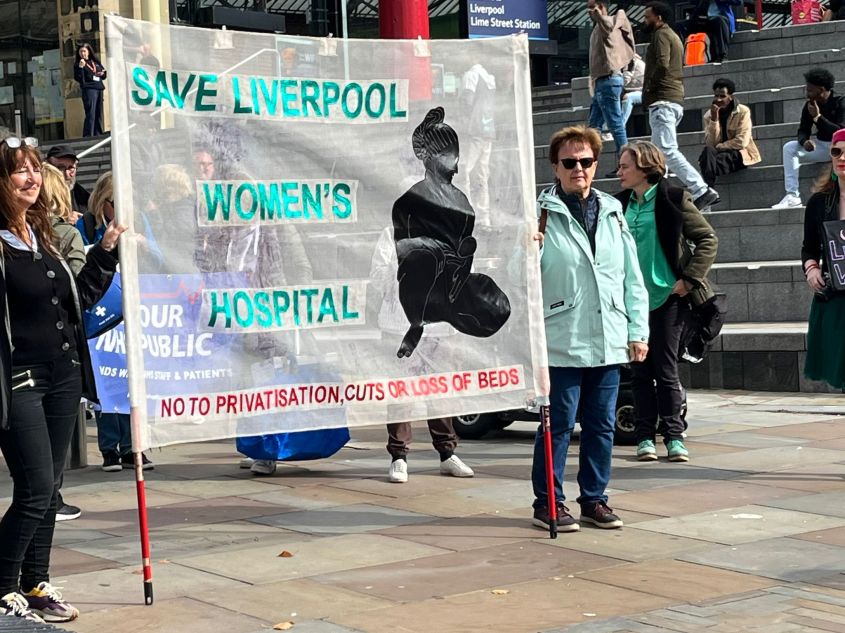
Thank you to everyone who turned out on September 28th for the protest at Labour’s Conference. Our campaign goes from strength to strength.
 Save Liverpool Women's Hospital