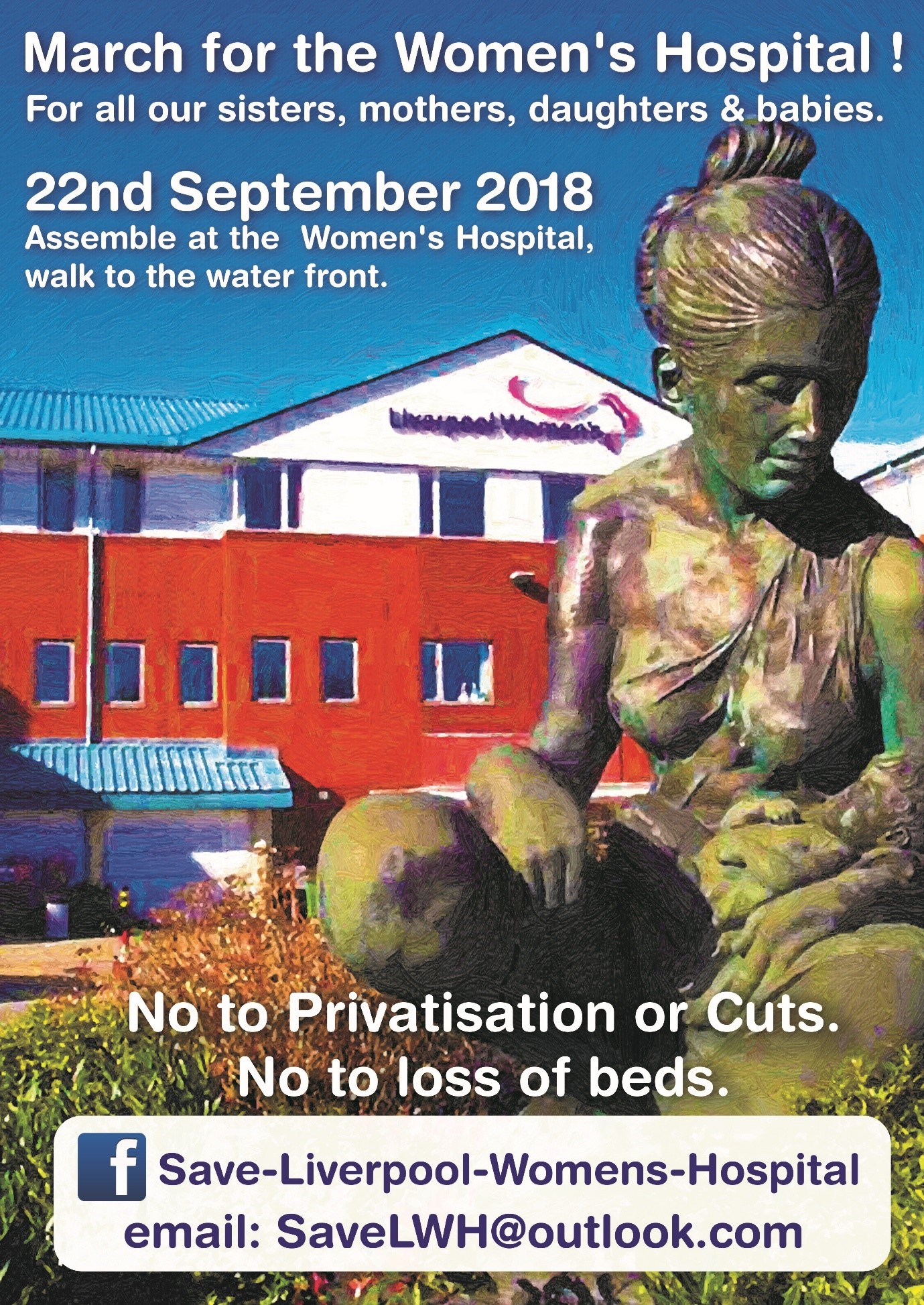

Tag: hospital

Make a mark for maternity in the general election.

Save Liverpool Women’s Hospital, the national maternity service, and women’s and babies’ healthcare. While we fight for Liverpool Women’s Hospital, we fight also for the whole NHS.

“As we go marching, marching
We battle too for men
For they are women’s children
And we mother them again.”

Together ordinary women and men can make a difference, and can put huge pressure on the government to improve our services and maintain that improvement. We cannot leave it to election promises, especially as neither main party at present is supporting the full restoration of the NHS.

The NHS is seen as the most important issue in the forthcoming General election.

Our campaign focuses on Liverpool Women’s Hospital. So, we asked local pregnant women for their thoughts.

I think the most basic thing that women giving birth need is to feel safe, and to be able to have confidence and trust in the people who care for them before, during and after the birth of their baby. Continuity of care is so important, and while this is challenging to deliver, this should be the goal wherever possible. The Women’s has suffered some serious problems in the recent past, and work needs to be done to restore trust and confidence for the women and families who rely on this vital service. Women need to be able to access midwifery-led care, and be supported in their choices around birth and beyond. I want to feel secure that I will be offered treatments that will be beneficial (nothing unnecessary), that the midwives and doctors will listen to me and answer my questions, that they will seek my consent before they intervene, and that the quality of care and communication will be consistently of a high standard. I have experienced both excellent care and coercive and traumatic care at the Women’s in the past. I understand that there are serious system pressures that affect staff throughout the trust, but no woman should leave the postnatal ward feeling traumatised and vulnerable. Staff need all the support and training necessary to ensure this does not happen. Research demonstrates that birth trauma is a national problem, and I would like to see the Women’s taking a leading role in addressing this silent epidemic. As a tertiary centre and leader in obstetrics and foetal maternal medicine, the Women’s should be setting standards, not struggling to meet them.”

Another comment was:

We need more focus on women with complex social needs as they have terrible experiences once they go in to deliver.”

We agree and say.

  • Fight to save and improve Liverpool Women’s Hospital.
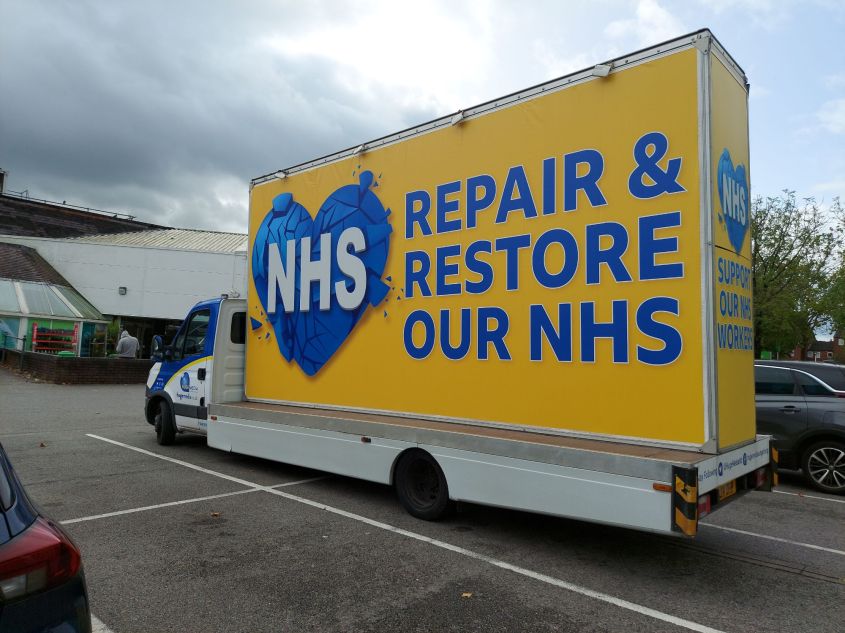
  • Restore and Repair the whole NHS.

We need a national health service, funded at least as well as other European Countries, publicly provided, not for profit, available to all humans in the country, free at the point of need. This model is the safest and most economical model of healthcare. The US have a dog’s dinner of a healthcare model but it costs much more than the NHS and has many more preventable deaths.

The UK does not spend enough on our healthcare and wastes billions on private profits.

If UK spending per person had matched the average across the EU14 during the decade, then UK total spending per year would have averaged £227bn between 2010 and 2019 – £40bn higher than actual average annual spending. Matching spending per head to France or Germany would have led to an additional £40bn and £73bn (21% to 39% increase respectively) of total health spending each year.

Governments know this and choose to involve big US corporations in the NHS so they can make a fortune, as our service runs on empty. The years of closures and mergers have done great harm and the last thing we need is more health care corporations to rip us off.

The U.S. has the lowest life expectancy at birth, the highest death rates for avoidable or treatable conditions, the highest maternal and infant mortality, and among the highest suicide rates. The U.S. has the highest rate of people with multiple chronic conditions and an obesity rate nearly twice the OECD average.

The years of closures and mergers have done great harm. In August 2023 a report said that “roughly 81 hospitals closed in the past 21 months, 6.6% of total hospitals.” 

Liverpool Women’s Hospital requires about 25% more funding. This is because eighty per cent of its work is maternity, and maternity is badly funded nationally. However, funding for the whole ICB (NHS) in Merseyside and Cheshire is also a problem. One of the hospitals that cannot safely work within the given budget is Liverpool Women’s Hospital. The Board of Liverpool Women’s Hospital has set a budget for safety and must be supported in this.

The Cheshire and Merseyside Integrated Care Board provides the bulk of funds to the hospital with a small amount coming nationally from funding for specialist services. The ICB in turn gets its funding from NHS England. NHS England funds maternity through what they call the maternity tariff. This maternity tariff is inadequate for safe care. NHS England gets its funding from the Government. The buck stops with the Government.

The ICB said it has serious funding issues in its most recent report;

“Colleagues will be aware that the financial planning round for 2024-2025 has yet to be concluded. This is largely because provider financial plans [providers are the Hospitals and non-hospital trusts our comment] exceed the level of funding available and we remain in an iterative process [iterative means going back and forth] with NHS England as we seek to find the right balance between further cost improvements [cost improvements means cuts] and maintaining the core quality of services.
5.2 At the time of writing this report we were forecasting a deficit for the year in the order of c£150million (2.24% of turnover). We will be able to report back to Board verbally at its meeting in May
[This meeting was cancelled].”

Sadly, Maternity does not feature in the priorities of the ICB despite reporting that many more women experienced a delay in induction of labour. This means that a woman has been told that her baby needs to be born soon and has come into hospital, to have the baby and then is kept waiting (and worrying) for more than 12 hours.

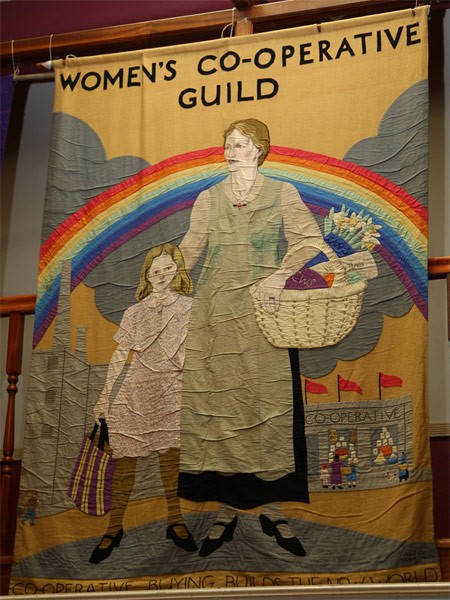
The NHS came from campaigns over many years from ordinary people, from trade unions in mining towns and working-class women’s organisations especially the Cooperative Women’s Guild who left behind a great record of their work in 1916 in the book ‘Maternity: Letters from Working Women, Collected by the Women’s Co-operative Guild’. Eventually, Nye Bevan founded the NHS as part of the 1945 Labour Government. It dramatically improved women’s survival giving birth, and the survival of babies.

Linked problems.

Women and children have been hardest hit by austerity and this has affected our health The prospects are grim indeed. In Liverpool “The life expectancy of women will fall by one year, and they will be in good health for 4.1 fewer years than they are currently. Although they are starting from a lower base, men will live 6 months longer than currently, and more of that time – 1.8 years – will be spent in good health.

Tell everyone who wants your vote to commit to real improvements in maternity services, a real commitment to the NHS. But do not leave it to MPs, get involved in the campaign to restore the full NHS and Maternity care. Suffragettes did not have a voice in parliament but they made themselves heard. We can campaign as well as our great-grandmothers.

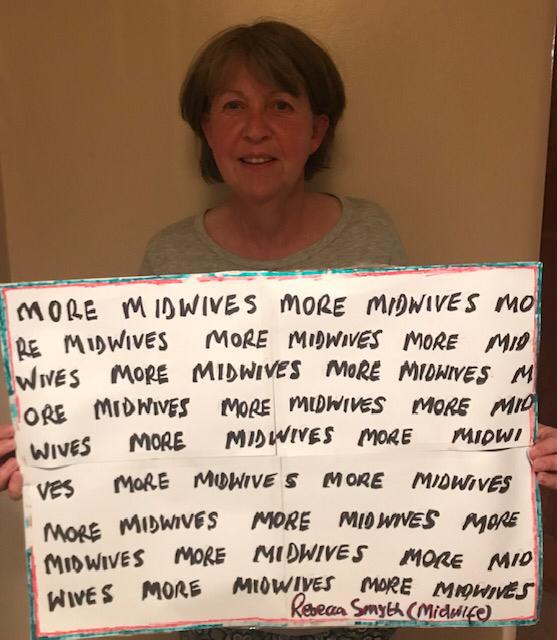
Save Liverpool Women’s Hospital. No mergers, no dispersal of services. We need more midwives. Fund all the maternity hospitals well. Staff them well. Staff should not be pulled from ward to ward just to manage day-to-day demands. Each ward should be well-staffed. Fund postnatal support. Fund safety-critical improvements. Fund and staff the specialist work of Liverpool Women’s Hospital. Make treatment timely and safe, without long waits for induction of labour. Make maternity services improve women’s mental health not damage it.
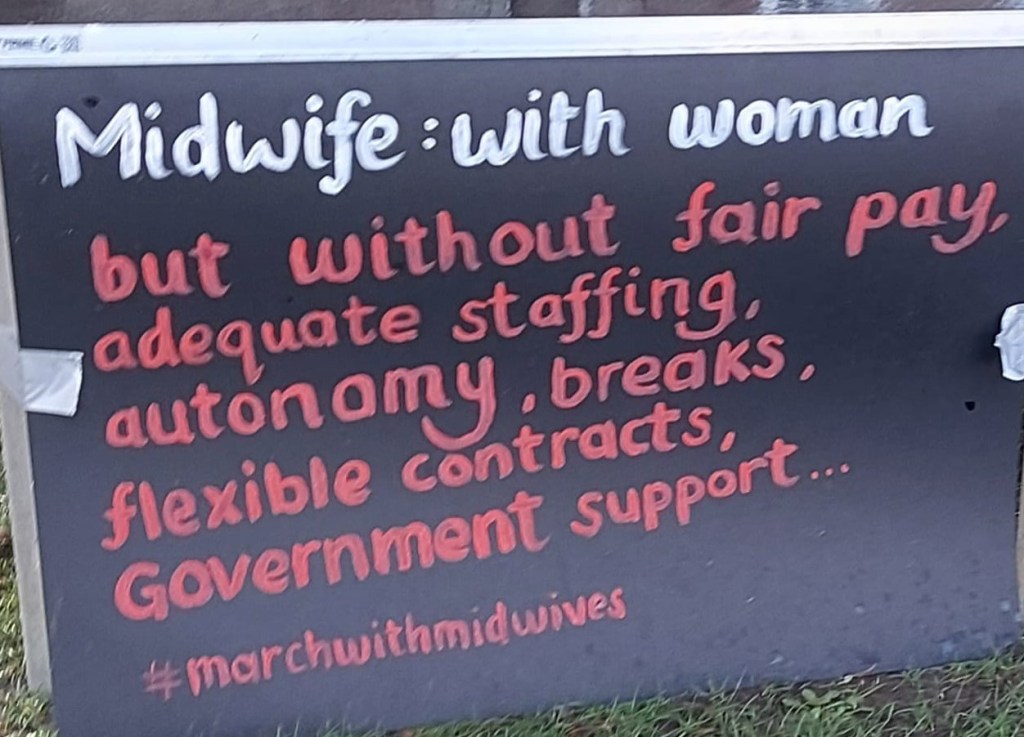
We need more midwives, and midwives need a professionally safe workload and good pay. It is hard to stay focused professionally if you are not sure where the next meal or heating bill is coming from or if you are working extra shifts to make ends meet.

Find out more about maternity here

Every life starts at birth.

As the suffragettes said

Do not appeal, do not beg, do not grovel. Take courage, join hands, stand beside us, fight with us.”

It takes a weird level of cruelty to cut services for the birth of a baby but that is what has happened. Our campaign is far from alone in raising these issues. The government knows quite well what is happening in maternity. Multiple national reports have shown the crisis in maternity services for mothers and babies. These are some of the reports, all reported to Parliament.

1. Care Quality Commission,

2. Donna Ockendon,

3. Bill Kirkup

4. Morecombe Bay,

5. Maternity Services in England House of Commons Health and Social Care Committee

6. Birth Trauma report

7. Report into the quality and safety of  maternity services

8. Saving Babies Lives Report

The government responded with endless cuts to the NHS budgets. This year’s funding allocation for the NHS in real terms, taking into account inflation, is the worst in many years.

Improving maternity outcomes needs to be everyone’s business. Let us make it our business.

There are other NHS problems. Mental health care has been sliced, diced and privatised. Dentistry is simply unavailable to many people; GP services are in serious trouble through underfunding and crazy schemes to reduce our contact with a GP. Meanwhile, reports show that having contact with the same GP adds years to our lives

The service must respect and work with mothers. There should be continuity of care, not an impersonal production line.

Eradicate racism from the maternity service.

Fund the whole NHS.

No cuts or closures.

Raise the funding paid to all hospitals for maternity.

Raise the Birthrate plus staffing standards.

Protect and improve mother and baby health.

We support campaigns for the safety of mothers and babies in other ways.

You can take action now for the NHS as we enter the election campaign Send these questions to your candidates.

Join our campaign. Spread the word.

The future of Liverpool Women’s Hospital is no safer this week.

Save Liverpool Women’s Hospital News May 2024.

Liverpool Women’s Hospital will not get a new building on the Royal Site. This announcement has been expected for some time. The BBC covered the story this week. On Radio Merseyside our campaign was asked to comment. We said that we were not surprised . The Hospital should stay on the Crown Street site and that what matters is proper funding, staffing, and resources because our babies deserve the best.

Our huge petition says.

Save the Liverpool Women’s Hospital.

No closure. No privatisation. No cuts. No merger.

Reorganise the funding structures, not the hospital.

Our babies and mothers, our sick women, deserve the best.

What’s happening with the  Liverpool Women’s Hospital?

There has been a press announcement that there will be no new women’s hospital built on the Royal site in the near future.

This announcement does not mean the future of Liverpool Women’s Hospital is safe, far from it. Public consultation about its future will be launched shortly.

The announcement is not a surprise to anyone who has followed the story of Liverpool Women’s Hospital or the story of broken promises from the Government about building new hospitals, even those in dire physical conditions.

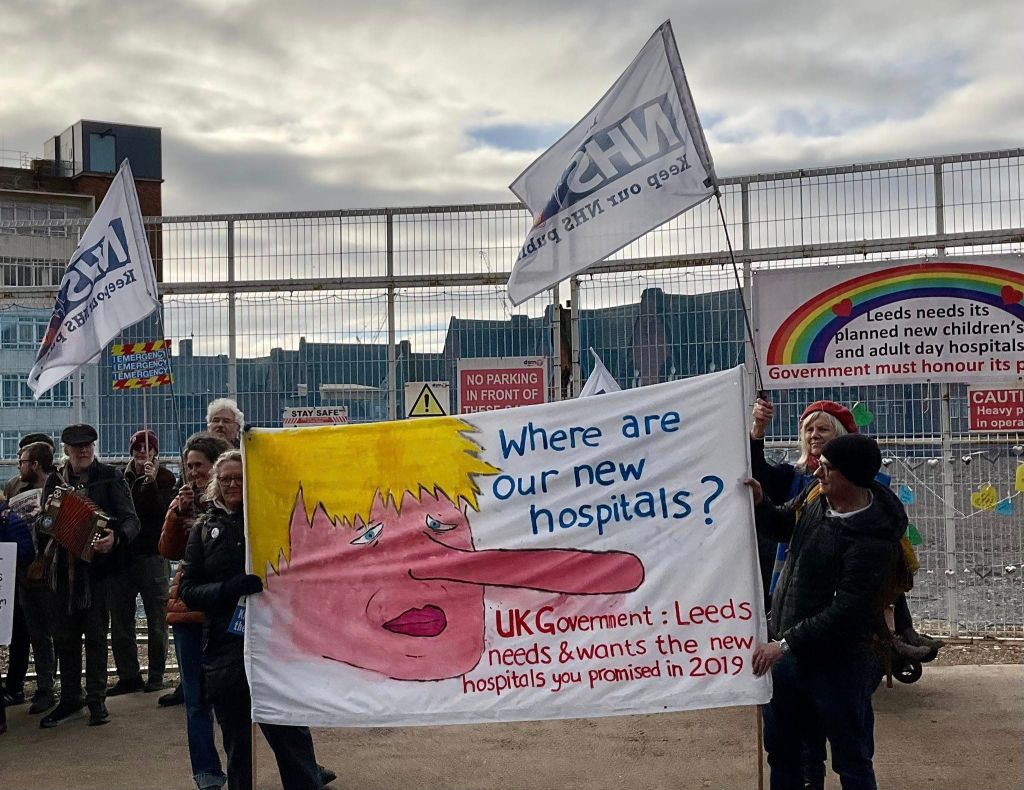
For example in Leeds, the people were promised a new Children’s Hospital. In the meantime, services were dispersed to different hospitals to allow demolition. Now the new Hospital is not going to happen.

Nationally, maternity is underfunded and understaffed and has seen terrible scandals. We have written much about this in other posts.  Just this week there was a report about delayed induction of labour across the country (and this also has been seen in Liverpool Women’s Hospital). The Care Quality Commission reported “The quality of maternity, mental health and ambulance services has seen a “notable decline” over the last year, which is contributing to “unfair care” and worsening health inequalities,”

The Neonatal Unit at Liverpool Women’s Hospital

The Health Service Journal  also reported that

families whose babies died and whose mothers were harmed – in some cases dying – in the East Kent maternity scandal were still having to prove legal liability to get any compensation. This is despite Bill Kirkup’s report, published around 18 months ago, having already looked at their cases in detail and reached conclusions on whether better care could have led to different outcomes.

But NHS Resolution, which handles the NHS’s clinical negligence claims, says causation and a breach of duty of care will need to be proved in each case. This may mean families have to engage not just lawyers but also experts in midwifery, obstetrics, and neonatal care.”

In such a national maternity crisis we must protect the services we have in the area. We say women and babies will be harmed if the Liverpool Women’s Hospital is forced into a merger with the huge general hospital. The focus on women and babies will be lost. The great maternity scandals of our age have happened where there was no real focus on women and babies.

The government and the NHS bureaucracy have wanted to close one hospital in Liverpool since 2015. Liverpool Women’s Hospital was chosen. This is to do with saving money not patient care.

Liverpool Women’s Hospital sits on a great site on Crown Street. The official opening was on 7th November 1995 and the building is in good condition. A £20million pound neonatal unit was recently added to the hospital. It does not need a rebuild.

Liverpool Women’s Hospital does need more staff and additional resources like a proper blood service, an improved emergency medicine service, a 24/7 consultant obstetric presence. It needs to tackle the long waiting list for Gynaecology treatment,  and improved intensive care. All of this requires funding and support from the national health service and government funding but without that funding our babies and mothers will suffer. The money must be provided.

Our Saturday stall n Bold Street

All hospitals should be run in a cooperative system with other hospitals but specialisms should be protected.

Liverpool Women’s Hospital, along with the whole of the UK, needs to improve infant mortality, maternal mortality and injuries to women and babies and to tackle gross inequalities.

Serious damage has been done to our health care. We see it in the terrible waiting times in Accident and Emergency, in the 14,000 preventable deaths caused by those A and E problems, we see it in dentistry, in the GP service, in mental health and in maternity. We see it in the eight million people on waiting lists. We see it in the exhausted staff.

The experience women have giving birth is getting worse because of these underlying, national problems and the day-to-day stress this brings into the hospital.

Liverpool Women’s Hospital is damaged too by the business model imposed on the hospitals. The drive to privatise and to move away from a service model in the NHS has caused problems all this century.

The new Chief Executive (James Sumner) and Chair of Liverpool Women’s Hospital (David Flory) are also the Chief Executive and Chair of the Royal, Aintree and Broadgreen Hospitals (Liverpool University  Hospitals Foundation Trust). Neither man is a specialist in maternal or infant health. The Health Service Journal has said these joint appointments are likely to lead to a merger of Liverpool Women’s with the big hospital. We say no to a merger, and a big yes to cooperation between all the hospitals in the area. Such cooperation is anathema to the privatisers. We need continued support from the people of Liverpool to win this fight and we need to link up with other maternity campaigners.

Please help Save Liverpool Women’s Hospital. Sign the petition, talk to friends family and workplaces about this, join the discussion, and help with leafleting and social media.

Invite us to speak to your organisation.

 Send us a donation.

 For all our mothers, sisters, daughters, friends, and lovers and for every baby

The Future of Liverpool Women’s Hospital, Spring 2024

Save Liverpool Women’s Hospital.

The future of Liverpool Women’s Hospital has been under threat for nine years now. The petition which is at the heart of the Save Liverpool Women’s Hospital Campaign says “No closure. No privatisation. No cuts. No merger. Reorganise the funding structures not the hospital. Our babies and mothers our sick women deserve the very best.

In the Liverpool Women’s Hospital Board papers 11.04. 2024, it was announced that “An indicative programme plan had been developed and this reflected the unlikelihood that a new hospital building, co-located with an adult acute site, would be built within a five-to-ten-year timescale.

( In plain English this means they will not get a new Hospital)

 And that

 “… discussions were held on alternative solutions for citywide women’s healthcare.

Our opponents promised the public that a new smaller hospital on the Royal site would improve services. We always said that such a plan was magical thinking and that even if they got the money for a new building the existing problems would still be there. We said moving the Liverpool Women’s Hospital from the Crown Street site would be bad for women and babies.

Now we are in the horrible position that the bribe of a new hospital has evaporated but the core financial and organisational problems remain. We well remember the Panorama programme many years ago when it was announced that they wanted to close one hospital in Liverpool, and that clearly was Liverpool Women’s Hospital.

There are serious problems for Liverpool Women’s Hospital not to do with the Hospital site.

The Board of Liverpool Women’s Hospital has made it clear that safe services require extra funding. We demand that this money be provided.

Liverpool Women’s Hospital has a grave shortage of funds for crucial services. The fault for this lies with the last four governments but especially the current government who are very much aware of the damage they are doing to maternity care. There have been numerous high-profile reports on this, not least of these reports, being the work of Donna Ockendon. Donna Ockendon is now working on another maternity report, this time from Nottingham.

There are five reasons this national problem impacts on Liverpool Women’s Hospital

  1. Healthcare in the UK is badly funded and badly organised, wasting money and resources on privatisation.
  2. Eighty per cent of Liverpool Women’s Hospital’s budget comes through maternity funding, mainly the Maternity Tariff. The maternity tariff nationally is inadequate. No other hospital relies quite as much on maternity funding as the Liverpool Women’s Hospital does.
  3. The costs of the Clinical Negligence Scheme weigh particularly hard on this, the largest maternity hospital. The Government scandalously spends more on compensation than it does for the whole maternity service.
  4. The hospital is a Foundation Trust, which is an expensive management model for a small hospital.
  5. The model of healthcare from this, and some earlier governments, saw hospitals as competing businesses rather than a cooperating system. A small hospital could not thrive in such a scenario. This model is changing but the new ICB model also poses serious problems. We call for a return to the original Bevan model of the NHS, where a fully funded national, publicly owned and delivered health system based on cooperation not competition, sees ongoing improvement in maternity services.

Liverpool Women’s Hospital lacks crucial services because of these funding issues.

Our petition, now with more than 40,000 signatures online and more than 20,000 on paper, says “Save the Liverpool Women’s Hospital. No closure. No privatisation. No cuts. No merger. Reorganise the funding structures not the hospital. Our babies and mothers our sick women deserve the very best.”

Our campaign wants to improve the whole maternity journey for women and babies, every aspect of it, safety, respect and celebration of birth. We campaign for maternity everywhere in the UK. It is not possible to solve the fundamental problems of Liverpool Women’s Hospital without solving national funding and staffing issues but we can stop projects that make things worse. There are many and detailed reports about how the experience of maternity has worsened in recent years.

Our campaign wants midwives, nurses, obstetricians, CSWs and other staff to feel safe, and respected at work, free from undue stress, with access to ongoing education and training and with the opportunity to eat well, go to the toilet and have proper breaks at work, both day and night.

Our campaign wants to see maternity well-funded and protected from privatisation and protected from trendy, untried innovations.

We want those running maternity services to remember that as medics they have a duty of candour, to tell the truth about funding and staffing issues.

Since 2010 there has been damage done to all maternity and women’s health services nationally, and Liverpool Women’s Hospital has not escaped that damage. Underfunding, understaffing, and lack of key equipment and services have all had an effect.

We campaign for the whole of the NHS, not just maternity

Why do we want a women’s hospital?

We want excellent healthcare for women and babies. Our babies, our mothers, deserve the best. It is that simple.

However, that is not what this and previous governments have provided. We want to keep the focus on the needs of women and their babies. The scale and depth of the maternity scandals in other big multi-site, multi-specialism hospitals is a testament to how important this is. There have been many prestigious reports published about how bad the damage has been to Maternity and to women’s health. One in seven maternity units have closed during the period of cuts and this wave of closures has not stopped.

Cuts in NHS funding are part of the Austerity project. Austerity cuts have hit women and children and the working class very badly whilst the rich get ever richer. In this situation, we must protect what we have and not let it go. Maternity in England has suffered grievously under austerity. Maternal deaths are the highest in 20 years.

Ockendon’s reports have painted a grim picture of the failings of the system. Our campaign has fought hard for national as well as local funding and held two conferences on this matter. None of these hospitals involved in the big maternity scandals were standalone  Women’s Hospitals like Liverpool Women’s Hospital and their failings were not blamed on being a standalone Women’s Hospital. Yet the standalone character of Liverpool Women’s Hospital was what all the case for change was based on.

When Donna Ockendon did her first report on the Shrewsbury baby deaths it was revealed that many hospitals providing maternity care did not even have a member of their board charged with Maternity care, so board papers could go with nary a mention of maternity. Bad Care Quality reports were not given due consideration by the Shrewsbury board.

  • The Trust board did not have oversight or a full understanding of issues and concerns within the maternity service, resulting in neither strategic direction and effective change, nor the development of accountable implementation plans.

Most of Liverpool’s babies are delivered at Liverpool Women’s Hospital. The hospital delivers roughly 8,000 births per year. The Hospital also provides maternity care from a wider region for complex pregnancies and very premature or very sick newborn babies. It is a Maternal Medicine Centre, one of three within the Northwest Maternal Medicine Network. The Hospital also provides Gynaecological treatments,  Fertility services, Genetics services, Cancer care and termination of pregnancy, when that requires surgical intervention. The hospital also has a reputation as being a safe and caring place for women (though that has faltered a little in recent years). For all these reasons,  Liverpool Women’s Hospital is considered to be especially important by the people of Liverpool and beyond, but not considered so important by the Government or NHS England. For the last nine years, the future of Liverpool Women’s Hospital has been under ongoing threat.

We ask the people of Liverpool to continue to support our campaign for a fully funded, fully staffed, fully equipped hospital on the Liverpool Women’s Hospital Crown Street Site and for a fully funded, fully staffed, publicly owned and delivered national health service.

What Is Happening in Health Care in Cheshire and Merseyside in January 2024?

Save Liverpool Women’s Hospital is part of a coalition of campaigns fighting to Restore and Repair the NHS, and to win full staffing (with good pay, conditions, and qualifications) to improve the health of our largely working-class communities in Cheshire and Merseyside. One of the tasks we do together is to monitor the activities of the ICB, the so-called Integrated Care Board which replaced the NHS in the 2022 Health and Care Act. We have to resist the vicious cuts being made and challenge the damage being done.

Arrowe Park Hospital Clinical Support Workers on strike for fair pay and equality with other hospitals

The Cheshire and Merseyside ICS  is meeting in New Brighton on 25th January, from 9.00am to midday. People can ask questions from 9 until 9.30

Location: Tower Room, Floral Pavilion Theatre & Conference Centre, Marine Promenade, New Brighton, Wallasey CH45 2JS.Free parking opposite the Fort Perch car park.

https://www.cheshireandmerseyside.nhs.uk/get-involved/upcoming-meetings-and-events/nhs-cheshire-and-merseyside-integrated-care-board-january-2024/

Even before we read the paperwork for the ICB meeting, ( It should be published this week) we know patients and staff face serious issues and we will not sit back and let our services be reorganized out of existence. We will though post a comment about the issues when the paperwork is published on their website.

These problems are all solvable if privatization is withdrawn and we revert to a public service healthcare model based on publicly funded and publicly delivered care as the NHS was founded. Fortunately, the original NHS model of healthcare happens to be the most cost-efficient model of care. The privatization and cuts that have plagued our NHS for two decades have robbed us of what was judged the best healthcare in the world in 2014 by the Commonwealth Fund, a US charity that surveys health systems each year.

We work to restore the NHS like the Women’s Cooperative Guild fought to found universal healthcare a century ago. Remember that they won!

Yes, it will require investment to Repair and Restore the NHS. However, that investment will repay itself in the health of the population and in enriching the economy.

“… spending on the NHS should be regarded as an investment, not a cost. Improving population health can drive higher levels of economic growth across the country.” https://www.nhsconfed.org/publications/analysis-link-between-investing-health-and-economic-growth

Even the World Bank a leading light in the world of global capitalism agrees. It said good population health, nutrition, and education create the foundation for sustainable economic growth. It is now much better understood that a well-educated, healthy, and well-nourished workforce pays bigger dividends to the economy than simply building new roads and bridges

Please tell us what the key issues in healthcare are for you. These are some issues we want to highlight ahead of the ICB meeting., but you may have issues we don’t yet know about.

Do come along if you are free on the 25th of January to this meeting with your questions and /or to support the campaign.

These are healthcare issues that we know are facing us in Cheshire and Merseyside healthcare.

  1. Deeper privatization and structural change to allow such privatization. It is now even easier for the ICB to give contracts to private companies without going through public procedures. GP practices can be bought and sold. See below. NHS campaigners are monitoring how much ICB spends is given to big corporations. For more information on just two companies see this. Privatization means not only does our healthcare have to pay profit on top of cost but the companies are, by law, aiming to make the the highest profit, not providing the highest care, and each company is likely to be taken over by another company particularly hedge funds or the huge US health corporations. Privatization of public services is a disaster.
  2. Reduction of services. The NHS /ICB has fewer beds and fewer doctors per head of population than comparable countries. The Kings Fund wrote in a comparison study of health care in advanced economies”The UK also has fewer hospital beds; 2.5 beds per 1,000 people, compared to an average of 3.2 beds per 1,000 in our basket. Again, fewer beds are not necessarily bad – this could reflect shorter hospital stays – but the high occupancy rates of beds in the UK (88 percent in 2022/23, above recommended levels, and third highest in our basket) implies there is a shortage.” Local hospitals have been way above 88 percent bed occupancy this year. The Royal College of Emergency Medicine said the huge loss of beds since 2010-11 was causing “real patient harm” and a “serious patient safety crisis”.“Since 2010-11 the NHS has lost 25,000 beds across the UK, as a result, bed occupancy has risen, ambulance response times have risen, A&E waiting times have increased, cancelled elective care operations have increased.
  3.  Greater problems with underfunding. The extent of Cuts ( CIPs) is dreadful, especially in this time of high inflation. Hospitals are given a budget by the ICB and have to show where they are going to make”Cost Improvements”. Reducing the service, though, is part and parcel of the ICS model imported from the USA. Each hospital is expected to make CIPs/cuts of about 5%. These are utterly unrealistic without causing still more preventable deaths, and the rules are saying the cuts must be replicable next year too with more cuts again. The NHS is underfunded and the strikes have cost money. The government could have settled the disputes for much less than the disputes have cost, but still refused to settlethe disputes or to fund the costs to the hospitals. This all means longer waiting lists longer queues in Accident and Emergency and longer waits for ambulances. The BMA said last year Between 2009/10 and 2021/22, the cumulative underspend – the difference between what funding would have been if historical growth rates had been maintained, and what was actually provided – reached £322 billion in real terms.
  4. The introduction of physician associates and other less qualified roles to replace doctors’ roles. https://www.bma.org.uk/bma-media-centre/bma-calls-for-immediate-pause-on-recruitment-of-physician-associates Although some PAs have been in place for some time the government is bringing in more lower-skilled staff rather than train and pay doctors.  We have seen the growth of other roles in General Practice. but this has not solved the problems. Pharmacists have proven useful but even The safest system is for patients first to see a qualified physician and then to be referred to a nurse or other health professional.  When we go for treatment we need to know how qualified the member of staff is. There is a consultation from the British Medical Association that you can take part in here. Margaret Greenwood MP for Wirral West spoke in Parliament about this. Her contribution can be found here.
  5. Our people in our working-class communities already die too young as shown in this report from Liverpool City Council. This class divide in health care is replicated across Cheshire and Merseyside with huge differences in life expectancy and life expectancy in good health between the rich and poor. The differences in health between different areas across Cheshire and Merseyside are stark and heartbreaking but we want better services for people in Walton and Woolton, for Crewe and Macclesfield the poorer and better-off areas of Cheshire and Merseyside. This country can provide far better healthcare for all. Our Government chooses not to do so. The slightly better-off communities are not the cause of the extreme poverty that has returned to this country.
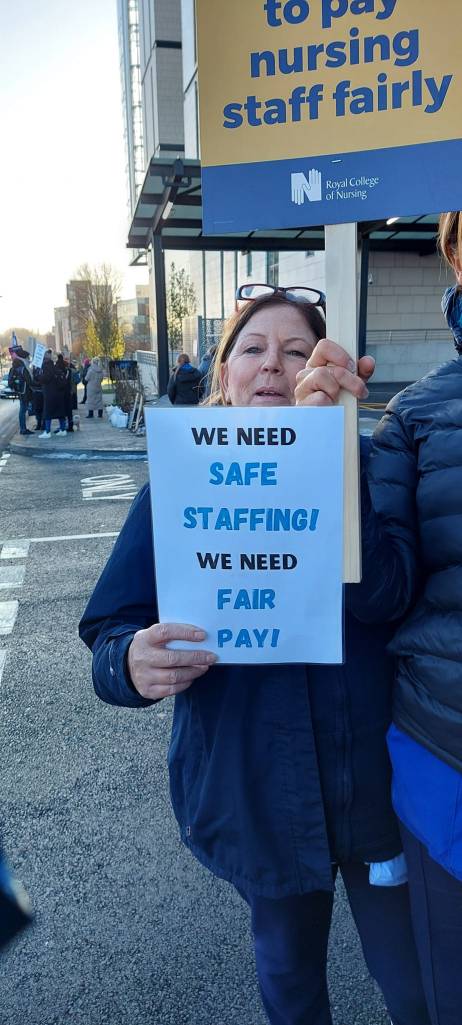
  6. NHS Staff pay and conditions. Our area has had the greatest involvement of healthcare workers in industrial action. They deserve our full solidarity and they still have not got a fair deal. Fair pay and good working conditions for staff at every level are requirements of an effective health service. nationally 112,000 vacancies are unfilled. For more details on staffing see this.
  7. A separate dispute at Arrowe Parke Hospital over back pay and grading is dragging on, with 100 or more pickets out in the cold winter. This strike is making history. The courage and determination are a model for others to follow.
  8. The proportion of the NHS budget spent on General Practice is due to fall to its lowest point in at least eight years. We need better GP services.
  9. Meanwhile, Centene the US health corporation is selling  60 GP practices to another company! HCRG is the entity that replaced Virgin Health when 75% of the shares were bought out in 2021 by Twenty20 Capital, which is a British-owned private equity group. So our GP practices are now at the mercy of the market! ( Thanks to research from Note by Carol Saunders (Tower Hamlets KONP & NELSON)
  10. The situation at Liverpool Women’s Hospital continues to cause concern. It is part of the national maternity scandal, although Liverpool Women’s is fortunate to have a full staff of midwives, albeit as measured by the government’s meager staffing levels. We need more midwives but are very pleased to see the new young midwives arrive at the hospital and we hope that they stay for many years. Midwives need respect, good pay, good working conditions, and access to ongoing professional education. The new Chief Executive of Liverpool Women’s Hospital said “.. the organization was well organized, and there were limited opportunities for further internally driven efficiencies to reduce the financial deficit position. Work would therefore need to continue to influence the national maternity tariff and the CNST premium – both significant cost pressures to the Trust.” He also said, according to the December Trust Board minutes, “The RQR meeting had also provided an opportunity for the Trust to outline significant safety issues that required immediate action. This included 24/7 obstetric cover, development of a Medical Emergency Team (MET), blood bank availability, anesthetic cover, and ongoing work on the antiracism agenda.” despite this, the hospital is expected to make significant CIPs( cuts)
  11. Money given for dentistry cannot be spent because of changes to the service contracts for dentists, yet thousands go without. The NHS  is on course for  £400m underspend on its dental contract!!
  12. Waiting lists. The waiting lists for hospital treatment rose to a record of 7.8 million in November 2023 and this winter has not made things better.
  13. Allowing Palantir access to our most personal data. We are told it is not yet happening here but that train is rolling. NHS is paying the company a huge sum of £480 million for this service which will give the company access to data worth billions and which will further enrich the health insurance conglomerates and big Pharma. They will administer a key system for the NHS, and the Post Office Horizon scandal tells us just how important it is that such systems work well for the users, not those who want to make a profit. For further details on this issue see https://www.foxglove.org.uk/2024/01/11/nhs-federated-data-platform-need-to-know/
  14. Stress and pain for patients and staff are caused by the deliberate policies of this government and all who support NHS restructuring for profit rather than care. We thank the staff who have been the best protectors of our care and point the blame squarely on this and earlier governments.
  15. Pharmaceuticals. Too many patients cannot get the medication they need. Chasing around different chemists has become familiar.” Multinational health corporations are raking in huge profits while demanding the UK’s National Health Service pay high prices for their products. The excessive power wielded by these firms needs curbing if UK health policy is to truly work in the public interest.” says author Nick Deardon. The NHS once had, and could have again, a powerful position in buying from big companies as the world’s biggest single purchaser. The scale of big pharma gives them huge power. There is a powerful campaign being run on this issue which you can contact here
  16. The use of and cost of agency staff is a waste of money. We know that staff sometimes need flexible working especially with the poor level of NHS pay and the huge cost of childcare. The shortage of staff has become another way for big businesses to rip off the health service. In 2017 the government sold off NHS Professionals. The Canary paper wrote at the time“The DoH owns NHS Professionals (NHSP), a private limited company created to supply a bank of over 90,000 medical staff across different NHS Trusts. The flexible arrangements apparently save the government £70m a year in costs while non-government-owned private staffing agencies can be around 30% more expensive.” HCRG, remember them from the private sale of GP practices earlier in the article ( point 8 )? Well, they are one of the agencies cashing in in NHS funds through agency staff.
  17. The Royal College of Nurses reported “Findings from a Freedom of Information (FOI) request to NHS trusts in England expose a total of £3.2bn spent on agency staff by hospitals between 2020 and 2022.…..According to RCN analysis, three-quarters of nursing vacancies in the NHS in England could be filled if the money had been redirected to hiring permanent staff. Cash spent on agencies could cover the salaries of 30,956 permanent full-time equivalent nurses paid at the top of a Band 5 salary (£34,581).
Last time we lobbied the ICB in New Brighton
The October 2023 Demonstration for the Liverpool Women’s Hospital and to Repair and Restore the NHS.
Additional staff in GP practices since 2019https://www.nuffieldtrust.org.uk/news-item/more-staff-in-general-practice-but-is-the-emerging-mix-of-roles-what-s-needed