
Tag: liverpool-womens-hospital

February update on the plans for Liverpool Women’s Hospital.

The ICB, the lead body for the NHS in Cheshire and Merseyside, began a process towards significant change for Liverpool Women’s Hospital last year. It was formally announced in the autumn, and action got underway in October and November, with what they called an Engagement exercise. Their latest meeting was on January 30th. You can find all the papers we quote from the meeting here. There is also a long video.

Many people cannot understand how anyone could tamper with Liverpool Women’s Hospital. Some simply don’t believe that it is happening. We want to ensure that people can check what we post about the ICB against their own material. Quotes from their papers will be in blue.

There is no money for a significant improvement, let alone a new build, or for alteration of buildings in the existing hospitals. There is famously no room at the Royal, and given the winter crisis with trolley care at Aintree, no room there either. Any other site would be further away from the highest levels of intensive care than the current Liverpool Women’s Hospital site on Crown Street.

It is not possible to separate the fight for better Maternity care, better outcomes for babies, and better gynaecology and fertility care, from the overall privatisation, Americanisation, underfunding, understaffing and neglect of buildings in the NHS. Our campaign is part of a national fight back to Restore and Repair the NHS.
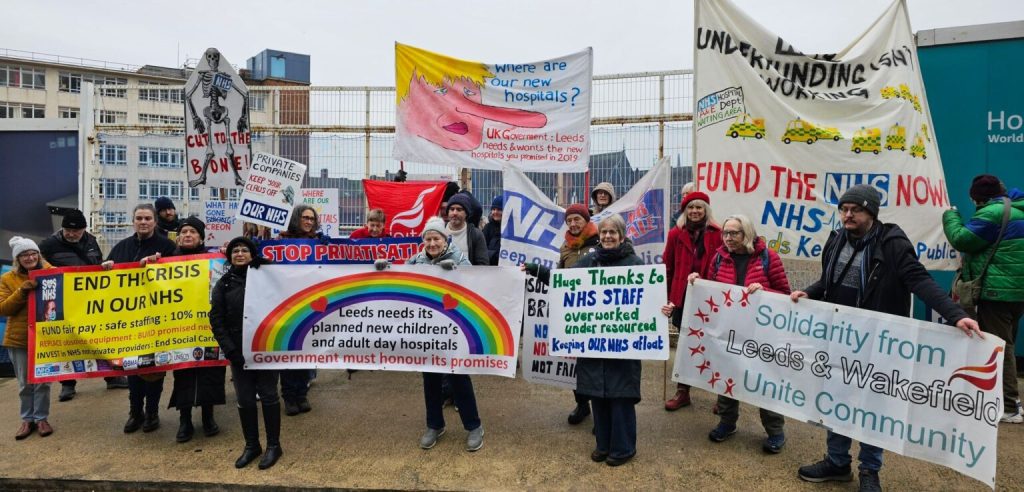
Leeds campaigners out in force.

What happened at the ICB meeting in January? During the “engagement” process in the autumn, the ICB presenters of their Case for Change stressed repeatedly that they wanted women’s services colocated in an acute general hospital, but that they did not yet have a plan as to how this would happen, or where our babies would be born. They insisted the Crown Street site did not meet national regulations. We have challenged this in detail here.

The issue of the future of Liverpool Women’s Hospital is managed by the ICB’s Women’s Hospital Services in Liverpool Committee.

The Steps which are already taken towards their Case for Change.

Liverpool Women’s Hospital management was moved into a group with the Royal, Aintree, and Broadgreen, which was agreed upon at the ICB. How such a crucial change can happen without public consultation baffles us. We can find no legislation that permits this, but we will continue to look. There was legislation about the reorganisation of hospitals into Trusts. Trusts still legally exist, but they have delegated their powers over finance and staffing to the Group in Liverpool.

“Liverpool Clinical Services Review – Liverpool University Hospitals Foundation Trust and Liverpool Women’s FT come together as University Hospitals of Liverpool Group from November 1st. This will streamline decision-making and develop further collaboration opportunities in terms of service quality, access, workforce capacity and finance. Plans for other acute and specialist trusts to join a group structure, retaining their status as separate Trusts, are in development. “

Plans for the future of Liverpool Women’s Hospital are discussed at a subcommittee held in private, and their reports then come to the meeting held in public. At January’s meeting, it was reported that;

Phase 2 Programme Plan The next stage summary programme plan – from January – December 2025 – was presented to the Committee. The plan set out the timescales and milestones for agreeing the model of care, managing the options appraisal process and developing any business cases. The Committee approved the phase 2 programme plan.

and

Women’s services in Liverpool programme case for change approved by ICB board and formal public engagement started on October 15th. In parallel work will begin on the design phase and development of a clinical model at a Clinical Reference group meeting in December 2024. A Lived Experience Panel has been established to support the programme.

The  (sub-committee) considered the following at its meeting in November 2024: Programme Update. This included: • Finalising the case for change and briefing councils and MPs prior to publication. • Planning and delivering the public engagement for the case for change. • Progress on delivering clinical improvements at LWFT. • Refreshing the counterfactual case. • Planning for the clinical engagement event in December.

design phase and development of a clinical model” This phrase presumably is when they will decide where our babies will be born and where Gyny and the NICU will be based.

The report on the engagement meetings did not reflect the experience of many people who attended them. Before writin g this we checked with a dozen people who attended. Our campaign told people about these poorly advertised meetings, and we were the majority of the (few) people who attended. The in-person meetings were held during the day when people at work could not participate. There was only one evening meeting. We objected to how notes were kept at these meetings and that there was no recording. The overall response from the public was ‘NO!’ to their case for change. The report given at the ICB meeting said:

Communications and Engagement Update
The Committee received feedback on the 6 week public engagement period which completed the day before the meeting.

The engagement process and products included face-to-face and online engagement events, a dedicated website, and a public facing version of the case for change (including an easy read version). Voluntary sector organisations were also commissioned to support the engagement with harder to reach groups and communities.

Feedback on the case for change was collected via a questionnaire (online, printed, and available in an easy-to-read format). This was also translated into 16 languages. An independent organisation, Hood and Woolf, has been commissioned to complete the analysis of the questionnaires; the Committee will receive the report of the analysis at its next meeting.

The engagement events proved to be challenging, with some individuals dominating the sessions. More resources are likely to be needed for effective engagement activities in the future to ensure all attendees can have a voice.

The plan for where the women’s services will go is not ready, and they don’t have the money for buildings or to fund significant change, but they intend to continue even in these circumstances.

Quotes about the finance for the Case for Change

The C&M system is already financially challenged, and therefore the risk score reflects that new expenditure and investment may not be possible in the current financial climate; this is as much about the wider availability of public sector capital as the C&M situation

and in more detail here

WSC3 – Failure to secure the required financial resources for the transformation of women’s hospital services in Liverpool, combined with revenue implications, will negatively impact on the successful delivery of proposals, currently rated as extreme (16). The C&M system is already financially challenged and therefore the risk score reflects that new expenditure and investment may not be possible in the current financial climate; this is as much about the wider availability of public sector capital as the C&M situation. A Finance and Estates Group is due to be established in January 2025 (as part of the emerging Programme governance and reporting arrangements). Further actions include baseline mapping to support the design phase and finance and estates modelling to support the options development – the latter action has a longer-term timescale of January – June 2025.

Date of next meeting: the Women’s Hospital Services in Liverpool Committee March 19th 2025

After the public meeting chaired by Kim Johnson MP on January 31st, with more people (around 100) in attendance than in the whole of the ICB “engagement” events in the autumn, we have been invited to a citizen’s assembly to be chaired by Ian Byrne MP for West Derby.

Other vital issues were discussed at the ICB meeting in January, including finance and the winter crisis. We will report on these in another blog post.

There is a lobby of parliament about the NHS. If you could go, please get in touch.

What does the Campaign to Save Liverpool Women’s Hospital want?

This is what we fight for!

Women having babies have the right to excellent antenatal care.

When giving birth, we need to keep our own agency, we need calm, and we need a good place to give birth, with well-rested, well-qualified staff available to be with us to help in a timely fashion.

Women and babies have a right to good restful care immediately after giving birth, with expert help in infant feeding and support with concerns. Mother and baby need speedy access to support in the early weeks and months in issues to do with physical and mental health.

That’s good Maternity care.

Next steps to Save Liverpool Women’s Hospital

We are planning a ‘Human Billboard’ – bring your own poster if you can -event outside Liverpool Women’s Hospital on March 8th at noon. Save the date.

We can do it!

We are collecting your stories about your experience with Liverpool Women’s Hospital. Please do get in touch.

We will be planning other public meetings around the city, holding stalls and leafletting events. We will continue to follow the meetings both at the ICB and at the Hospital Group.

Please invite us to any meetings you might be organising in the community, in your union or political party.

We need your help, and we need the money to pay for all of this. Please donate through Paypal or send cheques to Save Liverpool Women’s Hospital Campaign c/o News from Nowhere 96 Bold Street Liverpool l1 4HY

https://www.paypal.com/donate/?hosted_button_id=SVSL9LVZYJQ32

Happy Valentine’s Day to the NHS staff who do such wonderful work

This is link to the recoding of the public meeting  chaired by Kim Johnson on 31st January

https://www.unionsafety.eu/docs/HSNewsItems%202025/February/SaveLiverpoolWomensHospitalCampaignGroupContinuesIts10YearFightAgainstClosureOfEnglandsOnlyDedicatedMaternityHospital.html

A broken engagement.

We fight for Liverpool Women’s Hospital and to Restore and Repair the NHS.

Day by day, the NHS provides services for patients often with great skill and good humour. Despite years of cuts, the NHS survives but it cannot provide all services we need because of austerity and the privatisation agenda.

We are in grim times, but the fightback is growing. Our petition has reached 76,000 signatures. We have had support to pay for our leaflets and meetings. People who spoke at the engagement meetings unanimously supported keeping Liverpool Women’s Hospital. Not a single member of the public spoke in favour of closing it, or dispersing its services. We have great support from the public, and two Liverpool MPs, Kim Johnson and Ian Byrne, have helped this week. The same day as the ICB meeting and the first joint board meeting of LUHFT and Liverpool Women’s Hospital, Kim Johnson raised the issue in Parliament. Ian Byrne sent a great letter to the Engagement Team, saying “NO!”.

However, the process decided by NHS bureaucrats rolls on. We can stop it if we organise.

The many people who have said “that will never happen” should join the fight back.

Two quotes show the seriousness of the threat we face

At the October 9th meeting of the ICB Fiona Lemens, leading the process said, introducing the engagement, “It’s too early in the process to speculate about how services might look, in the future at the Crown St. site and across the city, because we’ve not started that design work yet, but what we can say is that we need that hospital at Crown St. The things that we could consider that we currently need space for would be out patients, day case procedures. We’ve invested in a CDC, we need that diagnostic capacity for the patients in Liverpool, and this is an excellent building to provide that from and we are absolutely committed to NHS delivered services being delivered from that site, and there are no plans to discuss any other forms of services going in there.

So, Fiona, where will our babies be born? Where will the women of Liverpool receive their gynaecology care? Where will fertility go? Where will genetics go?Where will the Bradford clinic go?

The website for Liverpool Women’s Hospital says about the second strand in this threat to the integrity of the Women’s Hospital, the largest maternity facility in the country :

From 1 November 2024, Liverpool Women’s NHS Foundation Trust became part of NHS University Hospitals of Liverpool Group (UHLG). UHLG has been created through the coming together of Liverpool University Hospitals NHS Foundation Trust (LUHFT) and Liverpool Women’s NHS Foundation Trust (LWH).

Please note, Liverpool Women’s Hospital is now represented on the Group Board of Directors of NHS University Hospitals of Liverpool Group (UHLG). Details of past Liverpool Women’s NHS Foundation Trust public board meetings can still be accessed via the links below.

On Thursday 28th November 2024, two crucial meetings happened. These meetings were:

1) The ICB meeting which received the first report of the Engagement process to decide the future of the Liverpool Women’s Hospital, discussed the winter crisis, and how to handle their lack of adequate funds. We, as members of the public, asked questions. We were told that the first response to the engagement would be reported in February or March. They are paying £24,000 to a company called Hood and Woolf to produce the report on the engagement.

We also learned of the grim financial position, and the situation regarding the terrible winter crisis, likely to be worse than last year. There will be a full report on this in a later post.

2) The inaugural meeting of a new joint committee, which has the delegated powers of the boards of Liverpool Women’s Hospital and the Liverpool University Hospital Foundation Trust (which covers the Royal, Aintree and Broadgreen). We fear that maternity will be treated as badly as maternity has been treated in so many other big acute hospitals, leading to major problems and major enquiries.

This joint committee of LUHT and LWH, also reported that the winter crisis is starting (staff tell us it started a while ago). They also discussed services that might be moved to, or from, the Crown Street site although such moves were already a fait acomplis, and the integrity of a Women’s Hospital seemed to be already lost.

We think it’s wrong that while the ICB follows a protocol to consult on service changes, the merging of the hospitals had no consultation whatsoever, and precious little discussion at the Liverpool Women’s Hospital Board. We were told at the engagement meetings, that merging hospitals does not need public consultation. This huge change was just ‘steamrollered’ through. Merging the Women’s is just the start. The intention is that the specialist hospitals in Liverpool, the Clatterbridge Centre, the Walton Centre and Broadgreen Heart and Chest, will be pulled into an even bigger merger. In contrast to LUHFT, the specialist hospitals have been funded nationally and do not share the financial crises facing LUHFT. It seems odd to us that such major reconfigurations are not considered to require public consultation, while (albeit cruel) changes to such things as celiac prescriptions do. At the ICB it was announced that they are going out to public consultation on whether prescriptions should still be available for gluten-free products for celiacs (A Gluten-free loaf can cost as much as £3.99.) We think this cut is terribly wrong for people already hard up, and struggling for enough food. Many celiacs don’t ask for prescriptions but the damage of this policy will hit the poorest hardest. The Celiac prescriptions cut is yet another cut amongst many – but surely, if this merits consultation, so must merging hospitals?).

Our campaign wants a well-staffed, well-funded Women’s Hospital on the Crown Street site. We want maternity to be funded and staffed well across the UK. We say enough of maternity scandals, enough of birth trauma, and enough of closures and cuts. We say this for all our mothers, daughters, sisters, friends, lovers, and babies. So many other countries do so much better than the UK in maternity and infant mortality. Once we were up with the best but austerity has damaged the service costing many of our babies’ and mothers’ lives, and women’s health.

We have 76,000 signatures on our petition to save Liverpool Women’s Hospital. People sent in many postcards opposing the idea of closure, or dispersal of services as set out in the engagement.

You can read more about the “engagement” process here from Greg Dropkin of Keep Our NHS Public.

We want to restore and repair the whole NHS, and to stop the relentless”Winter Crises”.

The NHS was founded to provide:

A national public service providing healthcare for all, free at the point of need, government-funded, publicly run, and publicly delivered, with well-qualified staff. For decades it worked very well, being declared the best health service in the world. Now it is seriously damaged and must be repaired.

The NHS came from decades of campaigning by working-class women, like the Cooperative Women’s Guild, and the Trade Unions, not from the rich and powerful. If we want to keep it we too fight for it.

The NHS has seen reorganisation after reorganisation in favour of the American model, most recently the Integrated Care Model. The ICB for our area is called Merseyside and Cheshire ICB. This body controls the allocation of money to the hospitals and policy over cuts. Cheshire and Merseyside ICB, and other ICBs simply do not have enough money to function properly. They were conceived as part of a hospital closure project, to reduce the costs of the service and make it more acceptable to US health corporations take-overs. There are other hospital closure plans still going on, as well as the threat to Liverpool Women’s Hospital.

The ICB conducted an “engagement” with the public about the future of Liverpool Women’s Hospital. It was not well publicised but did include four in-person meetings for which they asked people to register. In all four meetings, their proposals were roundly rejected, but the attendance was small, very little effort was put into getting real engagement. We will write more about this in another post. None of the meetings were at a time suitable for working mothers to attend.

What you can do to help

Help with the campaign distribute leaflets and help getting the petition signed.

Raise it with your trade union, or other organisation

Tell your MP and councillor Liverpool Women’s Hospital must stay at Crown Street as a full women’s service run by experts in women’s health, in maternity and related services. Tell your MP that hospitals must cooperate not compete or merge.

Tell them that the winter crisis is unacceptable. Tell them that problems including finance, staffing, buildings and equipment must be sorted and the drain into private companies must stop.

Above all talk to people about this issue

Protest at the ICB meeting in Liverpool October 9 2024

Today, October 9th 2024, the ICB started the legal process that will allow them to close Liverpool Women’s Hospital. The papers for this meeting can be found here. Campaigners opposed the plans. We include videos of some of the contributions in this post.

Protestors outside the ICB meeting discussing the future of Liverpool Women’s Hospital.

The document did not discuss the financial situation or alternative provisions, nor did it include an assessment of the benefits of having a stand-alone Women’s Hospital.

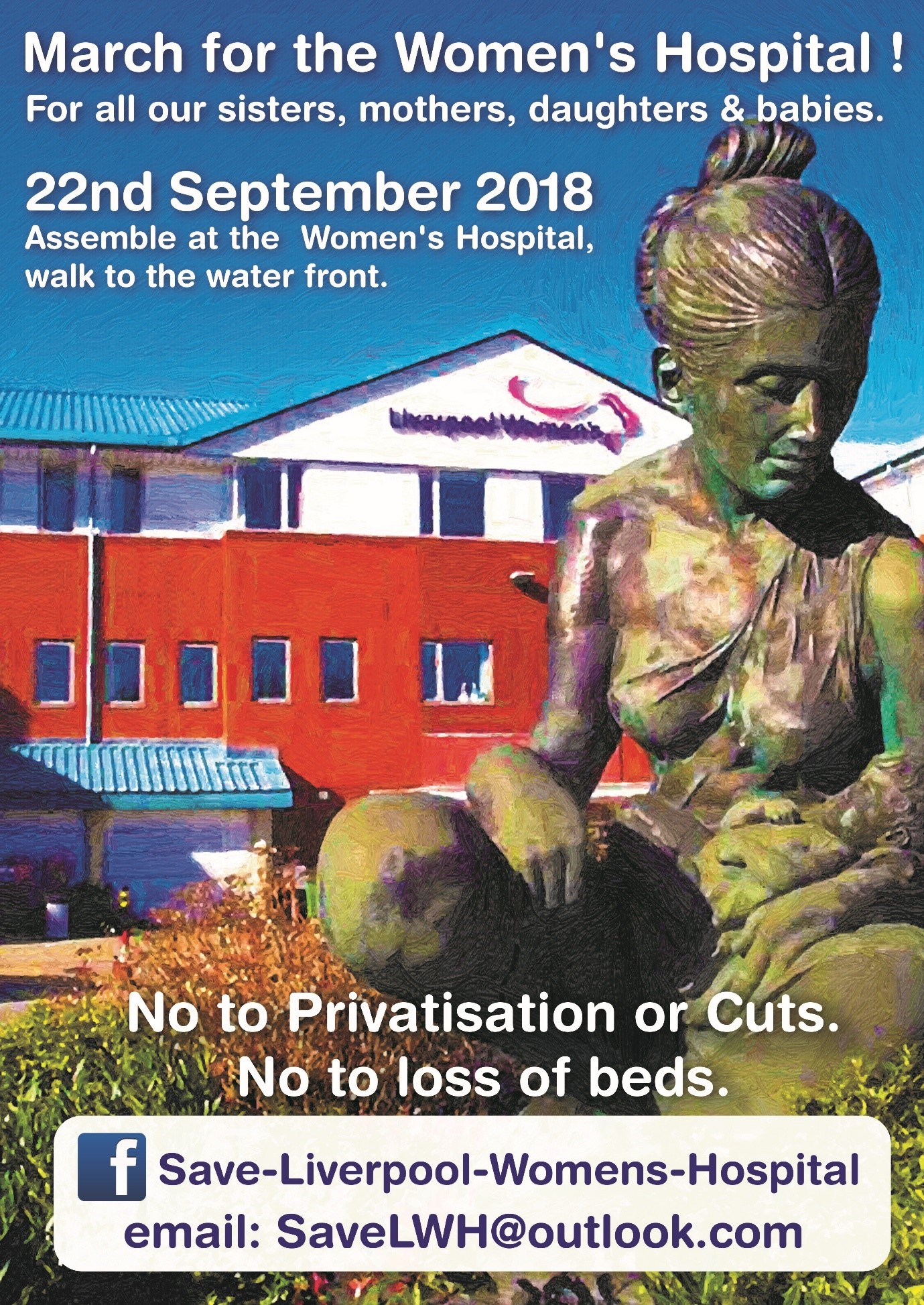
After decades of cuts in healthcare and growing crises in women’s health and Maternity, there is naturally great concern about these plans. Similar plans have been put forward before. Seventy-five thousand people have signed our petitions to keep Liverpool Women’s Hospital open, and we have held three large demonstrations over its future.

The campaigners’ key points are:

  1. Fund Maternity well nationally.
  2. Respect women, improve the experience of giving birth, and deliver timely gynaecological care.
  3. Fund the NHS well.
  4. Listen to the people.
  5. Act now to avoid the winter crisis, with patients dying because of the long waits.
  6. Keep Liverpool Women’s on the Crown Street Site and staff it well, with all the specialisms required to improve care and minimise transfers out of LWH. Give it long-term security.
  7. Improve the intensive care at Liverpool Women’s Hospital.
  8. Make all hospitals work cooperatively, not as competing organisations.
  9. Protect the Emergency Departments at Liverpool Women’s Hospital.
  10. Provide emergency Obstetric and Gynaecological care at the A and E at the Royal and Aintree.
  11. Nationally, address the workforce training issues that have resulted in shortages of key roles, like anaesthetists.
  12. Make the NHS a great place to work.
  13. Act against the racism that damages the health of women and babies health.
  14. Address the chronic poverty that is so severely affecting our children.
  15. End privatisation in its many forms.
Protestors holding a small sample of our petitions.

Liverpool Women’s Hospital opened in 1995. It is a modern low-rise hospital on a garden site in good condition. It provides maternity care and gynaecology for most of Liverpool’s women. About seven thousand babies are born there each year. It has a new large neo-natal unit and provides other linked services. It is just over a mile from the Liverpool Royal Hospital site.

Lesley Mahmood for Save Liverpool Women’s Hospital. Part one
The second half of Lesley’s speech

The ICB (Integrated Care Board) now runs finance and planning for the Cheshire and Merseyside area of the National Health Service, one of 42 such areas in the country, following the 2024 Health and Care Act. The aim is to bring all health spending for the area into this body and to restrict that spending. This mimics the Accountable Care boards that operate in some US States or cities. In the US, these organisations comprise one big or several small private healthcare corporations providing healthcare for profit. The Government provides funding, and the corporation profits by restricting the service. There has been a revolving door between the leaders of the NHS and the big US health corporations for some time, and there are close links between the governments and those big US health corporations. For details, see here.

This is an American definition of ACOs. “Accountable care organisations (ACOs) are defined as groups of clinicians, hospitals, and other healthcare providers who work together to provide high-quality, coordinated care to a defined population. If an ACO meets quality standards, achieves savings, and meets or exceeds a Minimum Savings Rate, the ACO will share in savings based on the ACO quality score. 

Felicity Dowling speaking for Save Liverpool Women’s Hospital Campaign.

The very grave financial difficulties of the NHS, this ICB, and Liverpool Women’s Hospital were not discussed. It was presented as a purely clinical case – as though such an idea is possible in such a funding crisis for the NHS. The Liverpool Women’s Hospital has been structurally underfunded for many years. The Maternity tariff and Birth rate + are inadequate. This funding problem affects all Maternity units nationally. Still, the impact is starker at Liverpool Women’s because it is such a large Maternity unit and does not share its budget with a general hospital. The Government made up some of the difference until the ICB was formed two years ago, but that has ceased. Many of the very real problems at Liverpool Women’s over the last few years stem from this chronic underfunding.

Greg Dropkin speaking at the ICB meeting. Greg is from Keep Our NHS Public.

Today’s meeting will be followed by a public engagement period, during which the public might be allowed to contribute to the discussion.

We believe Maternity is massively underfunded, and that is at the core of the national maternity and birth trauma crisis.

There were no alternative plans put forward as to where our babies will be born or where women’s health care will be delivered.

The core case made was that the most severely ill patients have to be transferred to the Royal, one mile away, and that women with obstetric and Gynaecological issues who present at the big A & E do not have on-site obstetric or gynaecological care available at those big sites.

Protestors reminded the board that the plans to close one hospital in Liverpool date back to 2015 when the then-head of the Clinical Commissioning Group announced them on a panorama programme.

Sheila Altes responded about some of the risks in the document.

Please sign our online petition.

Please talk about his to your friends family and work mates. Successful campaigns start with conversations.

Please let us know your views.

Please take part in the consultation. Please raise this matter in your union branch if possible.

No to closure or merger of Liverpool Women’s Hospital.

What has Liverpool’s “Place” NHS and Cheshire and Merseyside ICB done whilst maternity care nationally is in a well-publicised crisis and thousands of women are furious about the level of care they and their babies received? While the public enquiry into baby deaths at Countess of Chester has just opened? While Alderhey is at the centre of the Physician Associates scandal? While they can’t stop the next winter crisis, already upon our hospitals?

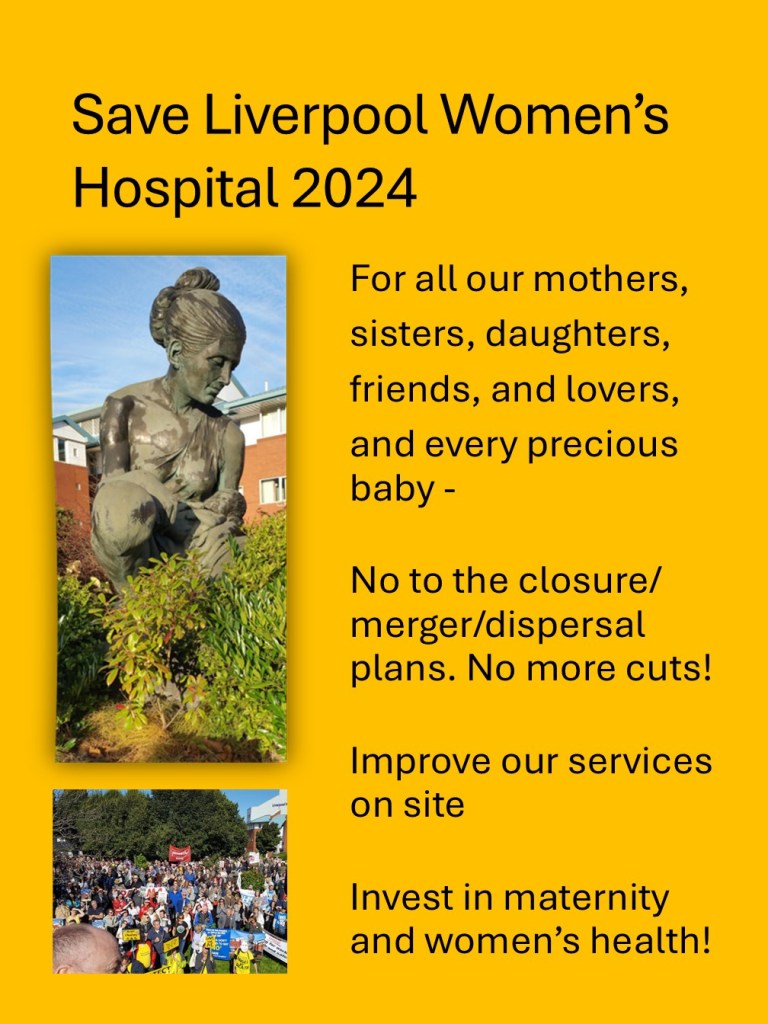
They announce the intention to fundamentally change Liverpool Women’s Hospital. This was without even a meeting with the organisations that have campaigned for a decade to keep the hospital and collected 75,000 signatures to keep the hospital on the Crown Street site as a women’s hospital for all our mothers, daughters, friends, lovers and for every precious baby.

The whole ICB is facing huge problems and does not have the resources to deliver safe A and E in the coming months. Yet, they think launching a discussion about merging Liverpool Women’s Hospital into one conglomerate of hospitals is sane and responsible.

This is the state of the Integrated Care Board, which is the controlling body for the NHS in Cheshire and Merseyside. It is from page 110 in the Board papers. A score of 20 in black means it is at the highest risk possible. They also said:

There are currently no known plans for any additional funding to be allocated ahead of winter to support additional capacity and the expectation is that maintaining system flow through winter will need to be achieved through the delivery of these improvement plans.

The document about Liverpool Women’s Hospital’s future can be found here. We will produce a detailed critique next week.

Maternity and women’s health need urgent changes, but they don’t include dispersing services and absorbing Liverpool Women’s Hospital into one giant conglomerate. We want to see the following changes nationally and locally.

  1. Far better funding and staffing for maternity and an end to birth traumas.
  2. More respect must be given to women giving birth and the women tending them in giving birth.
  3. The funding currently given to insurance for maternity damages should be invested in the service to reduce those damages.
  4. Women who need induction of labour should get that intervention in a safe and timely manner.
  5. Fertility services must be fully available on the NHS, not the prerogative of the well-off.
  6. Gynaecology services must be drastically improved, nationally and locally.
  7. The NHS workforce must be given more respect, their workload improved, and the service must once more become a good place to work.
  8. The whole NHS must be returned to being a national, fully publicly provided service, fully funded, repaired, and restored after all the damages of more than ten years of austerity and many forms of privatisation.
  9. The public’s views must be respected – most women likely to use the hospital will be at work when this first meeting happens.
  10. The research conducted at Liverpool Women’s Hospital must continue into key areas like endometriosis, menopause, and working to ensure our prem babies live and thrive despite being born very early.
  11. Midwifery training must be made available to all without incurring huge debts.
  12. Women’s health and healthcare must be given far more resources and respect.

Our petition, which is available on-line is at 44,656 signatures and more than 30,000 signatures on paper, says “Save the Liverpool Women’s Hospital. No closure. No privatisation. No cuts. No merger. Reorganise the funding structures not the hospital. Our babies and mothers, our sick women, deserve the very best”

It has over seventy-five thousand signatures. The people of Liverpool have attended three big demonstrations to save the hospital. Campaigners have attended every board meeting of Liverpool Women’s Hospital since the petition was launched and every ICB meeting since that was formed. Yet we have never been invited to present our views. Promises of consultation made in public clearly meant nothing.

Twenty thousand signatures were presented to the ICB in January 2023

Liverpool Women’s Hospital is a tertiary centre, which means patients are referred there from other hospitals from the rest of Merseyside and Cheshire, the Isle of Man and parts of Wales. Keeping that provision and the reputation that goes with it is important. The provision for the babies in the neonatal unit, near their mums, matters too.

We have said for years that the NHS must change the maternity tariff, the amount of money paid to hospitals for delivering maternity care. Liverpool Women’s Hospital is the largest provider of maternity care and is badly hit by how low the tariff is. Liverpool Women’s Hospital runs a deficit because of this, and over the years appears to have made some bad decisions on staffing because of the financial problems. Many midwives left. Yet somehow,the document from the ICB says:

The case for change is focussed solely on the clinical risks, issues and outcomes for people using hospital-based gynaecology and maternity services. It does not consider productivity or value for money.”

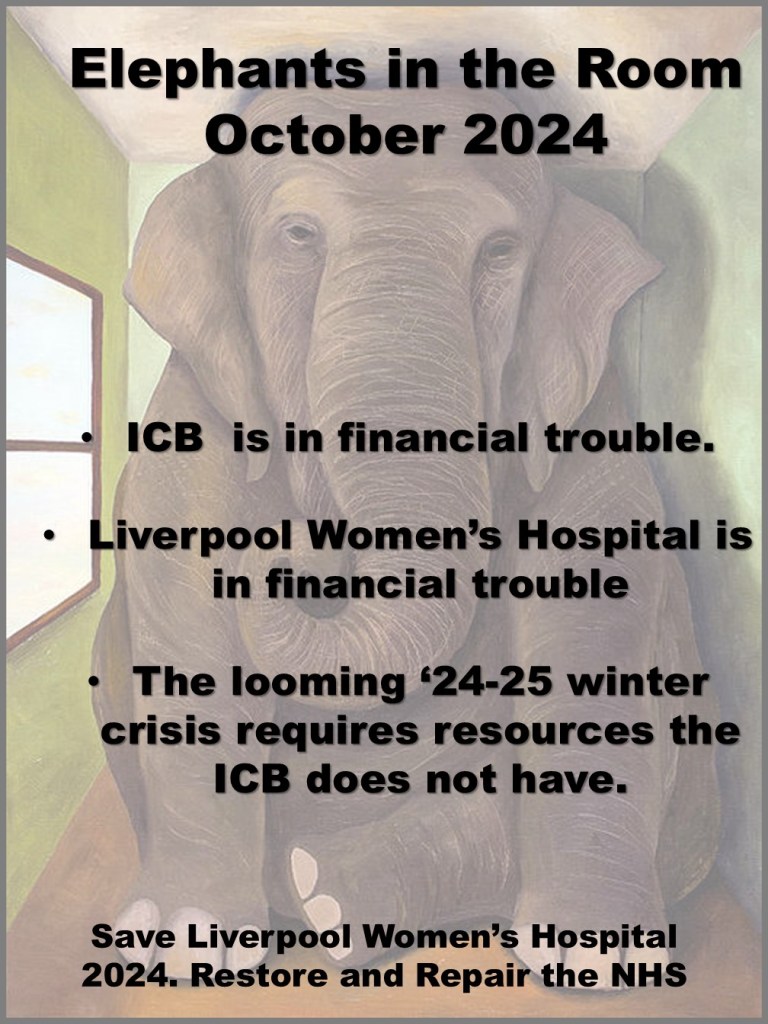
The ICB is in serious financial trouble yet it claims not to be considering money in this situation.

We say that right from the beginning, it has been about money. It was about the decision made nearly a decade ago to close one of the Liverpool Hospitals to save money at the cost of our health. It is also about disrespecting women’s health and women’s opinions.

“We’ve known for some time that the poorest households and women have shouldered the greatest burden of austerity measures.” Women’s health has suffered particularly in this time. Liverpool has seen some of the worst overall loss of healthcare. Yet we still kept Liverpool Women’s as a treasured service, where most of Liverpool’s babies are born and where great steps have been made in research. We said before and say it again “In these hard times. what we have we hold.”

Should we leave structural issues in our health care to “the professionals”? No way. The big managers of the NHS have caused havoc in the last ten years, implementing austerity, privatisation, and the move towards an American model. We have seen more than a decade of damage.

Remember the chaos of the building of Liverpool Royal, with fewer beds than the old one and now needing more, with chaos in the financing, construction, and demolition?

We call on the city of Liverpool to defend what we have in the NHS and to fight to improve the rest. No closures, no loss of services, no more mergers, no more outsourcing, no more overworked staff.

Please sign our petition here

Please attend any of the public meetings that you can get to. The first is this one:

When: 9th October 2024, 9.00am to 11.30am.

Where: Liverpool 1 Suite, Holiday Inn, Lime Street, Liverpool, L1 1NQ