These are the instructions sent to trusts.
This post first presents a copy of the letter sent to all trust and ICB boards about the Amos and Ockendon reports on Maternity by NHS England. Then there is a list of required actions.
We have been asked to publish this as not everyone has access to board papers, and many people are concerned about maternity safety. We as a campaign do not endorse all these actions. We think improved staffing is an absolute essential and this is not properly addressed. This post though is purely for information. We will publish our responses in detail soon. The reports are so detailed that we need time to read and process them. If you have had terrible experiences in maternity, be warned, the reports are truly heart breaking.
Love and solidarity to all who have lost babies or mothers in this horrible time.We also thank all the bereaved parents who made these reports happen. We honour them in campaigning for safe births for all.
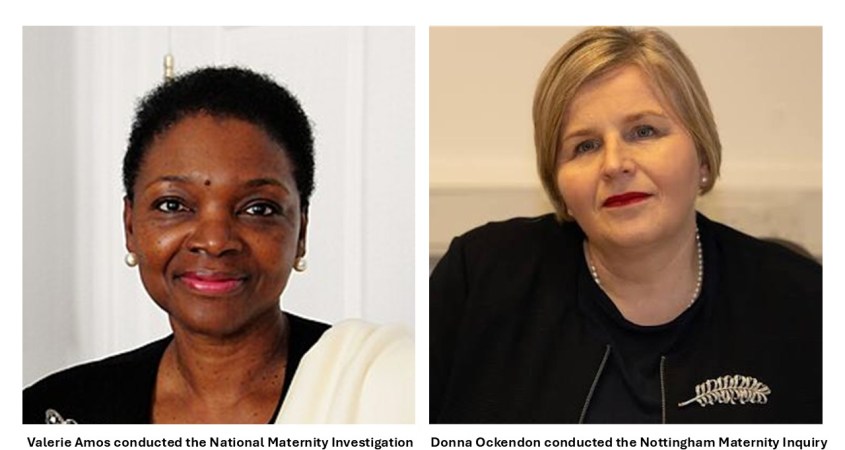
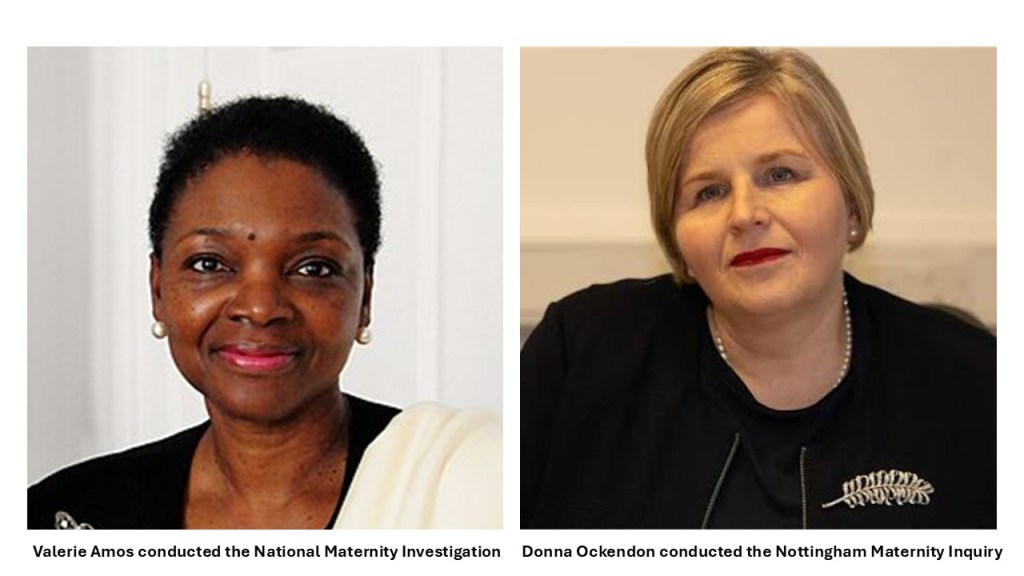
A word of thanks to both these women is in order though, for the work and compassion in producing the reports. They do not criticize the staff in the way some of the press reports say they do. but they are ruthless in their criticisms of the services failures.
Our enduring thanks to the staff of the maternity services.
NHS England
Wellington House
133-155 Waterloo Road
London
SE1 8UG
30 June 2026
Dear colleagues,
Publication of Baroness Amos’ independent investigation into maternity and neonatal
services in England
Thank you for joining today’s event and contributing to our conversation about maternity and neonatal services. I don’t think anyone who attended today could have been anything other than deeply moved by what we heard and discussed.
This is a moment in our history that requires our collective leadership to act with real urgency in addressing the failings and harm experienced by women, babies and families and improve maternity and neonatal care.
None of this is going to be easy, but we all agreed today that this must be a turning point for maternity and neonatal services in the NHS. Women, babies, and families deserve better, as do our colleagues working in these services.
As set out during the event today, we have created a 10 Point Plan for maternity and
neonatal services (see Annex 1), taking those elements from Baroness Amos’ national
30 investigation and Donna Ockenden’s recent review that we must focus on delivering now.
This is a set of urgent actions in response to the recommendations in both reports that we are asking trusts and the wider system to prioritise.
These urgent actions will support, and report into, the National Maternity and Neonatal
Taskforce as it develops the National Action Plan, which will be published in December.
Further information and a reporting template will be shared soon.
In response to the Amos report, the government has also announced NHS England will
make £10.6 million available in 2026/27 to support the recruitment of newly qualified
midwives, helping them enter and remain in the NHS while strengthening frontline maternity capacity. See Annex 2 for further information.
The government also announced the creation of the UK’s first ever Maternity and Neonatal Commissioner, providing an independent voice to strengthen focus on safety, experience, equity and accountability for women, babies and families. Alongside this, an additional £41million will be invested to improve the safety and quality of the maternity and neonatal estate, supporting better environments for those using and working in maternity and neonatal services.
As we heard today, this must be a turning point for the NHS. Trusts and systems have already prioritised improving maternity and neonatal care, and progress has been made through the commitment and hard work of staff. We cannot allow failures in care to persist and be followed by reviews that continuously highlight the same themes.
Thank you for your leadership as we respond and move forward together with urgency to deliver lasting change for women, babies and families, and rebuild trust and confidence in maternity and neonatal care.
Yours sincerely,
Sir James Mackey
Chief Executive
New Document
1.Required actions
Listening to women and their families by rolling out Martha’s Rule
Commence roll out of Martha’s Rule across all maternity and neonatal services in
2026/27.
Building on the learning and insights from the recent pilot, this next phase will
support implementation in all antenatal, intrapartum and postnatal inpatient
maternity and obstetric settings, including maternity triage and assessment units,
and neonatal settings.
Implementation will be led by the national Martha’s Rule programme team,
working closely with patient safety collaboratives to provide coordinated local
support, webinars, guidance and advice.
We will contact provider organisations in the coming weeks to confirm
expectations, resources and timelines.
2.Listen to women and their families using realtime and transparently reported outcomes and experience and clinical audit data that are acted upon at board level
All trusts should implement a monthly cycle of collecting and analysing real-time
patient outcomes and experience data at their public boards, using locally
meaningful measures like the friends and family test, selected elements of PREM
(when available) and insights from maternity and neonatal voices partnerships
(MNVPs). This should include regularly listening to women, families and neonatal
parents at different points in the pathway, publishing data and patient commentary
for full transparency, and ensuring a clear focus on the experiences of people from
minority backgrounds. This will ensure the voices and experiences of women and
families are heard, scrutinised and acted upon by boards.
As part of this, trusts should also reinvigorate clinical audits focusing on key and
relevant recommendations identified in the Ockenden and Amos reviews in a
focused and effective way, and act on the findings.
The aim is to support this approach through national webinar
3. Dual board-level accountability between medical directors and chief nursing officers for maternity and neonatal care
All trusts must establish clear joint accountability at board level for maternity and
neonatal services, with medical directors and chief nurses holding shared
responsibility for oversight, performance and improvement. This must include
consistent medical director engagement alongside the chief nurse, and parity
between obstetric, midwifery, neonatal and operational leadership. Directors of
midwifery and clinical directors leading maternity and neonatal services should
attend boards when maternity or neonatal matters are discussed.
This should also be implemented across all levels in the NHS including at system,
regional, and NHS England boards to eliminate siloed working and strengthen
system-wide leadership
4.‘Amos into action’ staff listening exercise Following the listening conversation undertaken by Baroness Amos to understand the nature of the issues in maternity and neonatal services, NHS England will launch a full, open conversation with NHS staff and leaders to identify how the recommendations can be implemented across the system.
It will explore and help address the role of culture, attitudes, approaches to practice and ways of working – bringing staff into the single largest national conversation about what trusts and individual clinicians need to do differently to implement both the letter and spirit of the Amos recommendations.
This will be done in a way that aligns to rather than duplicates the work of the taskforce and will report findings into it. It will focus on how we implement Baroness Amos’s findings from the listening exercise and the findings of the Ockenden review of Nottingham University Hospitals NHS Trust (NUH)
5.inequalities in maternity and neonatal outcomes
We can now confirm the timeline for national rollout of the Perinatal Equity and
Anti-discrimination Programme, which will be available to all trusts by the end of
2026. The programme has been developed to support maternity and neonatal
teams to tackle racism and discrimination, improve the experiences and outcomes
of ethnic minority groups and those from deprived communities, and support staff
to work in environments free from discrimination and racism. All boards must
ensure that provision is in place to allow enough staff to be released to complete
the Perinatal Equity and Anti-discrimination Programme, with full participation
expected across multi-disciplinary teams.
Boards must also regularly review and act on trends identified by their inequalities
data dashboards: Maternity and Neonatal Equalities dashboard – NHS England
All NHS trusts providing maternity services are responsible for fully implementing
the Maternal Care Bundle by March 2027. This includes providing regular reports
to the trust board on implementation.
6.Ensuring 24/7 safety and responsiveness of maternity and neonatal services
All boards must take accountability for ensuring safe and effective service
arrangements, including reviewing staffing to ensure 24/7 availability and
responsiveness across key workforce groups.
Boards must also review internal resource deployment and consider whether roles
not directly supporting frontline delivery can be redirected to strengthen service
provision. Trusts must ensure that, where specialist posts exist (including in
bereavement care and infant feeding), other staff have the knowledge and skills to
ensure that care is not compromised when the specialist midwives are not
immediately available.
Commissioners also hold responsibility for ensuring that their maternity and
neonatal service model aligns to local demographic needs. Boards and
commissioners must address local gaps and eliminate siloed working to ensure
services can consistently and safely respond to the needs of women, babies and
families.
7.Trusts to review their homebirth services
Trusts have a continuing responsibility to offer homebirth as a choice for women
and are responsible for ensuring that they manage their workforce to enable this.
In November 2025, the Chief Midwifery Officer for England asked trusts to
urgently review the safety and quality of their homebirth services.
Trusts should ensure that this review has been undertaken and reported to their
board and that any safety concerns requiring urgent attention have been actioned.
They should ensure that improvement plans are in place where necessary and
that risks have been communicated to their regional NHS England team.
NHS England is working with partners to develop homebirth standards and a
homebirth framework, to support women’s autonomy, choice and personalised
care, and to help services provide safe homebirth care.
8. Responding to patient safety incidents, complaints and concerns with humanity,candour and a trauma-informed approach
Trust boards should review how they are responding to patient safety incidents,
complaints and concerns within maternity and neonatal services, with openness,
humanity and candour.
We will work with trusts, in alignment with the work of the national taskforce, to
develop a blueprint for how organisations and leaders can respond with more
humanity and compassion when things go wrong with a patient’s care.
9. Deliver safe and effective triage in maternity services (already committed by Government)
All trusts must commit to delivering safe and effective triage, starting by
completing a board-level audit within 3 months, with a focus on ensuring that
maternity triage services are consistently safe, responsive and appropriately
resourced. This will be supported by new NHS England guidance, which will be
published this week.
This includes having dedicated midwifery staffing to answer calls and provide
face-to-face assessments, separate from other services such as the labour ward.
Services should also have enough clinical, antenatal and bed capacity, with clear
escalation routes in place at all times, including overnight and at weekends.
Boards should have clear oversight of triage quality and performance, supported
by regular data on waiting times, assessment and review times, redeployment,
delays and outcomes. Triage records should capture women’s preferences, and
services should use evidence-based standards, such as BSOTS, supported by
rapid assessment training for triage midwives. This should enable trusts to identify
risks, address delays and provide women with timely, consistent and high-quality
triage care.
The outcomes of this audit should be reported to regions and the Department of
Health and Social Care / NHS England. Within 12 months, trusts must implement
improvements in line with national triage guidance to ensure women have
consistent access to high-quality, responsive triage across the NHS.
National maternity triage principles and a supporting measurement framework will
be provided to trusts this week to reduce unwarranted variation, strengthen
consistency in how concerns are assessed and escalated, and provide a clearer
basis for local, regional and national improvement.
10 Post death care (already committed by Government)
All trusts must implement actions set out in the System letter following the Fuller
and NUH reviews, including responding to the board assurance statement by 31
July and to the Human Tissue Authority requirement to review and assure
completeness of incident records over the past 10 years.
Every board should continue to review its local position and assure itself that all
deceased people cared for in NHS settings are treated with the respect, dignity,
security and compassion they deserve. This goes beyond compliance; it is
fundamental to compassionate care.